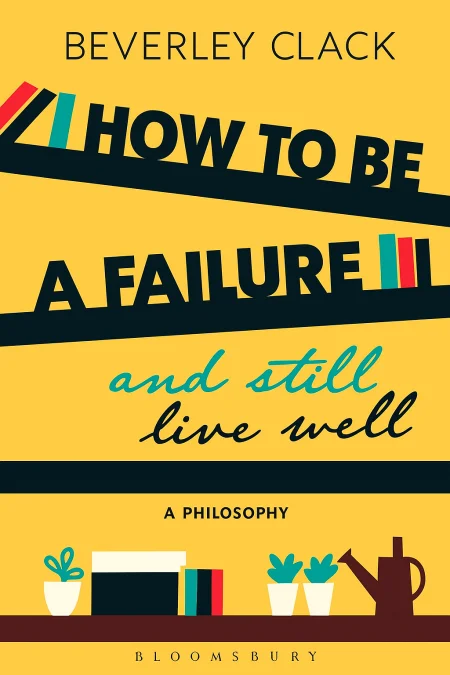
How to be a Failure and Still Live Well
A Philosophy
Book Edition Details
Summary
What if the blueprint for a fulfilled life was more about embracing our stumbles than our triumphs? In "How to be a Failure and Still Live Well," the age-old quest for material success and social prestige is turned on its head, revealing an unexpected ally: failure. This thought-provoking narrative nudges us to confront our fears of inadequacy and loss, not as detriments, but as integral threads in the tapestry of human existence. By delving into the depths of our vulnerabilities, we discover a treasure trove of values—authentic relationships, spontaneous joy, and profound generosity—that redefine what it truly means to thrive. This book offers a compassionate invitation to find beauty in imperfection and joy in the very act of living.
Introduction
Contemporary society has constructed an elaborate mythology around success and failure, one that reduces human worth to economic metrics and individual achievement. This mythology suggests that personal responsibility alone determines life outcomes, while systematically ignoring the fundamental realities of human existence: our interdependence, vulnerability, and mortality. The prevailing neoliberal framework treats failure as a personal deficiency to be overcome through entrepreneurial self-improvement, yet this approach fundamentally misunderstands both the nature of failure and the conditions necessary for human flourishing. The exploration that follows challenges this reductive understanding by examining how experiences typically labeled as "failures" - from unemployment and childlessness to aging and death - reveal essential truths about the human condition. Rather than aberrations to be eliminated, these experiences expose our shared vulnerability and interdependence, qualities that neoliberal ideology systematically obscures. Through philosophical analysis, personal reflection, and cultural critique, a different vision emerges: one where acknowledging our limitations and embracing our mutual dependence becomes the foundation for authentic well-being. This investigation reveals that learning to live well with failure requires not individual resilience, but a fundamental reorientation toward community, relationship, and acceptance of life's inherent precariousness.
The Neoliberal Construction of Success and Failure
The dominant economic paradigm of the past four decades has fundamentally restructured how we understand human value and purpose. Neoliberalism extends market logic into every aspect of existence, transforming individuals into "entrepreneurs of themselves" who must constantly adapt, compete, and optimize their performance across all domains of life. This system promises that hard work and personal responsibility will yield success, while failure becomes evidence of individual inadequacy rather than systemic inequality or simple misfortune. Under this framework, work assumes unprecedented importance as the primary site of self-realization and social worth. The traditional boundaries between labor and leisure dissolve as individuals become perpetually available, constantly networking, and forever upgrading their skills to remain competitive. Success is measured through visible markers of achievement - income, status symbols, career advancement - while those who fail to attain these markers face not just economic hardship but social stigma and personal shame. The psychological costs of this system are substantial. When every aspect of life becomes a performance metric, anxiety and depression flourish among those who cannot maintain the required pace of optimization. The promise that individual effort guarantees success proves hollow for many, yet the ideology persists by attributing failure to personal deficiencies rather than acknowledging structural limitations. This creates a cruel paradox where those most harmed by the system are encouraged to blame themselves for their circumstances. The neoliberal construction of success and failure ultimately fails because it ignores fundamental aspects of human existence: our dependence on others, our vulnerability to forces beyond our control, and our need for meaning that transcends material accumulation. Recognizing these limitations opens space for alternative understandings of what constitutes a life well-lived.
Gendered Failure and the Reality of Loss
The experience of failure takes on particular dimensions when examined through the lens of gender, revealing how women's bodies have historically served as repositories for anxieties about mortality and change. Traditional constructions of female success center on physical attributes - beauty, fertility, youth - that are inherently temporary, creating a form of "success" that inevitably transforms into "failure" through the natural processes of aging and bodily change. This gendered understanding of failure exposes deeper cultural fears about loss and impermanence. Women's bodies, closely associated with reproductive cycles and natural processes, become symbols of the mutability that threatens human attempts at control and permanence. The disgust and fear directed at aging women reflects not merely sexism, but a broader cultural anxiety about mortality that gets projected onto female flesh to make it seem manageable and containable. Contemporary workplace dynamics complicate this picture further. While the service economy ostensibly values "feminine" skills like emotional labor and relationship-building, these qualities remain undervalued when performed by actual women. The demand for flexibility in gender performance means that men can often adopt feminine traits more successfully than women can adopt masculine ones, creating new forms of disadvantage disguised as progress. The medicalization of female bodily processes - from menstruation to menopause - reinforces the notion that women's natural experiences constitute problems requiring intervention. This medicalization transforms normal life transitions into pathologies, encouraging women to view their own bodies as sites of potential failure rather than sources of wisdom about living with change. Recognizing how loss and failure become entangled in constructions of femininity reveals the broader human struggle with accepting impermanence as a fundamental condition of existence rather than a problem to be solved.
Systems of Control versus Human Spontaneity
Modern institutions increasingly rely on bureaucratic systems and quantitative metrics designed to eliminate human unpredictability and ensure optimal outcomes. These systems promise to factor out failure through standardized processes, performance measurements, and algorithmic decision-making. Yet this pursuit of control comes at a significant cost: the reduction of human complexity to manageable data points and the suppression of the very spontaneity that makes life meaningful. The historical development of bureaucracy reveals both its benefits and dangers. While systematic approaches can reduce arbitrary decision-making and improve resource allocation, they also create conditions where individuals become disconnected from the human consequences of their actions. The extreme case of Nazi bureaucracy demonstrates how the fragmentation of responsibility and emphasis on procedural correctness can enable horrific outcomes while allowing participants to maintain psychological distance from their effects. Contemporary metrics culture extends this logic into everyday life, transforming education, healthcare, and even personal relationships into quantifiable performances. The promise of objective measurement masks the subjective choices involved in determining what gets counted and how. Students become test scores, patients become statistics, and workers become productivity units, losing their full humanity in the process of optimization. The alternative to this systematic control is not chaos, but rather an embrace of human unpredictability as a source of creativity and renewal. Spontaneous action, genuine relationship, and the acceptance of uncertainty create possibilities that no system can anticipate or manufacture. The capacity to begin something new, to respond authentically to unexpected circumstances, and to maintain connection with others despite imperfect outcomes represents a form of human flourishing that transcends any measurable success.
From Economic Man to Relational Being
The neoliberal conception of humans as isolated economic units fundamentally misrepresents the conditions of human existence. We are not autonomous individuals who occasionally choose to interact with others; we are fundamentally relational beings whose very identity emerges through connection and interdependence. This recognition requires moving from homo economicus toward homo religiosus - understanding humans as beings who need to bind themselves to others and to the world. Psychoanalytic insights reveal how individual development depends on a complex process of making, unmaking, and remaking relationships. The child's separation from the mother, while necessary for growth, involves genuine loss that shapes all subsequent attempts at connection. This foundational experience of loss is not a problem to be overcome but a creative force that generates the capacity for language, relationship, and meaning-making throughout life. Religious and spiritual traditions, despite their institutional limitations, preserve important insights about human relationality that secular culture often overlooks. The etymology of religion as "binding together" points toward fundamental human needs for connection that transcend individual achievement. These traditions recognize vulnerability and interdependence as sources of wisdom rather than weaknesses to be overcome. Community engagement offers practical experience of moving beyond individualistic frameworks. Political participation, voluntary association, and neighborhood connection create opportunities to work toward shared goals that transcend personal success. These experiences reveal how individual well-being depends on collective flourishing and how personal meaning emerges through contribution to something larger than oneself. The shift from asking "How can I succeed?" to "How can we flourish together?" transforms both the experience of failure and the possibilities for authentic fulfillment.
Summary
The dominant cultural narrative that equates human worth with individual achievement and treats failure as personal deficiency fundamentally misunderstands the conditions necessary for human flourishing. True well-being emerges not from the successful accumulation of status markers or the elimination of setbacks, but from the cultivation of authentic relationships and the acceptance of our shared vulnerability. The experiences we label as failures - loss, aging, disappointment, mortality - are not aberrations to be overcome but integral aspects of existence that, when embraced rather than denied, become sources of wisdom, compassion, and genuine connection. This recognition requires abandoning the myth of the self-sufficient individual in favor of understanding ourselves as fundamentally relational beings who find meaning through community and mutual care rather than competitive achievement.
Related Books
Download PDF & EPUB
To save this Black List summary for later, download the free PDF and EPUB. You can print it out, or read offline at your convenience.
By Beverley Clack
