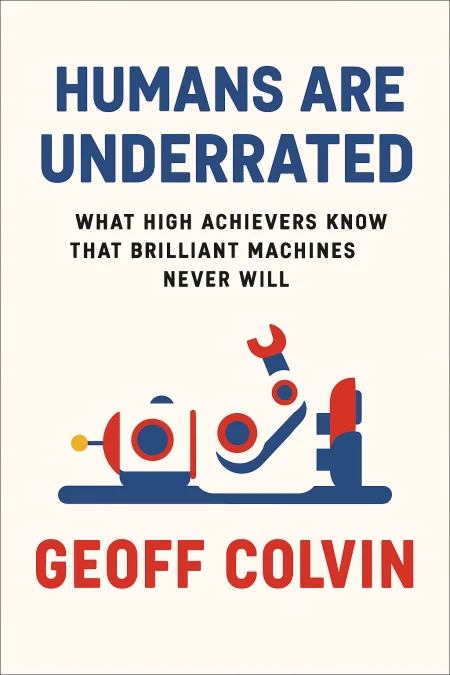
Humans are Underrated
What High Achievers Know that Brilliant Machines Never Will
Book Edition Details
Summary
In a rapidly evolving digital age, where algorithms edge closer to outperforming human capabilities, what uniquely human talents will set us apart? "Humans Are Underrated" by Geoff Colvin delves into this pressing inquiry, painting a vivid picture of a future where empathy, creativity, and social intuition reign supreme. As machines take on more technical tasks, Colvin argues that our true economic advantage lies in the quintessentially human traits that technology cannot replicate. Through compelling examples from institutions like the Cleveland Clinic and Stanford Business School, he illustrates how nurturing these innate abilities fosters innovation and connection. This book is a clarion call to embrace our humanity, offering a roadmap to thriving in a world increasingly dominated by technology.
Introduction
As technology advances at an unprecedented pace, conventional wisdom suggests that humans must compete with machines by becoming more machine-like themselves. Yet this fundamental assumption may be profoundly misguided. While computers excel at processing information, analyzing data, and executing logical operations with superhuman speed and accuracy, they remain fundamentally limited in their capacity for genuine human interaction. The evidence reveals a striking paradox: the more sophisticated our technology becomes, the more valuable distinctly human capabilities become in our economy and society. This analysis challenges the prevailing narrative that human workers must simply acquire more technical skills to remain relevant. Instead, it demonstrates through empirical research and real-world case studies that empathy, collaboration, creativity, and relationship-building are not just surviving technological advancement—they are becoming the primary sources of competitive advantage. The transformation occurring across industries, from healthcare to military operations, reveals that success increasingly depends on our ability to connect with, understand, and influence other human beings. Understanding this shift requires examining both the limitations of technological substitution and the irreplaceable nature of human social intelligence.
Technology's Unstoppable Advance Creates New Human Opportunities
Technology's relentless progress follows a pattern of exponential growth that defies human intuition. While most things in our world slow down as they mature, computing power doubles approximately every two years, meaning today's technological capabilities will seem primitive within a decade. This exponential advancement has already produced systems that outperform humans in domains once considered uniquely human, from medical diagnosis to legal research to creative writing. However, this technological revolution paradoxically creates unprecedented opportunities for human workers rather than simply displacing them. Historical precedent supports this counterintuitive reality. Previous technological revolutions initially displaced certain types of workers but ultimately created new categories of higher-value employment. The key lies in understanding that as machines assume routine cognitive and physical tasks, economic value shifts toward activities that require distinctly human capabilities. The most successful organizations are already recognizing this shift. Companies across industries report increasing demand for employees with strong interpersonal skills, emotional intelligence, and collaborative abilities. These skills cannot be automated because they depend on our evolved capacity for social connection and our deep understanding of human psychology and motivation. Rather than competing with machines at computational tasks where we will inevitably lose, humans can focus on what we do uniquely well: building relationships, creating meaning, inspiring others, and navigating the complex social dynamics that drive organizational success. Technology becomes our tool rather than our replacement, amplifying our distinctly human capabilities while handling the mechanical aspects of work.
Essential Human Skills Are Declining Just When We Need Them Most
A profound irony characterizes our technological age: as the economic value of human social skills reaches historic highs, these very skills are deteriorating across populations. Research demonstrates that empathy levels among college students have declined significantly since 2000, particularly in areas most crucial for professional success. This decline coincides with increased narcissism and reduced face-to-face interaction, creating a supply-demand mismatch with serious economic implications. Digital communication, while offering unprecedented connectivity, fails to develop the subtle interpersonal abilities that drive human connection. Screen-based interaction lacks the rich sensory input necessary for developing social sensitivity—the ability to read facial expressions, interpret body language, and respond appropriately to emotional cues. Studies show that children spending just five days away from screens demonstrate dramatically improved emotional intelligence, suggesting these skills can be recovered but require intentional cultivation. The shift toward virtual interaction carries hidden costs that extend beyond individual development. Online relationships, even among close friends, produce weaker emotional bonds than in-person connections. Social media use correlates with decreased happiness and life satisfaction, contrary to the enhanced well-being that genuine social relationships provide. These effects compound as reduced face-to-face interaction limits opportunities to practice and strengthen interpersonal skills. Organizations increasingly recognize that employees lacking social skills pose significant risks. Companies that depend on human interaction for competitive advantage cannot tolerate workers who undermine collaborative culture, regardless of their technical qualifications. The most successful firms actively screen for and develop interpersonal abilities, understanding that one socially inept employee can damage entire teams. As automation continues eliminating roles for the socially disconnected, developing these skills becomes essential for economic survival.
Empathy and Social Intelligence Define High-Value Work
Empathy represents the foundational skill underlying all valuable human interaction in the modern economy. Far from being a soft skill or personality trait, empathy emerges as a measurable competency that directly impacts organizational performance, customer satisfaction, and financial results. Healthcare research reveals that patients treated by more empathetic doctors show better clinical outcomes, higher treatment compliance, and lower rates of malpractice litigation. These benefits translate directly into improved financial performance and reduced costs. The business world increasingly recognizes empathy as a strategic necessity rather than a nice-to-have quality. Major corporations explicitly seek candidates with empathetic abilities, offering six-figure salaries for positions requiring emotional intelligence and social sensitivity. Technology companies, despite their analytical focus, prioritize collaborative and empathetic employees because even technical innovation requires teams that can work together effectively and understand user needs deeply. Military experience provides perhaps the clearest demonstration of empathy's strategic value. Modern warfare success depends heavily on soldiers' ability to read cultural cues, build trust with local populations, and navigate complex social situations. Training programs that develop these skills produce measurably better outcomes than those focused solely on technical military capabilities. The concept of "the human domain" reflects military recognition that social intelligence often determines mission success more than technological superiority. Empathy proves trainable through specific methodologies that mirror successful training approaches in other domains. Medical schools and healthcare organizations have developed evidence-based programs that significantly improve practitioners' empathetic abilities. These programs work by combining realistic scenarios, immediate feedback, and structured reflection—the same principles that create expertise in any field. The key insight is treating empathy as a skill to be developed rather than an innate trait some people possess and others lack.
Building the Interpersonal Abilities That Machines Cannot Replace
Developing superior interpersonal skills requires understanding both the science behind human connection and practical methodologies for improvement. Military training provides the most advanced examples of systematic human skill development, using principles refined through decades of research and real-world application. The foundation involves creating realistic scenarios where individuals must practice reading others, building trust, and coordinating group action under pressure. Effective teams demonstrate specific behavioral patterns that can be observed and replicated. High-performing groups share conversational time equally, maintain high levels of social sensitivity, and engage in brief but frequent exchanges of ideas rather than extended monologues. These patterns emerge naturally when team members possess strong interpersonal skills and operate within supportive organizational structures. Technology can measure these dynamics precisely, providing objective feedback for improvement. Corporate training programs are beginning to apply these insights through simulation-based learning, role-playing exercises, and structured team experiences. The most effective approaches mirror military training by creating emotional stakes, providing immediate feedback, and requiring genuine collaboration under challenging conditions. Companies that invest in developing these capabilities report improved employee engagement, reduced turnover, and enhanced financial performance. Individual skill development benefits from specific practices that strengthen social intelligence. Reading literary fiction improves empathy by exposing readers to complex character psychology and emotional situations. Engaging in unstructured social play develops collaborative abilities and emotional regulation. Minimizing screen time in favor of face-to-face interaction provides essential practice in reading nonverbal cues and building genuine relationships. These activities work because they exercise the same neural systems that drive professional interpersonal effectiveness.
Summary
The fundamental transformation of economic value from computational ability to interpersonal skill represents humanity's return to its essential nature after centuries of machine-like work. As technology assumes responsibility for routine cognitive and physical tasks, humans can finally focus on what we evolved to do exceptionally well: connecting with, understanding, and influencing other people. This shift creates unprecedented opportunities for those who develop superior social skills while potentially marginalizing those who cannot or will not adapt. The future belongs not to those who can compete with machines at mechanical tasks, but to those who can harness our deepest human capabilities to create meaning, build relationships, and solve problems that matter to human flourishing.
Related Books
Download PDF & EPUB
To save this Black List summary for later, download the free PDF and EPUB. You can print it out, or read offline at your convenience.
By Geoff Colvin
