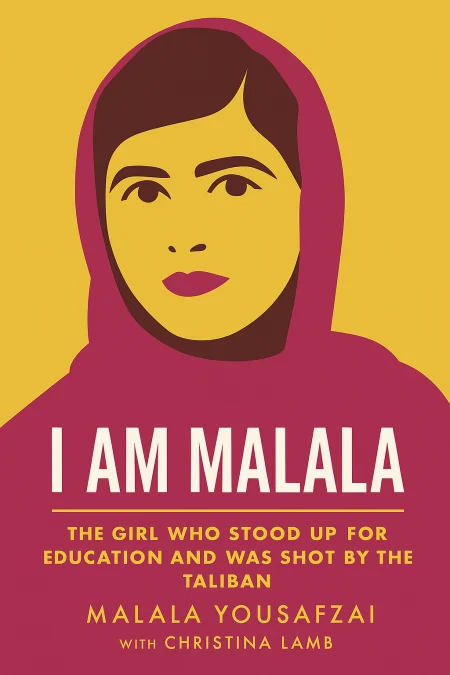
I Am Malala
The Girl Who Stood Up for Education and Was Shot by the Taliban
byMalala Yousafzai, Christina Lamb
Book Edition Details
Summary
In the shadow of fear and oppression, a beacon of hope rises—her name is Malala. From the lush landscapes of Pakistan's Swat Valley, where silence is often enforced with violence, a young girl dares to defy. Malala Yousafzai's courageous pursuit of education amidst the Taliban's tyranny is more than a personal battle; it's a symphony of resilience echoing across the globe. Shot for her beliefs, she transforms her survival into a powerful narrative of change. "I Am Malala" isn't just her story—it's a rallying cry for education, a tribute to familial courage, and a testament to the indomitable spirit of youth. As you turn each page, you'll find the pulse of a movement, urging you to believe in the transformative power of a single voice.
Introduction
In the mountains of Pakistan's Swat Valley, where morning mist clings to ancient peaks and children once walked safely to school, a teenage girl's defiance would echo around the world. Malala Yousafzai emerged from a region where education was a battleground, where the Taliban's shadow fell across classroom doors, and where speaking out could cost everything. Her father, an educator himself, had named her after a legendary Afghan heroine who rallied warriors with her words, perhaps unknowing that his daughter would one day need such courage. When extremists tried to silence her with bullets, they instead amplified her voice beyond anything they could have imagined. Through her extraordinary journey, we witness how individual courage can challenge systemic oppression, how education becomes both weapon and shield in the fight for human dignity, and how the most powerful force against darkness is often the simple act of refusing to be silenced. Her story reveals the price of progress, the power of unwavering conviction, and the remarkable resilience that can emerge from the most unlikely places.
A Daughter Born to Speak: Early Life in Swat
Malala Yousafzai entered the world at dawn on July 12, 1997, in Mingora, the main city of Pakistan's Swat Valley. In a culture where sons are celebrated with gunfire and daughters often hidden behind curtains, her birth was met with an unusual response. While neighbors offered condolences to her mother instead of congratulations, her father Ziauddin broke tradition by proudly adding her name to the family tree alongside the men. He named her after Malalai of Maiwand, Afghanistan's greatest heroine, who had inspired warriors to victory against the British Empire with her stirring words. Even as a baby, Malala displayed an unusual intensity, as if sensing the weight of her legendary namesake. Growing up in their valley paradise, surrounded by snow-capped peaks and crystal rivers, Malala absorbed the rich contradictions of her homeland. Swat had once been a princely state known for its Buddhist heritage and tolerant traditions, a place where ancient statues smiled serenely among wildflowers. Yet it was also a region where honor codes ran deep and women's freedoms remained carefully circumscribed. Her father's passion for education shaped their household, transforming their modest home into a gathering place for teachers, activists, and dreamers who believed learning could transform their corner of the world. From her earliest years, Malala displayed an insatiable curiosity and fearless spirit that set her apart. While other girls learned to lower their voices and eyes, she asked endless questions and spoke her mind with startling directness. Her mother, though traditional and unable to read, supported her daughter's boldness, while her father encouraged every sign of intellectual rebellion. In a society where daughters were expected to serve tea and remain silent, Malala was already practicing speeches in front of mirrors and challenging teachers with her questions. The foundation of her character was laid in these early years, where the collision between tradition and progress played out daily in their home. She learned that courage was not the absence of fear but the decision to act despite it, that education was not merely about books but about understanding one's place in the world and having the tools to change it. These lessons would prove essential when darkness began to gather over their beautiful valley.
Under the Taliban's Shadow: Fighting for Education
The transformation began quietly in 2005 when a charismatic preacher named Fazlullah started broadcasting from an illegal radio station. At first, his message seemed benign, encouraging good habits and proper Islamic behavior. But gradually, his tone darkened, and his demands became more extreme. Women were forbidden from markets, music was banned, and schools for girls became targets of his growing fury. By 2008, what had started as religious guidance had evolved into armed militancy that would terrorize the entire Swat Valley. As the Taliban's influence spread, Malala witnessed her beloved valley transform into something unrecognizable. The sounds of laughter and music that once filled the streets were replaced by the harsh voices of militants and the echo of explosions. Schools were bombed regularly, their ruins serving as stark reminders of the price of defiance. Girls who had once walked proudly to class now hid their books under shawls, fearing for their safety. Many families simply stopped sending their daughters to school altogether, surrendering to the Taliban's vision of a world where female education was forbidden. Despite the mounting danger, Malala refused to be silenced. At just eleven years old, she began writing an anonymous blog for the BBC, documenting life under Taliban rule with remarkable clarity and courage. Using the pseudonym Gul Makai, she described the fear that permeated daily life, the heartbreak of seeing her school close, and her determination to continue learning despite the threats. Her words painted a vivid picture of a childhood stolen by extremism, yet they also revealed an unbreakable spirit that refused to accept injustice as inevitable. When the Taliban officially banned girls from attending school, Malala and her father organized secret classes and continued their public advocacy. She gave television interviews, spoke at conferences, and became the young face of resistance against educational apartheid. Each appearance was an act of defiance that put her family at greater risk, but Malala had already internalized a crucial truth: the power of education was precisely why extremists feared it so desperately. She understood that knowledge was the enemy of oppression, and that her voice, however young, carried the hopes of countless girls who had been forced into silence.
Three Bullets Cannot Silence: The Attack and Recovery
On October 9, 2012, fifteen-year-old Malala boarded her school bus after taking a physics exam, chatting and laughing with her friends as they headed home. The normalcy of that moment—the teenage gossip, the relief of finishing tests, the casual complaints about lunch—made what happened next all the more shocking. Two young men stopped their bus and demanded to know which girl was Malala. When they identified her, one pointed a pistol at her head and fired three shots. The first bullet entered above her left eyebrow and traveled down to her shoulder, while the other two wounded her classmates Shazia and Kainat. The attack sent shockwaves far beyond the boundaries of Swat Valley. Within hours, news of the shooting spread globally, transforming a local act of terrorism into an international crisis of conscience. The image of a teenage girl targeted for the "crime" of wanting an education struck a chord that transcended cultural and political boundaries. As Malala lay unconscious in a Pakistani military hospital, her condition critical and her survival uncertain, people around the world began to grasp the full horror of what extremism could produce when left unchecked. The medical journey that followed was as remarkable as it was harrowing. Pakistani doctors performed emergency surgery to remove a piece of her skull and allow her swollen brain room to heal, but her condition remained precarious. After days of touch-and-go medical care, she was airlifted to Queen Elizabeth Hospital in Birmingham, England, where a team of specialists worked to save not just her life but her future. The bullet had damaged her facial nerve, affected her hearing, and left her with a partially paralyzed face that could no longer smile. Yet even as her body fought to recover, something extraordinary was happening around the world. The Taliban's attempt to silence Malala had instead amplified her message beyond anything she could have achieved through speeches alone. Students held vigils, world leaders issued statements, and millions of people who had never heard of Swat Valley suddenly understood the stakes in the global fight for educational rights. When Malala finally woke up in that Birmingham hospital room, she would discover that her near-death experience had transformed her from a local activist into a global symbol of resilience and hope.
A Global Voice: From Hospital Bed to World Stage
Awakening in a foreign hospital thousands of miles from home, Malala faced a new reality that would have overwhelmed most adults, let alone a teenager. Her face was partially paralyzed, her hearing damaged, and her family was still in Pakistan, unsure when they could reunite. Yet rather than succumb to despair, she demonstrated the same determination that had driven her advocacy in Swat. Her first questions were about her father's safety and when she could return to school, revealing priorities that remained unchanged despite everything she had endured. The months of recovery that followed became a masterclass in resilience and adaptation. Malala underwent multiple surgeries to repair her facial nerve, restore her hearing, and replace the missing portion of her skull with a titanium plate. Each procedure required patience and courage, but she approached her rehabilitation with the same methodical determination she had once applied to her studies. Physical therapy, speech exercises, and countless medical appointments became her new classroom, teaching her lessons about human fragility and strength that no textbook could provide. As her physical healing progressed, Malala began to understand the global movement that had emerged in her name. Letters arrived from world leaders and schoolchildren alike, totaling over 8,000 messages of support. The Malala Fund was established to promote girls' education worldwide, and her story became a rallying cry for human rights advocates across the globe. When she was strong enough to speak publicly again, she did so with a new authority born from having faced the ultimate consequence of her convictions and survived. On her sixteenth birthday, July 12, 2013, Malala addressed the United Nations General Assembly, wearing one of Benazir Bhutto's white shawls and delivering a speech that would define her transition from victim to victor. Her words—"One child, one teacher, one book, and one pen can change the world"—captured both the simplicity and power of her message. The girl who had once hidden textbooks under her shawl to attend secret classes was now speaking to world leaders about the transformative power of education, proving that the bullets meant to silence her had instead given her the ultimate platform from which to be heard.
Summary
Malala Yousafzai's extraordinary journey from a valley girl with big dreams to a global champion of human rights reveals a fundamental truth: that individual courage, when combined with unwavering principle, can challenge even the most entrenched systems of oppression. Her story demonstrates how the simple act of refusing to accept injustice—whether it comes in the form of closed schoolhouse doors or the barrel of a gun—can inspire millions and create change that ripples across generations. Through her example, we learn that true strength is not the absence of fear but the choice to act according to one's convictions despite that fear, and that education is indeed the most powerful weapon against ignorance and extremism. For anyone facing seemingly insurmountable obstacles, Malala's journey offers both inspiration and practical wisdom: that speaking truth to power requires preparation and support, that meaningful change often comes at great personal cost, and that the most important battles are often fought not with weapons but with words, determination, and an unshakeable belief in the possibility of a better world.
Related Books
Download PDF & EPUB
To save this Black List summary for later, download the free PDF and EPUB. You can print it out, or read offline at your convenience.
By Malala Yousafzai
