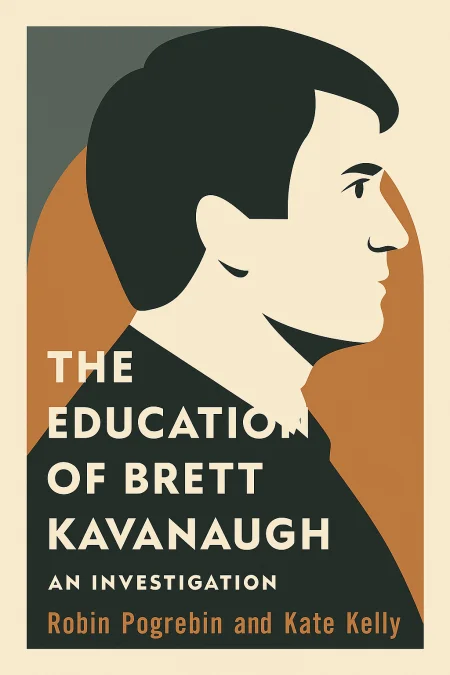
The Education of Brett Kavanaugh
An Investigation
Book Edition Details
Summary
When the gavel of history strikes, its echo often conceals more than it reveals. In "The Education of Brett Kavanaugh," acclaimed New York Times journalists Robin Pogrebin and Kate Kelly unravel the enigma behind one of America's most contentious Supreme Court confirmations. With unprecedented access to voices that have remained silent—until now—they weave a narrative that traverses Kavanaugh's formative years, spotlighting the elite educational corridors that shaped him. In the eye of a political storm, the book confronts the unresolved, the unspoken, and the unsettling questions left in the wake of a frenetic FBI investigation. This gripping chronicle is essential for anyone seeking to understand the intricate dance between power, privilege, and politics that defines the American judicial landscape.
Introduction
In the autumn of 2018, what began as a routine Supreme Court confirmation transformed into one of the most explosive political battles in American history, exposing deep fractures that continue to shape our democracy today. The nomination of Brett Kavanaugh became a lightning rod for three profound questions that transcend any single individual: How do we balance the presumption of innocence with the imperative to believe survivors of sexual assault? What happens when the informal networks of elite education and privilege encounter the harsh scrutiny of democratic accountability? And in an era of deep polarization, can our institutions still distinguish between legitimate political opposition and destructive partisan warfare? This extraordinary episode reveals how personal choices made decades earlier can collide with the highest levels of power, creating a national reckoning that illuminated the persistence of elite privilege, the courage required to speak truth to power, and the fragility of democratic norms under extreme pressure. The story serves as essential reading for anyone seeking to understand how American politics became so toxic, how the #MeToo movement reshaped public discourse, and how the Supreme Court became the ultimate prize in our nation's culture wars. It offers a sobering examination of power, privilege, and the price of speaking truth in a democracy under strain.
Elite Education's Shadow: Georgetown Prep to Yale (1980s-1990s)
The roots of this national crisis stretch back to the elite corridors of 1980s Washington, where privilege and entitlement created a culture that would later face harsh democratic judgment. At Georgetown Preparatory School, young Brett Kavanaugh moved through a world of wealthy Catholic families, rigorous academics, and weekend parties fueled by excessive drinking. This was an environment where boys learned that connections mattered more than consequences, and where the phrase "What happens at Georgetown Prep stays at Georgetown Prep" became both motto and shield against accountability. The party culture of these elite institutions was marked by a casual misogyny that reflected broader social attitudes of the era. Students bragged about sexual conquests, real or imagined, and treated young women as objects of ridicule rather than respect. The "100 Keg Club" and underground newspapers celebrating drunken exploits created a mythology of masculine excess that participants would later struggle to explain or defend. At Yale, this dynamic continued in different forms, as residential colleges and secret societies provided new venues for the same patterns of heavy drinking and questionable behavior toward women. The culture of entitlement that elite education fostered—the belief that certain rules simply didn't apply to the chosen few—would prove to have lasting consequences when subjected to public scrutiny decades later. These formative experiences reveal how institutional privilege can insulate individuals from accountability while creating the very behaviors that later threaten their advancement. The young men who felt invulnerable in their elite bubbles would discover that their past actions could resurface with devastating force, challenging not just individual careers but the entire system that had protected them.
From Bush Operative to Federal Judge (2000-2018)
Kavanaugh's professional ascent exemplified the modern conservative legal movement's methodical path to power, beginning with his aggressive work on Kenneth Starr's investigation of President Clinton and continuing through the corridors of George W. Bush's White House. His role in the administration's judicial selection process provided intimate knowledge of confirmation politics while building crucial relationships with Republican senators and conservative activists. The irony was unmistakable: the man who would later face intense scrutiny had helped orchestrate the very system designed to vet judicial nominees. His 2006 confirmation to the D.C. Circuit Court of Appeals marked the beginning of his transformation from political operative to respected jurist. Over twelve years on the bench, Kavanaugh built a reputation for intellectual rigor and conservative jurisprudence, while carefully cultivating relationships with law clerks, fellow judges, and legal scholars. His opinions reflected a consistent conservative philosophy, particularly on issues of executive power and regulatory authority, positioning him as an ideal candidate for a Republican president seeking to cement conservative control of the Supreme Court. Yet this period also revealed the tensions inherent in Kavanaugh's position between judicial restraint and political ambition. His political background made him suspect to Democrats, while his occasional moderate positions frustrated some conservatives. The careful balance he maintained would prove crucial when President Trump sought a reliable vote for his agenda. By 2018, Kavanaugh had positioned himself perfectly for Supreme Court consideration, embodying the conservative legal establishment's decades-long project to reshape American jurisprudence through careful career planning and institutional networking.
Allegations Emerge: Ford's Courage Sparks National Crisis (2018)
The emergence of Christine Blasey Ford's allegations transformed Kavanaugh's confirmation from a partisan battle into a national trauma that exposed America's deepest cultural fault lines. Ford's decision to come forward represented a collision between personal conscience and political consequence, as a psychology professor found herself at the center of a constitutional crisis. Her detailed account of an alleged assault during their high school years struck at the heart of America's ongoing reckoning with sexual violence and male privilege, embodying the #MeToo movement's challenge to traditional power structures. Ford's initial attempts to share her story confidentially through proper channels—contacting her congresswoman and Senator Feinstein—demonstrated both civic responsibility and naive faith in institutional discretion. The breakdown of confidentiality revealed the impossibility of containing explosive allegations in the modern media environment. Once Ford's story began circulating in Washington's interconnected political and journalistic networks, her anonymity became untenable, transforming a private disclosure into a public crisis that would consume the nation's attention. The political machinery surrounding the confirmation process struggled to adapt to these unprecedented circumstances. Democrats saw an opportunity to derail Trump's nominee, while Republicans faced the nightmare scenario of losing their Supreme Court majority due to decades-old allegations. The emergence of additional accusers created a pattern that supporters and critics interpreted through fundamentally different lenses, revealing how the same evidence could support entirely contradictory narratives about truth, justice, and accountability in American democracy.
Senate Showdown: Democracy's Test of Truth and Power (2018)
The September 27, 2018 hearings before the Senate Judiciary Committee became a defining moment in modern American politics, as the nation watched two individuals present irreconcilable versions of events from decades past. Ford's testimony, delivered in a trembling voice but with unwavering conviction, embodied the experiences of countless assault survivors who had never been believed or heard. Her clinical precision in describing traumatic memories—particularly her phrase "indelible in the hippocampus is the laughter"—while acknowledging gaps in peripheral details reflected both her scientific training and the neurological reality of trauma. Kavanaugh's response revealed a man fighting for his professional life and personal reputation, departing dramatically from judicial temperament through angry denials, partisan attacks, and emotional breakdown. The stark contrast between Ford's composed vulnerability and Kavanaugh's furious indignation created a Rorschach test for American viewers, who saw either a credible survivor confronting her attacker or a good man defending himself against false accusations. The hearings exposed the inadequacy of the Senate's investigative process for handling sexual assault allegations, as the FBI's limited supplemental investigation satisfied neither side's demands for thorough fact-finding. The final confirmation vote, decided by the narrowest margin in over a century, reflected America's deep polarization on issues of gender, power, and justice. Senator Jeff Flake's last-minute demand for an FBI investigation represented a brief moment when individual conscience challenged party loyalty, yet the investigation's limited scope revealed how institutional norms buckle under extreme partisan pressure. The 50-48 confirmation vote marked not just Kavanaugh's elevation but a watershed moment signaling that partisan advantage could override concerns about character and temperament, fundamentally altering expectations for future nominations.
Summary
The Kavanaugh confirmation crisis illuminated the central tension of American democracy in the 21st century: the enduring conflict between elite privilege and democratic accountability. Throughout this saga, we witness how institutional power protects itself even when confronted with credible challenges, revealing the persistence of hierarchies that many assumed had been dismantled. The story demonstrates that individual courage—whether Ford's decision to speak or Flake's demand for investigation—can disrupt established patterns, yet systemic change requires more than isolated acts of conscience. This episode offers three crucial lessons for navigating our polarized democracy. First, we must develop better mechanisms for evaluating serious allegations that balance fairness to accused individuals with respect for survivors' experiences, recognizing that traditional legal standards may be inadequate for addressing historical misconduct. Second, elite institutions must confront their role in perpetuating cultures of impunity rather than simply managing public relations crises when past behaviors surface. Finally, citizens must demand that representatives prioritize institutional integrity over partisan advantage, understanding that short-term political victories can inflict lasting damage on democratic norms and public trust. The Kavanaugh affair ultimately reveals that in a healthy democracy, no one—regardless of credentials, connections, or institutional position—should be beyond accountability. Yet it also shows how difficult such accountability becomes when partisan warfare replaces genuine deliberation, and how the pursuit of justice can become entangled with the pursuit of power, leaving truth itself as the ultimate casualty in our ongoing struggle to fulfill democracy's promise of equal justice under law.
Related Books
Download PDF & EPUB
To save this Black List summary for later, download the free PDF and EPUB. You can print it out, or read offline at your convenience.
By Robin Pogrebin
