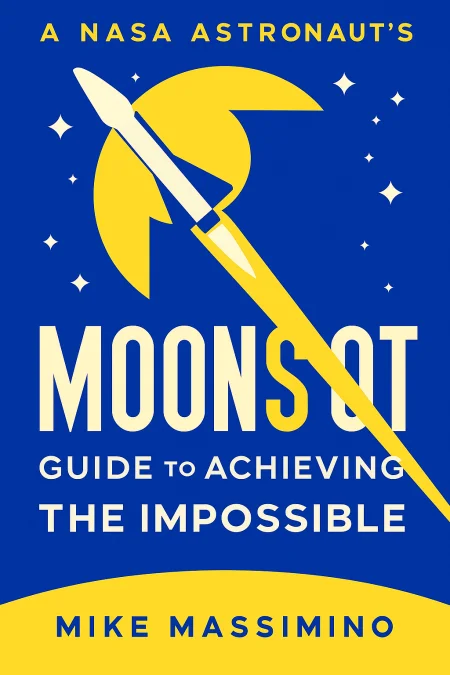
Moonshot
A NASA Astronaut's Guide to Achieving the Impossible
Book Edition Details
Summary
In a world where astronauts are seen as larger-than-life heroes, Mike Massimino defies the stereotype with his extraordinary tale of transformation. Once a Long Island kid with bad eyesight and a fear of heights, Massimino climbed the celestial ladder to become a NASA astronaut. "Moonshot" isn't just about space; it's a dynamic manifesto for anyone striving to conquer their own earthly frontiers. With a blend of humor and heartfelt storytelling, Massimino shares the art of turning setbacks into comebacks, harnessing the power of teamwork, and igniting innovation. As he unravels the secrets of his journey, readers are equipped with practical wisdom to reach for their stars and realize their ambitions. Let Massimino be your guide through the cosmos of personal growth, showing that even the smallest steps can lead to giant leaps.
Introduction
When Mike Massimino gazed up at the night sky as a six-year-old boy in 1969, watching Neil Armstrong take humanity's first steps on the moon, he made a declaration that would define his life: he wanted to be an astronaut. Yet this dream seemed impossibly distant for a working-class kid from Long Island with bad eyesight, a fear of heights, and no connections to the space program. What followed was a remarkable thirty-year journey from that starry-eyed child to becoming the first person to tweet from space and one of NASA's most accomplished spacewalkers. Massimino's path to the stars was anything but conventional. Unlike the stereotypical test pilot astronaut, he was a self-described "gangly, scrawny" academic who had to overcome seemingly insurmountable obstacles—including medical disqualification from NASA—through sheer determination and innovative problem-solving. His story illuminates not just the technical marvels of space exploration, but the deeply human elements of pursuing impossible dreams. Through Massimino's experiences, we discover profound lessons about perseverance in the face of overwhelming odds, the critical importance of teamwork in high-stakes environments, and the transformative power of maintaining wonder and perspective even when confronting our greatest challenges. His journey reveals how ordinary people can achieve extraordinary things when they refuse to let "one in a million" become zero.
Against All Odds: The Making of an Unlikely Astronaut
Mike Massimino's journey to space began with a crushing realization: he was spectacularly unqualified for his dream job. Growing up in Franklin Square, Long Island, in the 1970s, he possessed none of the traditional astronaut credentials. He wasn't a military test pilot with nerves of steel and perfect vision. Instead, he was a nearsighted kid who discovered his fear of heights on a family trip to a mountain peak at age eight, instantly believing this disqualified him from ever becoming the next Neil Armstrong. The obstacles seemed to multiply as Massimino pursued his goal. His first application to MIT graduate school was submitted to the wrong department entirely. His initial NASA applications in 1989 and 1991 were rejected outright. When he finally made it to the interview stage in 1994, he was medically disqualified due to his poor eyesight—a devastating blow that seemed to close the door permanently on his space dreams. But Massimino had internalized a crucial mathematical truth: "One in a million is not zero." While the odds were overwhelmingly against him, as long as he kept trying, there remained a possibility, however slim. The turning point came when Massimino decided to treat his vision problem like an engineering challenge rather than an insurmountable barrier. Working with an optometrist who specialized in vision training, he spent seven months doing eye exercises designed to strengthen his visual system. The training was intense and uncertain—his doctor had never worked with adults before—but Massimino's dedication was absolute. He understood that this wasn't just about improving his eyesight; it was about refusing to let a single obstacle define the limits of his possibilities. When NASA called him back for another medical examination, Massimino's vision had improved enough to overturn his disqualification. His persistence paid off dramatically: in 1996, he was selected as part of NASA's sixteenth astronaut class, nicknamed "The Sardines." His story became proof that determination and creative problem-solving could overcome seemingly impossible odds. The kid from Long Island who had once seemed least likely to reach space had earned his place among the stars through sheer refusal to accept defeat.
Teamwork and Leadership: Lessons from Space
The mythology of space exploration often celebrates individual heroes, but Massimino's experiences revealed a profound truth: getting to space is fundamentally a team sport. His first major lesson in NASA's collaborative culture came during astronaut training when he faced a swim test despite being a poor swimmer. Rather than letting him struggle alone, his classmates organized weekend training sessions where strong swimmers worked with weaker ones. The motto was clear: "No one leaves the pool until everyone passes the test." This wasn't about individual achievement but collective success. This philosophy proved crucial during Massimino's missions to service the Hubble Space Telescope, widely considered the most complex and dangerous spacewalks ever attempted. When a critical equipment failure threatened to derail their second mission, the crew's response exemplified NASA's team-first mentality. Rather than pointing fingers or rushing to assign blame, they worked together to solve the problem, with each crew member taking responsibility for the team's success. Even when Massimino made a potentially mission-ending mistake by stripping a bolt during a critical repair, his teammates rallied around him rather than throwing him under the bus. Massimino learned that true leadership in high-stakes environments isn't about being the smartest person in the room or the one with the most experience. It's about creating conditions where everyone can contribute their best work. He discovered this principle through the wisdom of Apollo astronaut Alan Bean, who shared "The First Rule of Leadership": find a way to admire and care for every member of your team. This wasn't mere sentiment but practical necessity—in space, your life depends on every person doing their job perfectly, from the astronaut beside you to the engineers monitoring from the ground. The power of this approach became evident when Massimino led teams developing new spacewalking procedures and tools. Initially dismissive of one engineer whose ideas seemed unconventional, Massimino learned to appreciate the value of diverse perspectives. That same engineer eventually developed crucial innovations that made their missions successful. The lesson was clear: the best teams aren't composed of people who think alike, but of individuals who can complement each other's strengths and compensate for each other's weaknesses. In space, as in life, nobody succeeds alone.
Problem-Solving Under Pressure: When Everything Goes Wrong
Space exploration operates on the knife's edge between triumph and disaster, where split-second decisions can mean the difference between mission success and catastrophic failure. Massimino learned this lesson viscerally during his most challenging spacewalk, when what should have been a routine task—removing four simple bolts from a handrail—nearly destroyed years of planning and millions of dollars of investment. In his eagerness to demonstrate competence, he stripped a bolt head, creating a problem that seemed to have no solution and threatened to prevent the critical repair of Hubble's imaging spectrograph. The crisis taught Massimino the wisdom of "Hoot's Law," named after legendary astronaut Robert "Hoot" Gibson: "No matter how bad things seem, you can always make them worse." This principle became a cornerstone of NASA's operational philosophy, emphasizing that panic and hasty action in emergency situations typically compound problems rather than solving them. The corollary was equally important: when facing a crisis, slow down, assess the situation carefully, and always have a second person verify critical actions before taking them. During the handrail crisis, Massimino watched this philosophy save his mission. While he fought the urge to panic, ground control implemented systematic problem-solving protocols. Engineers at multiple NASA centers collaborated to test potential solutions, eventually determining that breaking the handrail off with controlled force could work. The solution required precise execution—too little force wouldn't work, too much could damage sensitive telescope components or create dangerous debris. But by following methodical procedures and maintaining clear communication, they turned a potential catastrophe into a successful repair. The experience reinforced a crucial truth about high-pressure problem-solving: the first instinct to rush and fix things immediately is often wrong. Instead, the most effective approach is to pause, gather information, consult with teammates, and proceed deliberately. Massimino learned that going slow to go fast—taking time upfront to understand a problem thoroughly—ultimately leads to quicker and more effective solutions than reactive scrambling. This principle proved invaluable not just in space but in all aspects of life where careful thinking trumps frantic action.
Beyond NASA: Sharing the Wonder of Space
After eighteen years at NASA and two transformative missions to service the Hubble Space Telescope, Massimino faced a crossroads that many high achievers encounter: how to transition from a dream career to something new while maintaining purpose and passion. His decision to leave NASA in 2014 wasn't driven by dissatisfaction but by recognition that his greatest contribution might come through sharing the experience of space exploration with others rather than continuing to participate in it directly. The seeds of this transition had been planted years earlier when Massimino became the first person to send a tweet from space. That simple message—"Launch was awesome! I am feeling great, working hard, & enjoying the magnificent views, the adventure of a lifetime has begun!"—opened doors to new ways of communicating the wonder of space exploration. His natural ability to translate complex technical experiences into relatable human stories led to appearances on late-night television, recurring roles on "The Big Bang Theory," and countless speaking engagements where he shared lessons from space with audiences around the world. Massimino's post-NASA career exemplifies the principle of "pivoting" successfully—leveraging existing skills and experiences to create new opportunities rather than starting from scratch. His transition to academia at Columbia University allowed him to inspire the next generation of engineers and scientists while maintaining his connection to space exploration through research and public outreach. He discovered that teaching and media work provided the same sense of mission and purpose he had found at NASA, just expressed in different ways. Perhaps most importantly, Massimino learned that leaving a dream job doesn't mean abandoning your dreams—it can mean finding new ways to pursue them. His current work reaches far more people than his astronaut career ever could, spreading the inspiration and wonder of space exploration to audiences who will never experience it firsthand. Through his teaching, writing, and media appearances, he continues to serve the same mission that drove him to space: advancing human understanding and inspiring others to reach for seemingly impossible goals.
Summary
Mike Massimino's extraordinary journey from a nearsighted kid from Long Island to a spacewalking astronaut and beloved public educator demonstrates that the most powerful force in human achievement isn't natural talent or perfect circumstances—it's the refusal to accept that dreams are impossible. His life embodies the mathematical truth he discovered as a young man: "One in a million is not zero," meaning that as long as we continue trying, possibility remains alive, no matter how slim the odds may seem. The lessons from Massimino's experiences extend far beyond space exploration. His story teaches us that overcoming obstacles requires treating them as engineering problems to be solved rather than insurmountable barriers, that success in any challenging endeavor demands both individual excellence and extraordinary teamwork, and that maintaining a sense of wonder and perspective—what he calls "being amazed"—is essential for both achievement and happiness. Whether facing career transitions, personal challenges, or seemingly impossible goals, Massimino's approach offers a roadmap: prepare thoroughly, support your teammates, learn from failures, and never lose sight of the bigger picture that gives your work meaning. His journey proves that with enough persistence, creativity, and willingness to help others succeed alongside you, even the most unlikely dreams can become reality.
Related Books
Download PDF & EPUB
To save this Black List summary for later, download the free PDF and EPUB. You can print it out, or read offline at your convenience.
By Mike Massimino
