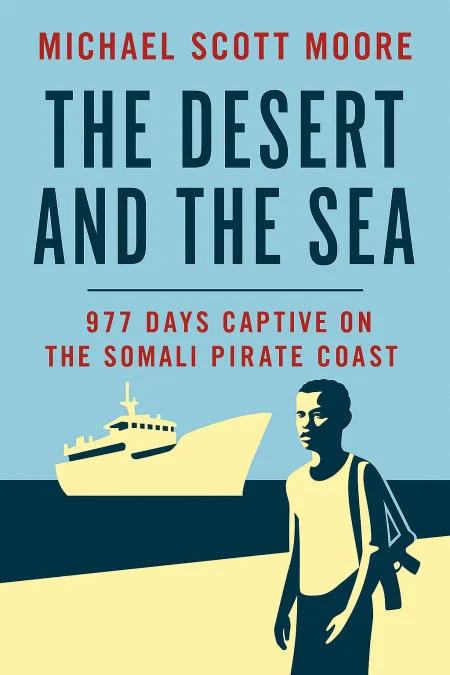
The Desert and the Sea
977 Days Captive on the Somali Pirate Coast
Book Edition Details
Summary
Michael Scott Moore's harrowing saga unfolds within the suffocating embrace of captivity—three interminable years spent under the shadow of Somali pirates. As a journalist with a thirst for truth, Moore's journey began with the intent to unravel the complex tapestry of piracy but swiftly spiraled into an unimaginable personal ordeal. Amidst the relentless hardships of physical wounds and psychological warfare, Moore's narrative reveals an indomitable spirit that refuses to shatter. Interwoven with his personal struggle is a profound dissection of the geopolitical forces at play—post-colonial legacies, the cold calculus of ransom negotiations, and the nuanced spectrums of Islamic identity. The Desert and the Sea transcends mere memoir, offering a piercing gaze into humanity's darkest corners, where resilience battles despair and humor emerges as a lifeline. It stands as a testament to survival, an eye-opening fusion of personal narrative and incisive reportage that challenges our understanding of endurance and empathy.
Introduction
In the unforgiving waters off Somalia's coast, where modern pirates turn cargo ships into floating prisons and ransom demands echo across international waters, one American journalist's routine assignment became an extraordinary test of human endurance. Michael Scott Moore arrived in Somalia in January 2012 with notebooks and cameras, seeking to understand the economic forces behind contemporary piracy. Instead, he found himself thrust into the very story he had come to tell, spending 977 days as a hostage in one of the world's most dangerous regions. Moore's transformation from observer to captive offers readers an unprecedented window into three profound aspects of human experience under extreme duress. First, we witness the brutal mechanics of modern hostage-taking, where desperate young men armed with Kalashnikovs operate within complex clan hierarchies and international criminal networks that turn human beings into commodities. Second, we explore the psychological landscape of prolonged captivity, where maintaining sanity and dignity becomes a daily act of resistance against forces designed to break the human spirit. Finally, we discover the remarkable resilience that emerges when everything familiar is stripped away, revealing unexpected sources of strength, compassion, and even forgiveness in the darkest circumstances. Through Moore's harrowing journey, we gain insights not only into Somalia's tragic complexities but into fundamental questions about survival, hope, and what it truly means to remain human when faced with seemingly insurmountable adversity.
The Assignment That Changed Everything: Journey into Somalia
Michael Scott Moore's path to Somalia began with the intellectual curiosity that had driven his career as both journalist and novelist. Based in Berlin and writing for prestigious publications, he had covered conflicts and social upheavals across the globe, but the rise of Somali piracy presented a story that demanded deeper investigation. The international media portrayed pirates as simple criminals, but Moore sensed more complex historical and economic forces at work in the transformation of fishing villages into bases for maritime crime. His preparation involved months of research and careful planning with local fixers who promised safe passage to the pirate stronghold of Hobyo. Moore partnered with a German documentary filmmaker and relied on Somali contacts who claimed connections with clan elders and former pirates willing to share their stories. The initial days in Somalia seemed to confirm his optimistic assessment, with successful interviews in Galkayo and what appeared to be carefully managed access to the world he had come to document. The betrayal, when it came, was swift and complete. On January 21, 2012, while traveling in a convoy supposedly protected by local security forces, Moore found himself surrounded by armed men who had been planning his capture all along. The security guards were actually pirates, the clan elders who had welcomed him were complicit in an elaborate deception, and his fixers had sold him to the highest bidder. In a matter of moments, the journalist became the story, transformed from observer to victim in the very criminal enterprise he had come to understand. The realization that his professional curiosity had led him into a carefully orchestrated trap was devastating. Moore discovered that nearly everyone he had trusted, from local officials to supposed protectors, had been part of a complex web designed to ensnare him. His German colleague managed to escape, but Moore faced the terrifying reality that he was now alone, completely dependent on men who saw him not as a person seeking to tell their story, but as a commodity worth millions of dollars in ransom money.
Captive at Sea: Survival Among Pirates and Fellow Hostages
The transition from land to sea marked a new chapter in Moore's ordeal as his captors transported him to the Naham 3, a hijacked Taiwanese fishing vessel that had become a floating prison anchored off the Somali coast. The ship held not just Moore but an entire crew of twenty-eight men from across Asia who had been captive for over a year when he arrived. This international community of hostages became his introduction to the brutal economics of modern piracy and the complex social dynamics that emerge among prisoners from different cultures and backgrounds. Life aboard the Naham 3 revealed piracy's industrial scale, far removed from romantic historical imagery. The vessel had become a grotesque parody of its former purpose, with pirates lounging in deck chairs while hostages performed the labor needed to keep the ship operational. Moore found himself sharing cramped quarters with Chinese engineers, Filipino cooks, and Cambodian fishermen, each carrying their own stories of economic necessity that had brought them to these dangerous waters. Despite language barriers that reduced communication to basic pidgin, profound bonds formed through shared suffering and small acts of mutual support. The daily routine oscillated between mind-numbing boredom and moments of acute terror. Moore learned to read his captors' moods, distinguishing between empty threats and genuine danger while finding meaning in the smallest freedoms. The simple act of moving his mattress from cabin to deck each morning became a form of resistance, a way of asserting some control over circumstances designed to strip away all agency. He witnessed and experienced beatings, threats, and elaborate psychological games intended to break down resistance, yet also discovered unexpected reserves of strength both in himself and his fellow captives. Perhaps most challenging was the psychological warfare employed by the pirates, who alternated between casual cruelty and unexpected kindness, keeping their prisoners off-balance and dependent. Moore befriended Rolly, a Seychellois fisherman whose humor and wisdom became essential to his survival, and observed how each hostage developed different coping strategies. Some withdrew into themselves, others maintained elaborate daily routines, and a few began planning desperate escape attempts. Through it all, the ocean itself became both prison and sanctuary, its endless horizon a reminder of the world beyond their captivity.
Desert Prisons: Two Years of Psychological Warfare and Endurance
After several months at sea, Moore was transferred to a series of safe houses in Galkayo, beginning a new phase of captivity that would test his endurance in fundamentally different ways. The concrete rooms and high-walled compounds of urban Somalia replaced the rolling deck of the fishing vessel, but the essential reality remained unchanged: he was a commodity in a business transaction that seemed to have no end. The prison houses became laboratories of human behavior under extreme stress, where the boundaries between captor and captive grew increasingly complex. Moore developed relationships with his guards that were simultaneously adversarial and oddly intimate, as months of shared confinement created unexpected dynamics. He learned fragments of Somali, engaged in theological debates with his Muslim guards, and witnessed their own struggles with poverty and limited opportunities. Some guards showed surprising kindness, sharing food or protecting him from more violent colleagues, while others seemed to take pleasure in his suffering. These interactions revealed the human complexity behind the pirate phenomenon, showing young men trapped by circumstances rather than the monsters he might have expected. Daily life followed rigid patterns designed to maintain control while minimizing costs. Moore was chained at night, fed minimal rations, and subjected to constant surveillance, yet within these constraints he found ways to preserve his sanity and sense of self. He practiced yoga when possible, wrote in notebooks when allowed, and developed elaborate mental exercises to keep his mind sharp. The ransom negotiations proceeded at a glacial pace, with demands that shifted according to the whims of various pirate bosses and the complex clan politics that governed Somalia's lawless regions. The disconnect between urgent activity on his behalf and his own static existence created its own form of psychological torture. Moore's mother worked tirelessly in California to raise funds and maintain pressure on government agencies, while he remained largely ignorant of these efforts. Promises of imminent release repeatedly proved false, forcing him to confront fundamental questions about hope, despair, and the meaning of survival. Through it all, he discovered that maintaining dignity and humanity required constant vigilance against the forces designed to reduce him to a mere commodity in his captors' criminal enterprise.
Liberation and Recovery: Finding Meaning in Trauma
After 977 days in captivity, Moore's release came with the same sudden unpredictability that had characterized his entire ordeal. The final negotiations involved shadowy intermediaries, last-minute complications, and a cash payment representing the accumulated efforts of family, friends, media organizations, and government agencies. On September 23, 2014, he found himself in a small aircraft flying away from Somalia, struggling to comprehend that his nightmare was finally ending while grappling with the complex emotions that freedom brought. The transition to normal life proved almost as challenging as captivity itself. Moore discovered that his Berlin apartment had been maintained by friends, his mother had aged years during his absence, and the world had continued evolving while he remained frozen in Somali prison houses. Simple decisions about food, movement, and social interaction became overwhelming challenges for someone whose choices had been eliminated for nearly three years. Physical recovery was only part of the process; he had to rebuild his capacity for normal relationships and learn to sleep without expecting to be chained. Perhaps most significantly, Moore had to confront the question of meaning and what his ordeal had taught him about human nature, resilience, and forgiveness. He found that extreme circumstances had stripped away many illusions and pretenses, leaving him with clearer understanding of what truly mattered. The experience had been horrific, but it had also revealed capacities for endurance and appreciation that he might never have discovered otherwise. His relationships with fellow hostages had shown him the power of human connection under the worst circumstances, while even some interactions with his captors had revealed unexpected complexity and humanity. The process of writing about his experience became part of his recovery, allowing him to transform trauma into understanding and to share insights that might help others facing their own extreme challenges. Moore discovered that survival had required not just physical endurance but the ability to maintain essential humanity while adapting to circumstances designed to destroy it. His journey from victim to survivor to storyteller demonstrated that even the darkest experiences could ultimately serve purposes beyond the suffering they initially represented.
Summary
Michael Scott Moore's extraordinary journey from journalist to hostage to survivor reveals that human resilience can triumph over even the most extreme circumstances when sustained by hope, dignity, and connection to others. His 977-day ordeal demonstrates that survival requires not just physical endurance but the preservation of one's essential humanity through small daily acts of resistance and the refusal to let circumstances define one's identity. Moore's experience offers profound lessons about finding meaning in suffering, the unexpected ways that extreme adversity can reveal hidden strengths, and the possibility of emerging from trauma not just intact but transformed in positive ways. His story will resonate particularly with anyone facing seemingly insurmountable challenges, journalists working in dangerous territories, and readers interested in the psychological dimensions of survival, offering both sobering insights into human cruelty and inspiring testimony to the resilience of the human spirit when tested by unimaginable circumstances.
Related Books
Download PDF & EPUB
To save this Black List summary for later, download the free PDF and EPUB. You can print it out, or read offline at your convenience.
By Michael Scott Moore
