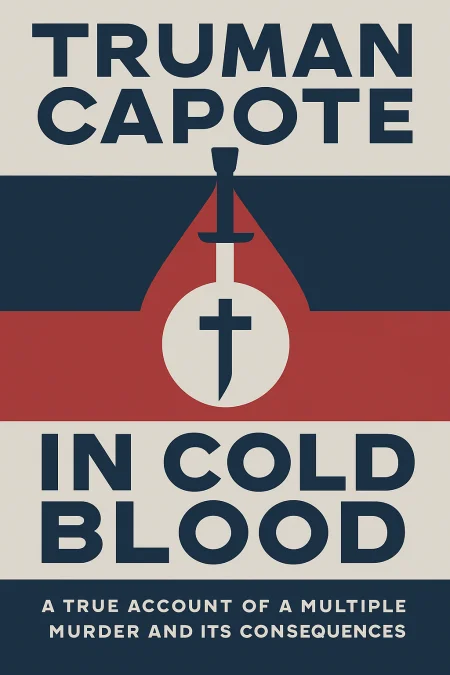
In Cold Blood
A True Account of a Multiple Murder and its Consequences
Book Edition Details
Summary
Kansas, 1959: a tranquil farmhouse becomes the stage for an unspeakable horror, forever altering the lives of a small community. In Truman Capote's groundbreaking work, "In Cold Blood," the true tale of this chilling crime unfolds with masterful precision. Capote delves deep into the psyche of Perry Smith and Dick Hickcock, the young perpetrators whose shocking brutality defies comprehension yet reveals unsettling humanity. With his unparalleled narrative prowess, Capote paints a vivid portrait of a community shattered and a nation transfixed, weaving a tapestry of journalistic excellence and haunting prose. This seminal work not only immortalizes a tragic event but also redefines the boundaries of literary nonfiction, compelling readers to confront the darkest corners of the human soul.
Introduction
On a quiet November night in 1959, the American heartland was forever changed when four members of the Clutter family were brutally murdered in their Kansas farmhouse. This shocking crime would expose the fragile veneer of safety that small-town America had wrapped around itself in the post-war era, revealing how quickly the promise of prosperity and security could dissolve into nightmare. The case offers a penetrating examination of three interconnected aspects of American society: the psychology of violence that lurks beneath civilized surfaces, the mechanics of criminal investigation in an era of emerging forensic science, and the moral complexities of capital punishment as society's ultimate response to evil. Through the lens of this single crime, we witness how a nation grappled with questions that remain painfully relevant today - what drives ordinary people to commit extraordinary acts of violence, how justice systems balance mercy with retribution, and whether the death penalty serves as deterrent or merely satisfies society's thirst for vengeance. This story will resonate with anyone seeking to understand the darker currents of human nature, the evolution of American criminal justice, and the enduring tensions between individual pathology and societal responsibility. It reveals how a single act of violence can illuminate the deepest contradictions within a culture that prides itself on both compassion and swift justice.
November 1959: The Perfect American Dream Shattered
The Clutter family embodied everything that post-war America aspired to become. Herbert Clutter had built a prosperous wheat farm in western Kansas, creating a life of quiet dignity for his wife Bonnie and their children Nancy and Kenyon. Their home represented the fulfillment of the American dream - a testament to hard work, moral values, and the promise that virtue would be rewarded with security and success. Yet this very success made them targets. Two ex-convicts, Perry Smith and Dick Hickock, had heard rumors of a safe containing thousands of dollars hidden somewhere in the Clutter house. On that fateful November night, they drove across Kansas with shotgun and knife, driven by fantasies of easy wealth that would transform their desperate circumstances. What they found instead was a family that kept no safe, possessed little cash, and posed no threat beyond their inconvenient existence as witnesses. The murders that followed revealed the terrifying randomness of violence in American life. The Clutters were not killed for who they were or what they had done, but simply because they were there when two damaged men arrived seeking something that never existed. Perry Smith later reflected that the family "never hurt me like other people have all my life. Maybe it's just that the Clutters were the ones who had to pay for it." This chilling admission exposed how personal trauma and social alienation could explode into senseless destruction, shattering not just individual lives but an entire community's sense of order. The crime marked a turning point in American consciousness, demonstrating that the sanctuary of home and family could be violated by forces entirely beyond prediction or control. The randomness of the violence was perhaps its most disturbing aspect, suggesting that safety was ultimately an illusion and that evil could strike anywhere, anytime, without warning or reason.
The Investigation Unfolds: Modern Police Work Emerges
The discovery of the Clutter family's bodies on November 15th launched one of the most intensive criminal investigations in Kansas history. Agent Alvin Dewey of the Kansas Bureau of Investigation found himself confronting a crime scene that defied easy explanation - four victims bound and shot, with no apparent motive, no obvious suspects, and precious few clues beyond some muddy footprints and spent shotgun shells. The investigation revealed both the strengths and limitations of 1950s law enforcement. While forensic science was advancing rapidly, with new techniques for analyzing blood, fingerprints, and ballistics, the case initially seemed to lack the physical evidence necessary to identify the perpetrators. The breakthrough came not from scientific analysis but from human intelligence - a former cellmate of Dick Hickock who remembered conversations about the wealthy Clutter family and their rumored safe. This tip transformed a baffling local mystery into a nationwide manhunt. The investigation expanded across multiple states as agents tracked the killers' wandering path from Kansas to Mexico and back through the American Southwest. The case demonstrated how modern criminal investigation required both traditional detective work and emerging technologies, combining shoe-leather investigation with laboratory analysis, local knowledge with federal resources. The pursuit also revealed the interconnected nature of American criminal justice, as multiple agencies coordinated across state lines to track two men whose crime had shocked the nation. When Smith and Hickock were finally arrested in Las Vegas, their capture represented not just the solution to a particular crime but validation of the evolving methods that would define modern law enforcement for decades to come.
Trial and Execution: Justice System Under Scrutiny (1960-1965)
The trial of Smith and Hickock in March 1960 exposed fundamental tensions within the American legal system regarding mental illness, criminal responsibility, and the quality of justice available to the poor. Both defendants had clearly committed the murders, but their attorneys faced the nearly impossible task of saving their lives while working within a legal framework that offered few options for addressing the psychological factors that had contributed to the crime. The case highlighted the limitations of existing insanity laws, which recognized mental illness only if defendants could not distinguish right from wrong at the time of their crime. Despite evidence of severe psychological damage, particularly in Perry Smith's case - including childhood trauma, personality disorders, and possible brain damage - the legal system provided no mechanism for considering these factors as mitigating circumstances. The psychiatrists who examined the defendants were restricted to simple yes-or-no answers about their sanity, unable to explain the complex psychological dynamics that had led to murder. After nearly six years on death row, Perry Smith and Dick Hickock were executed by hanging in the early morning hours of April 14, 1965. Their deaths marked the end of a legal odyssey that had tested every level of the American justice system, from local courts to the United States Supreme Court. The final moments revealed the complex humanity that persisted even in condemned men - Hickock maintaining his characteristic bravado while Smith questioned the morality of capital punishment itself. The executions satisfied society's demand for retribution but left deeper questions unresolved. Detective Alvin Dewey, who had pursued the killers relentlessly and witnessed their deaths, found himself unexpectedly moved by the sight of Perry Smith's small feet dangling from the gallows. Rather than the sense of completion he had anticipated, Dewey experienced something more complex - a recognition of the waste and tragedy that extended far beyond the original crime.
Summary
The Clutter family murders illuminated a fundamental tension at the heart of American society - the collision between our ideals of safety, prosperity, and moral order with the harsh realities of violence, mental illness, and social breakdown. The case revealed how quickly the promise of the American dream could be shattered by forces that seemed to emerge from nowhere but were actually rooted in deep patterns of trauma, alienation, and systemic failure. This tragedy offers several enduring lessons for contemporary society. First, we must recognize that public safety depends not just on law enforcement and punishment but on addressing the root causes of criminal behavior - poverty, mental illness, childhood trauma, and social isolation. Second, our justice system must evolve to better balance the demands of punishment with the insights of psychology and social science, creating space for nuanced understanding of criminal responsibility while maintaining accountability. Finally, we must acknowledge that some forms of evil may be beyond our capacity to fully understand or prevent, requiring us to build resilience and community support systems that can help society heal from inevitable tragedies. The story reminds us that true security comes not from the illusion of perfect safety but from our collective commitment to creating conditions where human dignity can flourish and where those who are struggling receive help before desperation drives them to destroy others and themselves. In facing the darkness that this case revealed, we find not reasons for despair but imperatives for building a more just and compassionate society.
Related Books
Download PDF & EPUB
To save this Black List summary for later, download the free PDF and EPUB. You can print it out, or read offline at your convenience.
By Truman Capote
