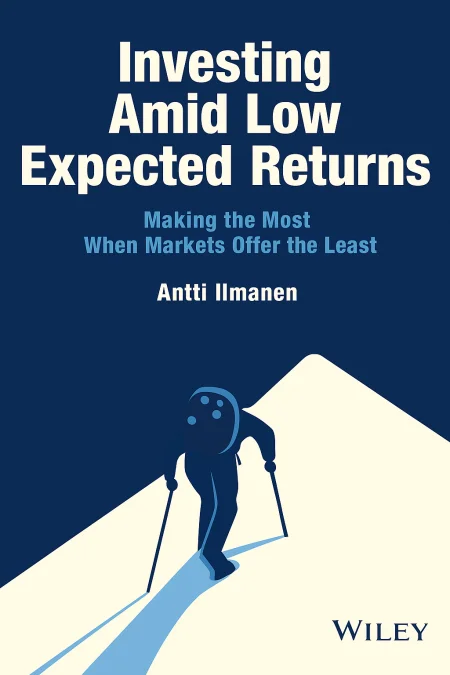
Investing Amid Low Expected Returns
Making the Most When Markets Offer the Least
Book Edition Details
Summary
Facing the financial horizon with trepidation? "Investing Amid Low Expected Returns" is your indispensable compass in navigating the turbulent seas of modern markets. This insightful guide strips away the noise, revealing how timeless virtues—discipline, humility, and patience—are your anchors in an era of unpredictable returns. As economic winds shift from favorable to fierce, the book offers a meticulous examination of empirical strategies to bolster your portfolio. Dive into the essentials of asset class, illiquidity, and style premiums while exploring the art of diversification without the folly of market timing. Whether you're at the helm of institutional investments or charting your personal financial course, this resource empowers you to sail confidently, embracing serenity amid the storm of low expectations.
Introduction
The investment landscape has fundamentally shifted, confronting investors with a reality where traditional strategies face diminishing returns across virtually all asset classes. This transformation stems from structural forces including demographic changes, monetary policy extremes, and market maturation that have compressed risk premiums to historically low levels. The comfortable assumptions that guided investment decisions for decades no longer provide reliable pathways to wealth creation, demanding a complete reconceptualization of portfolio construction and risk management. The theoretical framework presented here introduces a systematic approach to navigating this challenging environment through what can be termed "multi-dimensional return harvesting." This methodology transcends conventional asset allocation wisdom by identifying diverse, independent sources of returns that can be systematically captured and combined. The approach integrates factor-based investing, alternative risk premia, and sophisticated implementation techniques into a coherent investment philosophy designed for resilience rather than speculation. The core theoretical questions this framework addresses include how investors can maintain purchasing power when traditional diversification fails, why return sources must be understood at a granular level rather than through broad asset class categories, and how systematic approaches can provide sustainable competitive advantages in an increasingly efficient market environment.
The Low Return Environment and Structural Market Changes
The current investment paradigm represents a fundamental departure from historical norms, characterized by what economists describe as a "new neutral" where equilibrium interest rates have permanently declined across developed economies. This environment has emerged from the confluence of demographic transitions, technological disruption, and unprecedented monetary accommodation that have collectively compressed risk premiums across asset classes. The mathematical reality underlying this shift is straightforward: when risk-free rates approach zero and asset valuations reach historical extremes, future returns must necessarily disappoint relative to past experience. Understanding this structural transformation requires recognizing how interconnected global financial markets have become. Central bank policies that were once considered emergency measures have become permanent features of the investment landscape, creating artificial suppression of volatility and systematic distortions in asset pricing. The traditional relationship between risk and return has been altered, not temporarily but structurally, as the fundamental drivers of economic growth have shifted toward intangible assets and technological advancement that require less capital investment. The implications extend far beyond portfolio returns to encompass institutional sustainability and retirement security. Pension funds designed around historical return assumptions now face actuarial impossibilities, while individual savers confront the stark choice between dramatically increased savings rates or significantly extended working years. This challenge resembles a river that has permanently changed course, leaving investors who continue to rely on historical patterns stranded in what was once fertile territory but has now become barren ground. The persistence of this environment suggests that tactical adjustments are insufficient; instead, investors must develop new frameworks that acknowledge structural changes while identifying return sources that remain robust across different market regimes. This reality demands a more sophisticated understanding of what drives investment returns and how these drivers interact under varying economic conditions.
Multi-Factor Return Sources and Portfolio Building Blocks
The solution to the low return challenge lies in expanding the conception of return sources beyond traditional asset class categories to encompass a broader universe of systematic risk premia that can be harvested through disciplined implementation. This building blocks approach recognizes that sustainable portfolio returns can be decomposed into distinct components, each with different risk characteristics, correlation patterns, and return drivers that operate independently across market cycles. Traditional asset class premia, while remaining important, represent only the foundation of this expanded framework. Equity risk premiums, credit spreads, and real asset returns continue to provide the bulk of long-term portfolio growth, but their expected contributions have diminished significantly due to elevated valuations and structural economic changes. The modern approach requires decomposing these broad categories into their constituent elements: equity returns driven by earnings growth, dividend yields, and valuation changes each respond differently to economic cycles and monetary policy shifts. Alternative risk premia introduce additional dimensions to portfolio construction by capturing systematic patterns that persist across asset classes and geographic regions. Value strategies systematically favor underpriced securities relative to fundamental metrics, exploiting the behavioral tendency for markets to overreact to short-term information. Momentum approaches capitalize on the persistence of trends, while carry strategies harvest yield differentials across currencies, yield curves, and credit markets. Quality factors target financially robust companies with sustainable competitive advantages, providing defensive characteristics during market stress periods. The integration of these diverse return sources resembles the construction of a well-engineered building where each component serves a specific structural purpose while contributing to overall stability. Just as architects must consider load distribution, material properties, and environmental stresses, portfolio architects must understand how different return sources interact under various market conditions. The mathematical relationship between uncorrelated factors suggests that combining multiple independent return sources can potentially enhance risk-adjusted performance while reducing overall portfolio volatility, creating more robust wealth accumulation that can withstand unexpected market shocks.
Risk Management and Implementation in Modern Portfolios
Effective portfolio construction in the modern environment requires a comprehensive risk management framework that extends far beyond traditional volatility measures to encompass tail risks, liquidity constraints, and systematic factor exposures that can simultaneously impact multiple portfolio components. This approach recognizes that the greatest portfolio threats often emerge from unexpected correlations during market stress periods, when traditional diversification benefits may disappear precisely when they are most needed. The theoretical foundation of modern risk management rests on distinguishing between diversifiable and systematic risks while implementing multiple layers of protection against various failure modes. Static diversification involves constructing portfolios with permanently low correlations across geographic regions, economic sectors, and investment styles. Dynamic approaches incorporate systematic rules for adjusting portfolio exposures based on changing market conditions, such as volatility targeting mechanisms that reduce risk during periods of market stress and increase exposure when opportunities emerge. Implementation considerations play a crucial role in translating theoretical insights into practical investment success. Transaction costs that might be negligible in a high-return environment become material when expected returns are compressed across asset classes. Market impact, capacity constraints, and behavioral factors can significantly erode the benefits of sophisticated portfolio construction techniques, requiring careful attention to execution efficiency and systematic rebalancing protocols that maintain target risk exposures without excessive trading costs. The integration of these risk management techniques resembles the navigation system of a modern aircraft, which relies on multiple redundant instruments and automated systems to ensure safe passage through various weather conditions. No single risk management tool is sufficient, but their combination creates a robust framework capable of protecting portfolios across diverse market environments. The key insight is that effective risk management is not about eliminating all risks, but rather about taking calculated risks that are likely to be rewarded while protecting against catastrophic losses that could permanently impair long-term wealth accumulation, enabling investors to maintain the financial resilience necessary to participate in eventual market recoveries.
Summary
The essence of successful investing in a low return environment lies in the systematic identification and intelligent combination of diverse, independent return sources that can collectively generate superior risk-adjusted performance despite challenging market conditions. This comprehensive framework represents a fundamental evolution in investment thinking, moving beyond simplistic asset allocation models toward a sophisticated understanding of the multiple dimensions through which returns can be generated and risks can be managed. For investors willing to embrace this complexity, the approach offers both the intellectual foundation and practical tools necessary to construct resilient portfolios capable of delivering meaningful returns across varying economic environments, ultimately providing a pathway to financial success that acknowledges current market realities while positioning portfolios to capture whatever opportunities emerge in an era of structural change.
Related Books
Download PDF & EPUB
To save this Black List summary for later, download the free PDF and EPUB. You can print it out, or read offline at your convenience.
By Antti Ilmanen
