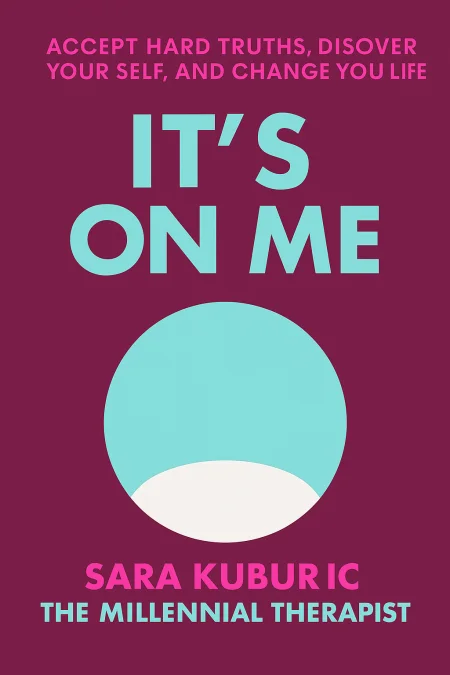
It's On Me
Accept Hard Truths, Discover Your Self, and Change Your Life
Book Edition Details
Summary
In a world where the noise of daily life often drowns out our inner voice, Sara Kuburic's "I’m The Problem, It’s Me" offers a profound guide back to oneself. As an existential psychotherapist, Kuburic introduces the concept of "self-loss," a silent struggle that leaves us feeling disconnected from who we truly are. This book isn't about quick fixes or superficial solutions. Instead, it invites readers to pause and reflect, challenging them to take ownership of their actions and choices. Through insightful guidance, Kuburic empowers us to forge a genuine connection with our emotions, bodies, and boundaries. Her approach helps declutter both mind and space, paving the way for authenticity and purpose. Whether you’re trapped in the cycle of self-sabotage or simply seeking a more meaningful existence, Kuburic's teachings illuminate a path to rediscovering the vibrant self that's been yearning to emerge.
Introduction
In a world that constantly tells us who we should be, the question "Who am I?" has become both more urgent and more difficult to answer. Sara Kuburic, an existential psychotherapist, confronted this question in the most dramatic way possible when a panic attack at an airport forced her to reckon with a life she was merely performing rather than truly living. Her journey from self-loss to authentic selfhood illuminates a struggle that defines our modern age. Kuburic's story begins in the aftermath of war-torn Yugoslavia, where survival meant disconnecting from one's inner voice, and continues through her twenties when she found herself trapped in relationships and roles that felt fundamentally wrong. Yet it was precisely this deep sense of being lost that led her to discover what it truly means to exist as oneself. Through her training in existential psychology and her work with countless clients, she has mapped the territory of self-loss and recovery with remarkable clarity. From Kuburic's transformative experience, readers will discover how to recognize the subtle ways we abandon ourselves in daily life, understand the philosophical foundations of authentic existence, and learn practical methods for reconnecting with their deepest truth. Her approach combines rigorous psychological insight with profound compassion, offering both the why and the how of living as one's genuine self. This is not merely a story of personal recovery, but a roadmap for anyone who has ever felt like a stranger in their own life.
The Depths of Self-Loss: Understanding Personal Disconnection
Self-loss is not a dramatic event but a gradual erosion, like water wearing away stone. Kuburic describes it as "being estranged from and lacking congruence, resonance, and alliance with who we truly are." It manifests in the small moments when we say yes but mean no, when we perform emotions we don't feel, when we make decisions based on what others expect rather than what resonates with our core being. The tragedy is that this disconnection from self has become so normalized in our society that many people don't even realize they're living as strangers to themselves. The symptoms of self-loss appear across every dimension of human experience. Emotionally, we might find ourselves overwhelmed by feelings we can't understand or completely numb to experiences that should move us. Physically, we treat our bodies as objects to be controlled rather than integral parts of our being. In relationships, we lose ourselves in others' needs or remain so guarded that genuine connection becomes impossible. We struggle to set boundaries because we're unclear about where we end and others begin. Perhaps most painfully, self-loss robs us of our sense of meaning and direction. When we're disconnected from our authentic self, we can't access our true values or desires. We make decisions based on external expectations or old patterns, wondering why nothing feels quite right. We might achieve conventional success while feeling hollow inside, or find ourselves paralyzed by choices because we've lost touch with our inner compass. The insidious nature of self-loss lies in how we participate in our own disconnection. Through self-betrayal in relationships, conformity to social expectations, or simply the habit of ignoring our inner voice, we gradually become complicit in our own disappearance. Yet recognizing this participation is also the beginning of hope, because what we have given away through our choices, we can reclaim through different choices.
Breaking Free from External Expectations and Internal Barriers
Society offers us countless scripts for who we should be, and most of us spend our lives trying to fit into roles that were never designed for our unique shape. Kuburic explores how family systems, cultural norms, and social media create a relentless pressure to conform to external expectations. We learn to be "good girls" or "successful men," to prioritize others' needs over our own, to suppress emotions that make others uncomfortable. These patterns often begin in childhood when being ourselves feels dangerous to our belonging and safety. The challenge is that we can't simply reject society altogether. We need relationships, community, and the mirror that others provide to understand ourselves. The key lies in becoming conscious about whose opinions we allow to shape us. Kuburic introduces the concept of inner consent, asking whether we can wholeheartedly say yes to the life we're living. When our actions don't align with our deepest truth, we experience a profound dissonance that manifests as anxiety, depression, or a nagging sense that something is fundamentally wrong. Breaking free requires recognizing the difference between compromise and self-betrayal. Healthy relationships involve negotiation and flexibility, but they shouldn't require us to abandon core aspects of who we are. This means learning to tolerate the discomfort of disappointing others when living authentically conflicts with their expectations. It means accepting that some relationships may not survive our growth, while others will deepen as we become more genuinely ourselves. The internal barriers are often more challenging than external ones. We carry voices from our past that tell us we're too much or not enough, too sensitive or too hard. We fear that if we stop performing, no one will love the real person underneath. Kuburic emphasizes that authenticity isn't about being perfect or even likeable—it's about being real. The courage to be ourselves, flaws and all, is what creates the possibility for genuine connection and fulfillment.
Reconnecting with Body, Mind, and Authentic Emotions
Modern culture has taught us to treat our bodies as machines to be optimized rather than integral parts of our being. Kuburic argues that we cannot separate our sense of self from our physical experience—we don't simply have bodies, we are our bodies. This disconnection manifests in countless ways: ignoring hunger and fatigue, pushing through pain, using our bodies as objects for others' approval rather than vehicles for our own expression. Reconnection begins with simple acts of attention, asking what our body needs and honoring those needs as valid and important. The mind-body-emotion complex works as an integrated system, and healing requires addressing all dimensions simultaneously. Our emotions aren't obstacles to clear thinking but essential information about what matters to us. When we judge our feelings or try to control them, we cut ourselves off from crucial data about our values and needs. Kuburic teaches that emotions are messengers, pointing us toward what we love, what we fear, and what requires our attention. Learning to feel fully doesn't mean being overwhelmed by emotion, but rather developing the capacity to experience the full spectrum of human feeling without losing our center. This requires what Kuburic calls "turning toward"—the willingness to face whatever arises within us with curiosity rather than judgment. When we can be present with our anger, sadness, joy, and fear, we access a richness of experience that makes life worth living. The journey back to embodied authenticity involves both releasing what doesn't serve us and embracing what does. This might mean changing relationships that require us to be someone we're not, leaving jobs that drain our vitality, or simply saying no to commitments that feel wrong in our bodies. It also means actively choosing experiences that bring us alive—whether that's dancing, hiking, deep conversation, or quiet solitude. The goal isn't to be happy all the time, but to be fully present to whatever we're experiencing.
The Art of Being Your Authentic Self
Authenticity isn't a destination but a practice—the ongoing choice to align our actions with our deepest truth. Kuburic emphasizes that being authentic doesn't mean being selfish or ignoring others' needs, but rather showing up as our genuine selves in relationship with others. This requires constant attunement to our inner experience, regularly checking whether our choices feel right in our bodies and align with our values. The art of authentic living involves embracing both our freedom and our responsibility. We're free to choose who we become, but we're also responsible for the consequences of those choices. This can feel overwhelming until we recognize that taking responsibility for our lives is ultimately liberating. When we stop blaming external circumstances for our unhappiness and start making conscious choices about how we want to live, we reclaim our power. Kuburic introduces the concept of phenomenology—approaching each moment with fresh eyes, allowing ourselves to be moved by our encounters with the world. This means treating every interaction, every sunset, every difficult emotion as an opportunity to learn something new about ourselves and our place in the world. It's about being present to our lives rather than sleepwalking through them. The ultimate goal isn't to achieve some perfect state of authenticity, but to keep choosing alignment over and over again. This means being willing to fail, to make mistakes, to disappoint others when being true to ourselves requires it. It means treating our lives as ongoing experiments in being human, approaching each day with curiosity about who we're becoming. When we can embrace this process of constant becoming, we find that the question isn't who we are, but who we're choosing to be in each moment.
Summary
Sara Kuburic's journey from self-loss to authentic living reveals that the path home to ourselves begins with the courage to face our own disconnection honestly. Her central insight is profound in its simplicity: we cannot love a life that isn't truly ours, and we cannot live authentically without taking full responsibility for our choices. The pandemic of self-loss in our culture isn't just a personal problem but a collective crisis that requires both individual healing and societal change. From Kuburic's hard-won wisdom, we can learn to recognize the subtle ways we abandon ourselves and develop the skills to choose differently. This means learning to listen to our bodies, honor our emotions, and make decisions based on inner resonance rather than external approval. It means being willing to disappoint others in service of our deeper truth and accepting that authentic living sometimes comes with the cost of relationships that cannot accommodate our full selves. Most importantly, it means understanding that the question of who we are isn't something to be answered once but lived anew each day through our choices and actions. This book speaks especially to those who feel lost in their own lives, who have achieved external success while feeling empty inside, or who suspect they're living someone else's dream rather than their own. Kuburic's approach offers both philosophical depth and practical guidance for the essential human task of becoming who we truly are.
Related Books
Download PDF & EPUB
To save this Black List summary for later, download the free PDF and EPUB. You can print it out, or read offline at your convenience.
By Sara Kuburic
