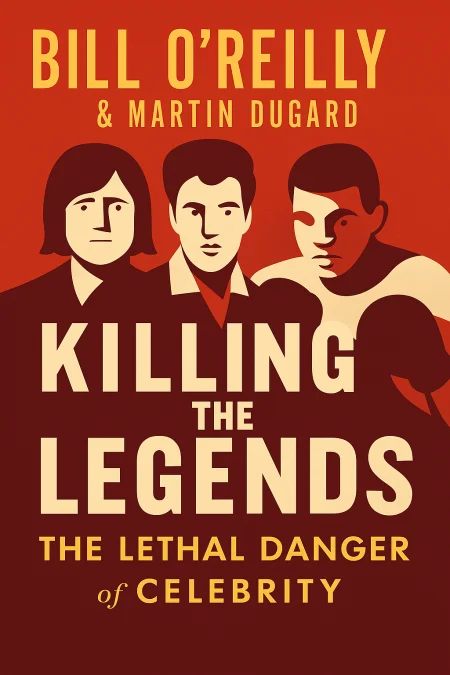
Killing the Legends
The Lethal Danger of Celebrity
byBill O'Reilly, Martin Dugard
Book Edition Details
Summary
Elvis Presley, John Lennon, Muhammad Ali—icons who didn’t just capture the spotlight; they redefined it. In "Killing the Legends," Bill O'Reilly and Martin Dugard unravel the tapestry of triumph and turmoil that wove their extraordinary lives. Witness the intoxicating rise to fame and the heart-wrenching descent into shadows cast by betrayal and isolation. These legends stood atop the world, their every move watched, yet faced battles unseen by the masses. This gripping narrative delves into the poignant reality of their vulnerabilities amidst the glimmer of their public personas. A masterstroke of narrative history, this book transcends mere biography, offering a riveting exploration of human fragility amidst greatness.
Introduction
In the span of just a few decades, three men rose from humble beginnings to become the most recognizable figures on Earth. Elvis Presley, the truck driver's son from Mississippi who revolutionized music with his swiveling hips and smoldering voice. John Lennon, the working-class Liverpool lad whose wit and musical genius helped define a generation's dreams and rebellions. Muhammad Ali, the brash young boxer from Kentucky who floated like a butterfly and stung like a bee while challenging America's conscience on race and war. Yet by examining their lives through the lens of power and control, we discover a darker truth about fame's ultimate cost. Each man, despite possessing extraordinary talent and charisma, gradually surrendered his autonomy to others who promised to manage their careers but ultimately managed their destruction. The very success that elevated them became the prison that confined them, as handlers, managers, and enablers systematically isolated these icons from reality, exploited their vulnerabilities, and prioritized profit over their wellbeing. This exploration reveals how the machinery of celebrity can transform even the most gifted individuals into prisoners of their own fame. It serves as both a tribute to their incredible contributions to culture and a cautionary tale about the price of surrendering personal agency to those who claim to have your best interests at heart. For anyone seeking to understand how power corrupts and how even legends can become victims of the very system that created them, these three intertwined stories offer profound insights into the dark side of American celebrity.
Rise to Glory: The Making of Cultural Legends (1950s-1960s)
The seeds of destiny were planted in the most ordinary of circumstances. In 1954, eighteen-year-old Elvis Presley walked into Sun Studio in Memphis to record a song for his mother's birthday, paying four dollars he could barely afford. That same year, thirteen-year-old John Lennon was forming his first band, the Quarrymen, in Liverpool's working-class neighborhoods. Meanwhile, twelve-year-old Cassius Clay was learning to box at a local gym after his bicycle was stolen, channeling his anger into athletic excellence. These three young men shared more than talent—they possessed an indefinable magnetism that would soon captivate the world. Presley's fusion of country, rhythm and blues, and gospel created a revolutionary sound that made teenage girls scream and parents worry about moral decay. His 1956 appearance on The Ed Sullivan Show drew 60 million viewers, proving that a new cultural force had arrived. Lennon's partnership with Paul McCartney produced songs that spoke to universal human experiences while pushing musical boundaries ever forward. The Beatles' 1964 arrival in America triggered unprecedented mass hysteria, with fans literally fainting at the sight of their idols. Clay, who would later become Muhammad Ali, combined athletic brilliance with unprecedented showmanship. His Olympic gold medal in 1960 was just the beginning—his bold predictions, poetic trash talk, and genuine charm made him boxing's first true crossover star. "I am the greatest," he proclaimed, and increasingly, the world believed him. Yet even in these golden years of ascension, the patterns of control were already being established. Elvis signed with Colonel Tom Parker, a carnival barker with a mysterious past who would take an unprecedented 50 percent of everything the King earned. The Beatles, while maintaining creative control, relied heavily on manager Brian Epstein to navigate the business world they never understood. Clay's conversion to Islam and name change to Muhammad Ali brought him under the influence of the Nation of Islam and manager Herbert Muhammad, who would similarly extract enormous commissions from the fighter's success. These early arrangements, seemingly protective and profitable, would eventually become the golden chains that bound these legends to their eventual destruction.
Peak and Peril: Fame's Golden Cage Takes Hold (1967-1975)
By the late 1960s, all three men had achieved the kind of global recognition that transcended their individual crafts. Elvis commanded the Las Vegas stage with an authority that made him the undisputed King of Entertainment. The Beatles had evolved from loveable mop-tops into sophisticated artists whose albums like "Sergeant Pepper's Lonely Hearts Club Band" redefined what popular music could be. Muhammad Ali, stripped of his boxing title for refusing induction into the Vietnam War, had become a symbol of resistance and principle that resonated far beyond the sporting world. Yet this peak of cultural influence coincided with the tightening of the very constraints that would ultimately destroy them. Elvis, trapped in Colonel Parker's vision of him as a movie star, found himself making increasingly forgettable films while his musical relevance waned. The 1968 Comeback Special briefly reignited his artistic fire, but Parker quickly steered him back into the lucrative but creatively stifling cycle of Las Vegas performances and formulaic recordings. The King began relying on prescription drugs to maintain the grueling schedule his manager demanded, a dependence that would only deepen with time. The Beatles' unprecedented success created pressures that ultimately fractured the group. John Lennon's relationship with avant-garde artist Yoko Ono became a source of tension within the band, while business disagreements over new management drove wedges between longtime collaborators. Lennon's increasing heroin use and political radicalism alienated him from his bandmates, while his surrender of personal autonomy to Ono marked the beginning of his artistic isolation. When the Beatles finally disbanded in 1970, Lennon lost not just his creative partners but his connection to the disciplined structure that had channeled his talents. Ali's principled stand against the Vietnam War cost him three prime years of his athletic career, but his return to boxing in 1970 brought new challenges. Herbert Muhammad's relentless scheduling of fights prioritized financial gain over the boxer's long-term health. The brutal trilogy of fights with Joe Frazier, culminating in the legendary "Thrilla in Manila," showcased Ali's warrior spirit but left him with cumulative brain damage that would manifest more clearly in later years. Each man had reached the pinnacle of his field, yet the very machinery of their success was already grinding away at their humanity, health, and creative autonomy.
The Final Act: Decline and Fall of Icons (1976-1981)
The final phase of these three legends' lives revealed the devastating cost of surrendering control to others. Elvis, bloated by prescription drugs and trapped in a cycle of increasingly mediocre performances, had become a parody of his former self. Colonel Parker's stranglehold over his career prevented any possibility of artistic renaissance or meaningful change. The King's attempts at serious acting were sabotaged by his manager's preference for quick profits over long-term career development. His death at age 42 in 1977, alone on his bathroom floor at Graceland, was the inevitable result of years of exploitation by those who should have protected him. John Lennon's final years were marked by a different kind of surrender—the complete abdication of his independence to Yoko Ono's management of their life together. After a brief period of rebellion during his "Lost Weekend" affair with May Pang, Lennon retreated into domestic isolation, becoming a "househusband" who rarely emerged from their Dakota apartment. His 1980 comeback album "Double Fantasy" suggested renewed creative energy, but his assassination outside his home that December ensured the world would never know if he might have reclaimed his artistic voice. The man who once sang "All You Need Is Love" died having become almost entirely dependent on one person's vision of what his life should be. Muhammad Ali's decline was perhaps the most tragic, as his continuing presence in the ring long after his skills had deteriorated was driven purely by financial pressures orchestrated by Herbert Muhammad. The boxer's slurred speech and trembling hands were visible signs of the neurological damage accumulating from too many fights and too many punches absorbed. His 1980 defeat by Larry Holmes was a painful spectacle that should never have been allowed to occur. His final fight against Trevor Berbick in 1981, staged in a makeshift ring in the Bahamas, was a sad epilogue to one of sport's greatest careers. Each man's downfall followed a similar pattern: isolation from genuine friends and advisors, dependence on handlers whose primary motivation was financial gain, and the gradual erosion of the very qualities that had made them extraordinary. Their handlers had succeeded in creating immensely profitable enterprises, but the human beings at the center of those enterprises paid an ultimate price for their success.
Legacy and Lessons: What Their Destruction Teaches Us
The parallel trajectories of Elvis Presley, John Lennon, and Muhammad Ali offer profound lessons about the corrosive nature of unchecked power and the vulnerability of even the most gifted individuals to exploitation. Their stories reveal how quickly the machinery of celebrity can transform from protective shield to imprisoning cage, particularly when financial incentives override human considerations. Each man possessed talents that should have ensured creative fulfillment and personal happiness, yet all three found themselves trapped by the very success they had worked so hard to achieve. The central tragedy lies not in their individual weaknesses but in their systematic isolation from authentic relationships and honest feedback. Surrounded by sycophants, enablers, and financial dependents, they lost touch with their own authentic voices and desires. Colonel Parker's manipulation of Elvis, Herbert Muhammad's exploitation of Ali, and even Yoko Ono's well-intentioned but ultimately controlling management of Lennon's later life all demonstrate how those closest to power can become its most effective instruments of destruction. These cautionary tales remind us that talent alone is never enough—success requires maintaining personal agency, cultivating genuine relationships, and resisting the temptation to surrender decision-making to others, no matter how qualified they may appear. The price of fame need not be the loss of self, but only if we learn to recognize the warning signs of control disguised as care, exploitation masked as protection, and dependence presented as love. Their legacies endure not just in their artistic achievements but in the hard-won wisdom their struggles can offer to anyone navigating the treacherous waters of success and influence.
Summary
The intertwined stories of Elvis Presley, John Lennon, and Muhammad Ali illuminate a fundamental contradiction at the heart of American celebrity culture: the very system designed to elevate exceptional individuals often becomes the mechanism of their destruction. What began as partnerships intended to nurture and protect these extraordinary talents gradually evolved into relationships of control and exploitation. The managers, advisors, and even loved ones who promised to handle the complexities of fame instead created new forms of imprisonment, prioritizing profit and control over the wellbeing of the human beings whose gifts made their own success possible. Their parallel decline offers crucial lessons for our current age of instant celebrity and social media influence. First, we must recognize that surrendering personal autonomy, even to seemingly trustworthy handlers, inevitably leads to the erosion of authentic self-expression and creative fulfillment. Second, the isolation that fame can bring must be actively resisted through the cultivation of genuine relationships with people who value the person over the persona. Finally, we must understand that true success requires maintaining the courage to make difficult decisions about our own lives, rather than delegating those choices to others whose motivations may not align with our deepest interests. Perhaps most importantly, these stories remind us that even legends are human beings deserving of protection, honesty, and respect. As we witness new generations of talented individuals rise to prominence, we have the opportunity to learn from these tragic examples and create systems that nurture rather than exploit, that preserve humanity rather than consuming it in service of profit and fame.
Related Books
Download PDF & EPUB
To save this Black List summary for later, download the free PDF and EPUB. You can print it out, or read offline at your convenience.
By Bill O'Reilly
