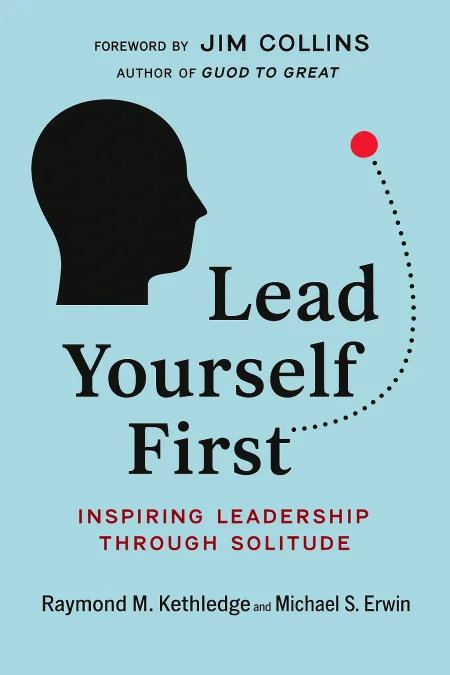
Lead Yourself First
Inspiring Leadership Through Solitude
byJim Collins, Raymond M. Kethledge, Michael S. Erwin
Book Edition Details
Summary
Amidst the cacophony of modern life, where every moment is consumed by the chatter of screens and social media, "Lead Yourself First" whispers a revolutionary truth: solitude is the silent forge of great leadership. Journey through time with Eisenhower, King, and Goodall, as they harness the profound power of isolation to find courage, creativity, and clarity. Raymond Kethledge and Michael Erwin invite you to rediscover this lost art, revealing how intentional solitude can birth innovative ideas and bolster emotional resilience. With a compelling foreword by Jim Collins, this book is not just a guide—it's a call to arms for leaders seeking to reclaim their inner sanctum and ignite their potential.
Introduction
Modern leadership has become synonymous with constant connectivity, perpetual meetings, and reactive decision-making. Yet this paradigm fundamentally misunderstands what creates truly effective leadership. The most transformative leaders throughout history have shared a common practice that modern organizational culture actively discourages: the deliberate cultivation of solitude for deep reflection. This exploration challenges the prevailing assumption that great leadership emerges from extroverted charisma and relentless activity, instead revealing how periods of intentional isolation enable leaders to develop the four critical capacities that distinguish exceptional leadership from mere management: clarity of thought, creative problem-solving, emotional equilibrium, and moral courage. Through examining both contemporary leaders and historical figures, the analysis demonstrates how solitude serves not as withdrawal from responsibility, but as the essential foundation for bearing it effectively. The evidence reveals that leaders who master the discipline of productive solitude gain access to insights, perspectives, and inner resources unavailable through external input alone, enabling them to navigate complexity with wisdom rather than mere reaction.
The Essential Role of Solitude in Leadership Development
Leadership fundamentally begins with self-leadership, yet contemporary culture systematically undermines the conditions necessary for developing this foundational capacity. The constant barrage of information, meetings, and electronic communications creates what amounts to mental noise pollution, preventing leaders from accessing their own thinking processes. Solitude provides the essential space for leaders to move beyond reactive patterns and develop proactive judgment. This is not simply about being physically alone, but about creating mental space free from external inputs where genuine reflection becomes possible. The relationship between solitude and leadership effectiveness operates through several mechanisms. First, isolation from others' opinions allows leaders to form independent judgments rather than merely synthesizing popular viewpoints. Second, the absence of immediate pressures creates space for considering long-term consequences and alternative perspectives. Third, quiet reflection enables leaders to connect with their fundamental values and principles, providing an internal compass for navigation through complex decisions. Historical analysis reveals that many transformational leaders deliberately structured solitude into their routines, treating it not as luxury but as essential preparation for public responsibility. These leaders understood that the quality of their external actions depended directly on the depth of their internal preparation. Modern leaders who neglect this practice often find themselves overwhelmed by the very responsibilities they sought to embrace, reactive rather than responsive, and ultimately less effective despite greater activity levels. The challenge for contemporary leaders lies in recognizing that true accessibility to others requires periods of deliberate inaccessibility, and that serving others effectively demands first developing the capacity to think clearly about what that service requires.
Four Pillars: Clarity, Creativity, Balance, and Moral Courage
Productive solitude generates four distinct but interconnected capacities that form the foundation of exceptional leadership. Clarity emerges when leaders create space to think systematically about complex problems, moving beyond surface-level reactions to identify core issues and underlying patterns. This analytical clarity allows leaders to distinguish between symptoms and root causes, between urgent distractions and truly important priorities. Creative solutions often arise when the conscious mind stops actively searching and allows subconscious processing to occur. Solitude provides the mental quiet necessary for innovative insights to surface, particularly when leaders face unprecedented challenges that existing frameworks cannot address. Many breakthrough strategies and novel approaches emerge not from brainstorming sessions but from individual reflection where unconventional connections can form without group pressure toward conformity. Emotional balance represents perhaps the most crucial yet overlooked benefit of solitary reflection. Leadership inevitably involves managing both personal stress and organizational tensions, yet public environments rarely allow for authentic emotional processing. Solitude enables leaders to acknowledge, understand, and integrate their emotional responses rather than suppressing or being controlled by them. This emotional intelligence then translates into more stable decision-making and more effective interpersonal relationships. Moral courage develops when leaders connect with their deepest values and convictions during periods of reflection. This inner grounding provides the strength necessary to make difficult decisions, resist popular but misguided pressures, and maintain integrity under stress. Leaders who lack this internal foundation often find themselves compromising principles under pressure, not from malice but from insufficient connection to what they truly believe and value. These four capacities work synergistically, with each strengthening the others and all depending on the protected mental space that only solitude can provide.
Historical Leaders and Their Practices of Productive Solitude
Examination of historical leadership reveals consistent patterns in how transformational figures utilized solitude to develop their effectiveness. Dwight Eisenhower's wartime leadership exemplified analytical clarity gained through solitary reflection, particularly his practice of writing detailed memoranda to himself to work through complex strategic decisions. His D-Day decision-making process demonstrated how leaders use solitude to identify the critical variables underlying complex situations, enabling focused judgment even under extreme pressure. Winston Churchill's moral courage during the 1930s emerged from years of solitary writing and historical study in his Chartwell study. His opposition to appeasement policies, though politically costly, drew strength from deep reflection on historical precedents and fundamental principles. This pattern reveals how solitude enables leaders to develop conviction strong enough to withstand social and political pressure. Martin Luther King Jr.'s transformation from reluctant participant to committed leader of the Montgomery Bus Boycott occurred during a profound moment of solitary reflection at his kitchen table. This experience demonstrates how solitude can provide access to sources of strength and resolve that sustain leaders through extended periods of difficulty and opposition. His subsequent fearlessness in facing physical danger traced directly to insights gained during that solitary encounter. These historical examples illustrate a common pattern: leaders facing their greatest challenges often withdrew temporarily from external demands to gain internal clarity and strength. Rather than avoiding responsibility, these periods of solitude prepared them to bear greater responsibility more effectively. The quality of their public leadership correlated directly with the depth of their private reflection. Contemporary leaders can learn from these patterns while adapting the principles to modern circumstances and challenges.
Implementing Solitude in Modern Leadership Challenges
Translating historical insights into contemporary practice requires addressing the specific obstacles modern leaders face in creating space for reflection. The expectation of constant availability, open office environments, and information overload all work against the conditions necessary for productive solitude. However, effective implementation begins with recognizing that solitude is not selfish withdrawal but essential preparation for better service to others. Practical implementation involves both structural and cultural changes. Structurally, leaders must deliberately schedule time for reflection, protect it from interruption, and communicate its importance to their organizations. This might involve designated thinking time, periodic retreats from electronic communication, or physical spaces designed for contemplation rather than collaboration. The key is treating reflective time as seriously as any other important meeting or responsibility. Culturally, leaders must model the value of thoughtful preparation over instant response. By demonstrating that better decisions emerge from careful consideration rather than immediate reaction, leaders can shift organizational expectations and give others permission to engage in similar practices. This creates a positive feedback loop where reflective practices spread throughout the organization. The benefits extend beyond individual leaders to entire organizations. Teams led by leaders who practice regular reflection tend to be more strategic, less reactive, and better at learning from both successes and failures. The calm confidence that emerges from reflective leadership creates psychological safety that enables others to think more clearly and contribute more effectively. Modern leaders who master these practices often discover that they accomplish more by doing less, that their influence increases as their activity level becomes more purposeful, and that their capacity to handle complex challenges grows as they invest in the internal resources that make such handling possible.
Summary
The core insight emerging from this analysis is that genuine leadership authority derives not from external position but from internal development, and that this development requires the kind of deep reflection that only solitude can provide. The four capacities of clarity, creativity, emotional balance, and moral courage represent not personality traits but developed skills that any leader can cultivate through disciplined practice of productive solitude. Rather than representing withdrawal from leadership responsibilities, solitary reflection serves as the essential foundation that makes effective leadership possible in the first place.
Related Books
Download PDF & EPUB
To save this Black List summary for later, download the free PDF and EPUB. You can print it out, or read offline at your convenience.
By Jim Collins
