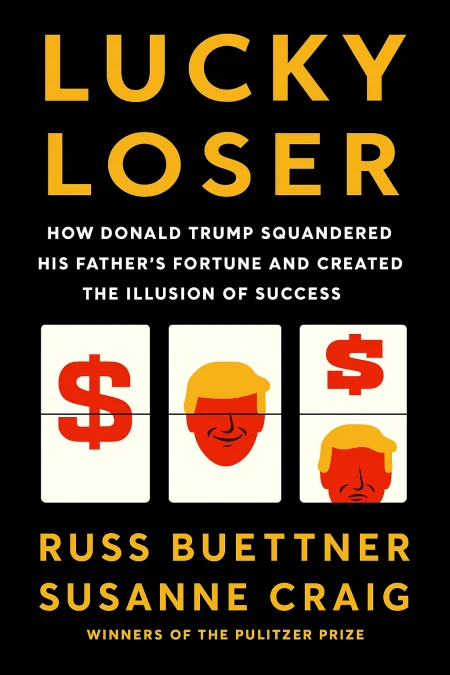
Lucky Loser
How Donald Trump Squandered His Father's Fortune and Created the Illusion of Success
byRuss Buettner, Susanne Craig
Book Edition Details
Summary
In a world where public personas often mask the truth, "Lucky Loser" peels back the gilded facade of Donald Trump's self-made success story to reveal a narrative steeped in financial smoke and mirrors. Crafted by the Pulitzer Prize-winning journalists who first unearthed the intricate tapestry of Trump's wealth, this investigation meticulously exposes the stark contrast between the flamboyant billionaire's public bravado and the behind-the-scenes fiscal chaos. Aided by secretive tax documents and insider testimonies, Russ Buettner and Susanne Craig unravel the myth of Trump's empire, highlighting the precarious balance of inherited wealth, financial gambles, and relentless reinventions. This gripping account offers a profound look into the paradox of a man who, despite monumental failures, clinched the highest office in the land.
Introduction
In the summer of 1973, a young real estate developer named Donald Trump sat in a federal courthouse in Brooklyn, facing discrimination charges that would have destroyed most careers before they began. Yet this moment of crisis marked not an ending, but the beginning of one of America's most extraordinary political ascensions. How did a family business built on government housing subsidies transform into a global brand that would ultimately reach the highest office in the land? This remarkable journey reveals three fundamental questions that define our era: How do family dynasties systematically leverage government programs to build private fortunes across generations? What role does media spectacle play in transforming business failures into perceived success? And how do the methods of accumulating wealth ultimately shape the exercise of political power? The answers illuminate the hidden mechanics of American capitalism, where public resources become private advantages, and where the appearance of success can become more valuable than actual achievement. This narrative will resonate with anyone seeking to understand the intersection of money, media, and power in contemporary America. It offers essential insights for students of business history, political observers, and citizens grappling with questions of meritocracy and privilege in democratic society. Through careful examination of financial records, legal documents, and firsthand accounts, we witness how inherited advantages compound across generations, creating opportunities that appear to reflect individual merit but actually depend on systemic privileges.
Fred Trump's Foundation: Government Housing Programs and Wealth Accumulation (1920s-1960s)
The foundation of the Trump fortune was laid not through entrepreneurial brilliance, but through Fred Trump's masterful exploitation of government housing programs designed to address America's greatest crises. Beginning in the 1930s, as the Great Depression devastated the construction industry, Fred recognized that federal initiatives like the Federal Housing Administration represented unprecedented opportunities for builders willing to navigate bureaucratic complexities. Fred's approach was methodical and disciplined, studying every detail of programs like Section 608, which provided government-backed mortgages for apartment construction. He discovered that loose oversight allowed builders to pocket the difference between actual costs and estimated expenses, transforming programs intended to house veterans and working families into mechanisms for private wealth accumulation. His projects like Shore Haven and Beach Haven were built almost entirely with government-backed financing, yet he retained full ownership and collected millions in what investigators would later call windfall profits. The key to Fred's success lay in understanding that government programs created during emergencies often contained exploitable loopholes. He developed relationships with officials like Clyde Powell, who oversaw the Section 608 program, learning to present cost estimates that maximized mortgage amounts while minimizing actual expenses. This wasn't illegal, but it established a template that would influence his son's approach to business: the importance of political connections, the value of understanding government programs, and the recognition that the greatest fortunes often come from finding ways to privatize public benefits. By the 1950s, Fred had assembled a real estate empire worth hundreds of millions of dollars, built largely on government-backed financing. Congressional investigations would eventually expose widespread profiteering in federal housing programs, but Fred's careful legal positioning protected him from serious consequences. His success demonstrated that in America, knowing how to work the system often mattered more than working hard within it, a lesson that would prove crucial as the family business evolved from Fred's methodical approach to Donald's more theatrical style of wealth building.
Donald's Manhattan Rise: Media Creation and Business Theater (1970s-2000s)
The transition from Fred to Donald Trump marked a fundamental shift from quiet accumulation to loud self-promotion, reflecting broader changes in American culture as the country moved from post-war modesty toward the wealth celebration that would define the 1980s. While Fred had built his empire quietly in the outer boroughs, Donald was drawn to Manhattan's glittering towers and the celebrity that came with high-profile development. Donald's early projects, particularly the Grand Hyatt Hotel, revealed both his ambitions and his dependence on his father's foundation. The Commodore Hotel renovation succeeded not because of Donald's experience, which was virtually nonexistent, but because of Fred's financial backing, political connections, and willingness to guarantee massive loans. Mayor Abraham Beame's declaration that "whatever the Trumps want in this city, they get" reflected decades of Fred's careful relationship building within New York's political machine. The construction of Trump Tower represented more than just another real estate project; it became a symbol of the era's excess and Donald's mastery of personal branding. Unlike his father, who shunned publicity, Donald courted media attention with the intensity of a political candidate, understanding that fame itself had become a valuable commodity. The building's distinctive design, with its bronze glass facade and pink marble atrium, reflected Donald's preference for theatrical luxury over architectural subtlety, creating an impression of opulence that attracted both tenants and media attention. This period established patterns that would define Donald's entire career: the willingness to take on massive debt based on his father's backing, the skill at generating publicity that far exceeded actual accomplishments, and the tendency to present inherited advantages as personal achievements. The success of Trump Tower provided Donald with credibility that opened doors to larger projects, creating a cycle where media attention and borrowed money combined to generate the appearance of independent success, even as the foundation remained his father's wealth and connections.
Reality TV Empire: From Failed Developer to Celebrity Brand (2004-2015)
By 2003, Donald Trump was a fading celebrity whose business empire consisted largely of licensing deals and management contracts, with his casinos failing and his debts remaining crushing. Then producer Mark Burnett called with an idea that would resurrect Trump's career and transform American culture: a reality show that would portray him as the ultimate business mentor, despite his record of spectacular failures. The Apprentice represented the perfect marriage of Trump's need for relevance and Burnett's genius for creating compelling television. Burnett's production team worked tirelessly to craft an image of Trump as a successful, powerful mogul, using every tool of modern television production to disguise the shabby reality of his actual business operations. The show's opening sequence transformed Trump from a debt-ridden celebrity into America's business guru, while the phrase "You're fired" became a cultural phenomenon. The show's success revealed the power of repetition in shaping public perception. Week after week, millions of viewers watched contestants compete for the privilege of working for Trump, reinforcing the narrative that such an opportunity represented the pinnacle of business achievement. More importantly, The Apprentice created a new business model for Trump: monetizing his celebrity rather than building actual businesses, generating millions in product placement revenue while requiring minimal involvement in actual production. The irony was profound: Trump made more money playing a successful businessman on television than he ever had being an actual businessman. His endorsement deals with companies ranging from steakhouses to vitamins, his branded merchandise, and his speaking engagements generated hundreds of millions of dollars, all based on a television persona that bore little resemblance to his actual business record. This period demonstrated how completely the lines between entertainment and business had blurred in modern America, where manufactured success on television could generate actual opportunities in the real world.
Political Transformation: Business Methods Meet Democratic Institutions (2016-2021)
Trump's presidential campaign represented the culmination of decades spent perfecting the art of public persuasion, applying techniques developed in real estate and television to the political arena. His ability to dominate media coverage through controversial statements, combined with his outsider status and business celebrity, resonated with voters seeking alternatives to traditional politicians during a period of economic anxiety and cultural change. The campaign revealed how thoroughly Trump had internalized the lessons of his father's career, particularly the importance of controlling narratives and exploiting institutional weaknesses. His attacks on media credibility echoed Fred Trump's strategies for managing negative coverage during congressional investigations, while his promises to "drain the swamp" appealed to anti-establishment sentiment even as his own career had been built on government relationships and subsidies. The presidency itself became another stage for Trump's performance, with the Oval Office serving as a backdrop for the same kind of spectacle that had made The Apprentice successful. Policy decisions were often secondary to their television potential, while traditional diplomatic and governmental protocols were subordinated to the demands of maintaining public attention and loyalty from his political base. The Trump International Hotel in Washington became a symbol of how private business interests could intersect with public power. Trump's business empire continued operating throughout his presidency, creating unprecedented conflicts of interest as foreign governments and domestic interests sought favor through patronage of Trump properties. This period demonstrated how the methods used to accumulate wealth, particularly the blending of public resources with private gain, inevitably shaped the exercise of political power. The techniques that had built the family fortune across three generations found their ultimate expression in the transformation of democratic institutions themselves into vehicles for personal advancement.
Summary
The Trump family's century-long journey from immigrant origins to the presidency reveals the enduring power of government programs to create private wealth, and the crucial role of media manipulation in transforming business practices into political power. At its core, this story demonstrates how systematic exploitation of public resources, combined with masterful control of public narratives, can generate both enormous personal success and significant institutional damage to democratic society. The techniques perfected across three generations of Trumps offer sobering lessons about vulnerabilities in American democratic and economic systems. Their success depended not on revolutionary business innovations, but on identifying and exploiting gaps between public policy intentions and private implementation, while maintaining public personas that obscured these realities. From Fred's methodical extraction of profits from housing programs to Donald's transformation of business failures into television success, the family's approach consistently prioritized appearance over substance, narrative control over actual achievement. For contemporary readers, this history provides essential insights for evaluating political and business leaders who claim self-made success while benefiting from government programs, who use media spectacle to obscure operational failures, and who leverage personal brands to access political power. The most important lesson may be that institutional safeguards are only as strong as the public's willingness to demand transparency and accountability. Understanding these dynamics becomes crucial for anyone seeking to navigate or reform the systems that shape economic opportunity and democratic governance in American society, where the appearance of success can become more valuable than actual achievement.
Related Books
Download PDF & EPUB
To save this Black List summary for later, download the free PDF and EPUB. You can print it out, or read offline at your convenience.
By Russ Buettner
