
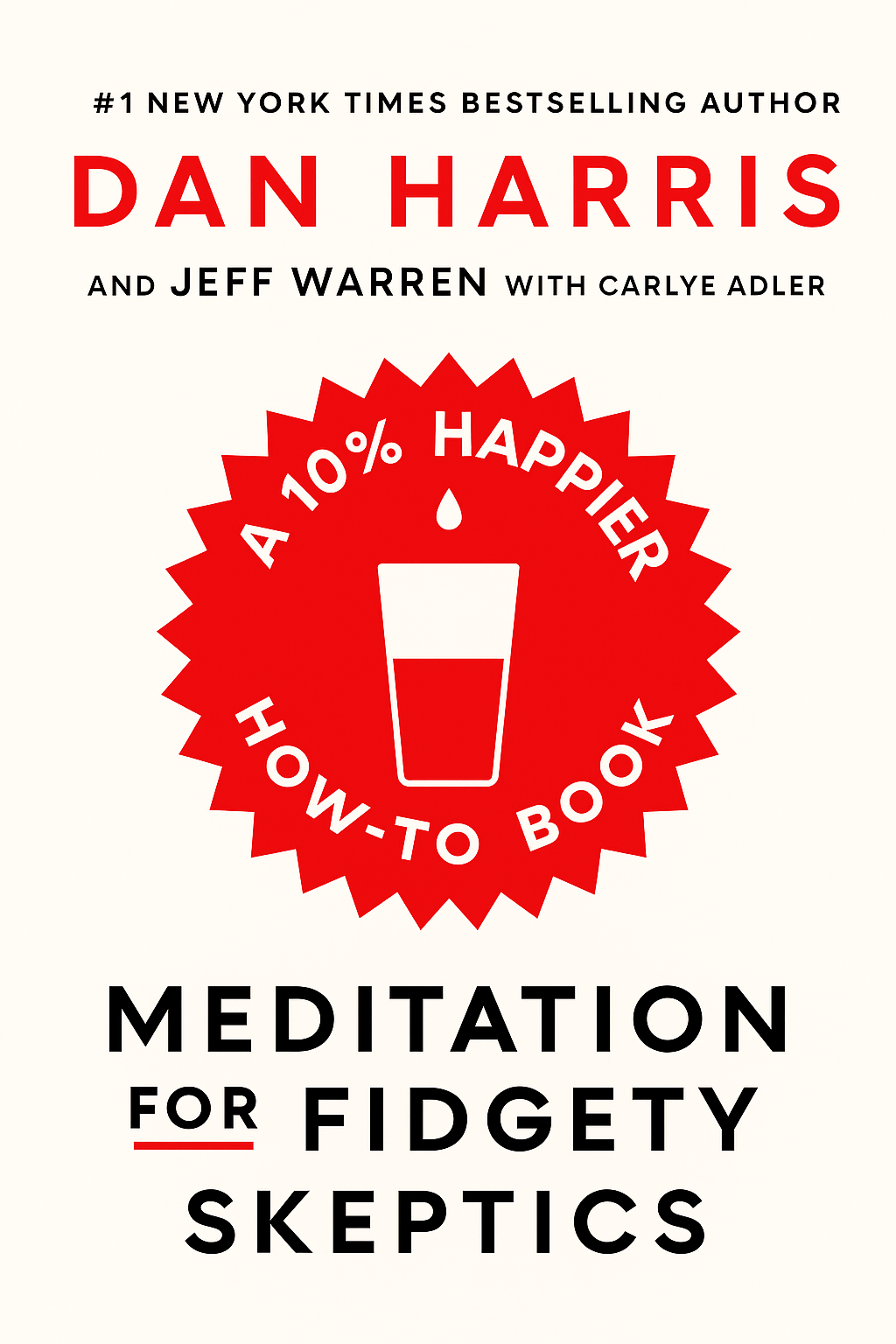
Meditation for Fidgety Skeptics
A 10% Happier How-To-Book
byDan Harris, Carlye Adler, Jeff Warren
Book Edition Details
Summary
In a realm where skeptics reign supreme, Dan Harris—an ABC News anchor with a penchant for sarcasm—finds himself on an unexpected odyssey into the mystifying world of meditation. Following a nerve-wracking on-air panic attack, Harris joins forces with Jeff Warren, a guru-like meditation maestro, to uncover why so many are drawn to meditation yet hesitate to practice it. Their journey is anything but typical, traversing the United States in a tour bus once occupied by Parliament Funkadelic, engaging with everyone from frazzled parents to high-stakes police officers. Together, they demystify the barriers to mindfulness with humor and insight, offering practical, science-backed strategies to soothe even the most restless minds. "Meditation for Fidgety Skeptics" is a hilarious, relatable guide for those who roll their eyes at "namaste" and crystal collections but secretly yearn for inner peace.
Introduction
Picture this: you're sitting in traffic, heart racing, jaw clenched, mentally rehearsing the argument you're about to have with your boss, while simultaneously planning dinner and worrying about your kid's math grades. Sound familiar? This is the modern human condition—a mind that never stops chattering, analyzing, and spinning elaborate stories about everything from our morning coffee to our mortality. What if there was a way to step back from this mental circus and find some peace without becoming a flower-crown-wearing, kale-smoothie-sipping stereotype? The ancient practice of meditation has undergone a fascinating transformation in recent decades, shedding its mystical robes and entering the laboratory. Neuroscientists have discovered that regular meditation literally rewires the brain, reducing activity in areas associated with stress while strengthening regions linked to attention and emotional regulation. This isn't about achieving some blissful state of eternal calm—it's about developing a healthier relationship with the voice in your head. Through this exploration, we'll uncover how mindfulness can enhance focus and productivity, how it might actually sharpen rather than dull your competitive edge, and why the simple act of noticing when your mind wanders might be the most radical thing you can do in our distraction-heavy world.
The Science Behind Meditation and Mental Training
Imagine your brain as a bustling city with millions of neural highways. For most of us, traffic flows along well-worn routes of worry, distraction, and reactive thinking. Meditation, it turns out, is like opening up new roads and installing better traffic management systems. When neuroscientists peer into the brains of experienced meditators using advanced imaging technology, they discover something remarkable: these brains look different. The science is both elegant and compelling. Studies show that just eight weeks of regular meditation practice can measurably shrink the amygdala—the brain's alarm system responsible for fight-or-flight responses—while simultaneously thickening the prefrontal cortex, the area associated with executive function and emotional regulation. It's as if meditation provides a volume knob for life's intensity, allowing you to turn down the chronic stress response that keeps so many of us wired and tired. But here's what makes this particularly fascinating: meditation doesn't just change how your brain looks; it fundamentally alters how you experience reality. The practice trains what researchers call "meta-cognitive awareness"—the ability to observe your own thinking process. Instead of being trapped inside your thoughts like a prisoner in a cell, you develop the capacity to step back and watch them unfold with curious detachment. This isn't about becoming emotionally numb or losing your edge. Professional athletes, Navy SEALs, and Fortune 500 executives are increasingly turning to meditation not to become passive, but to enhance performance. The research suggests that mindfulness meditation improves working memory, increases cognitive flexibility, and actually speeds up reaction times in high-pressure situations. It's mental training for the real world, as practical and evidence-based as any other form of self-improvement.
Overcoming Common Obstacles to Mindful Practice
The most persistent myth about meditation might also be the most destructive: the idea that you're supposed to empty your mind completely. This misconception has probably derailed more meditation careers than any other single factor. The truth is far more liberating and practical—meditation isn't about stopping thoughts, it's about changing your relationship with them. Think of it like sitting by a busy highway: you're not trying to stop the cars, you're just watching them pass by. When people say "I can't meditate because my mind is too busy," they're essentially saying "I can't exercise because I'm out of shape." The restless, chattering mind isn't a bug in the system—it's the very reason meditation exists. Every time you notice your attention has wandered and gently guide it back, you're not failing at meditation; you're succeeding. That moment of recognition is like doing a bicep curl for your awareness muscle. Time represents another major hurdle, but here's where the science offers encouraging news: you don't need to meditate for hours to see benefits. Research suggests that even one to three minutes of daily practice can begin to rewire neural pathways. The key is consistency over duration. It's better to meditate for two minutes every day than for thirty minutes once a week. This isn't about carving out huge chunks of time from your already overpacked schedule; it's about finding tiny pockets of possibility. The social aspect presents yet another challenge in our achievement-oriented culture. Many people worry about appearing weak or flaky if they admit to meditating. But consider this: some of the world's most successful and hard-driving individuals—from hedge fund managers to professional athletes—have discovered that mindfulness enhances rather than diminishes their competitive advantage. The practice isn't about becoming soft; it's about developing the mental clarity and emotional regulation that high performance actually requires.
Practical Techniques for Daily Mindfulness Integration
The beauty of mindfulness lies not in perfect execution but in endless opportunities for practice. Every moment of awareness—whether you're brushing your teeth, walking to your car, or sitting in a meeting—can become a meditation in disguise. The formal practice of sitting quietly with eyes closed is valuable, but it's just the training ground for the real game: bringing mindful awareness to ordinary life. Start with the breath, not because it's mystical, but because it's always available and naturally anchoring. You don't need special breathing techniques or complicated counts. Simply notice the sensation of air moving in and out of your body. When your mind inevitably wanders to grocery lists, work deadlines, or relationship dramas, gently escort your attention back to breathing. This isn't a failure to overcome; it's the fundamental exercise. Think of it as training your mental "muscle" of attention. But mindfulness extends far beyond formal breathing exercises. You can practice while walking by paying attention to the rhythm of your steps and the feeling of your feet touching the ground. During conversations, you can notice when your mind starts preparing rebuttals instead of truly listening. Even mundane activities like washing dishes become opportunities to observe the temperature of the water, the texture of soap bubbles, and the simple satisfaction of making something clean. The key is to approach these micro-meditations with what researchers call "beginner's mind"—a quality of fresh curiosity about experiences you might normally take for granted. This isn't about becoming perpetually serene or losing your ability to think critically and plan ahead. Instead, it's about developing the skill to choose where you place your attention rather than being perpetually hijacked by whatever thoughts and emotions happen to arise.
Building Sustainable Habits for Long-term Benefits
The meditation graveyard is littered with ambitious New Year's resolutions and well-intentioned apps downloaded but never used. Building a sustainable practice requires understanding the psychology of habit formation and working with, rather than against, human nature. The most crucial insight from behavioral science is this: motivation is unreliable, but systems are powerful. Instead of relying on willpower to meditate, create conditions that make it almost inevitable. Start ridiculously small. If five minutes feels daunting, try one minute. If one minute seems impossible, try three conscious breaths. The goal isn't to meditate perfectly; it's to establish the neural pathway of remembering to practice. Once the habit is anchored, you can gradually expand the duration. Many successful meditators report that they often find themselves continuing past their minimum commitment simply because they're already settled and present. Attachment is another crucial element. Link your meditation practice to an existing habit rather than trying to create an entirely new routine from scratch. Perhaps you meditate immediately after your morning coffee, or you take three mindful breaths before checking your phone, or you practice for a minute before going to sleep. The established habit becomes a natural cue for mindfulness. Expect setbacks and plan for them. Life will inevitably interfere with your practice—illness, travel, family crises, or simply forgetting. The measure of a sustainable practice isn't perfect consistency; it's the ability to return without self-judgment. Think of meditation like exercise: missing a day doesn't erase previous benefits, and you can always start again. The practice teaches you something profound about resilience: every moment offers a fresh opportunity to begin again, both on the cushion and in life itself.
Summary
At its core, this exploration reveals that meditation is not about transcending the human experience but about inhabiting it more fully and skillfully. The most transformative insight isn't that we can eliminate the voice in our head, but that we can develop a healthier relationship with it—treating our thoughts and emotions as temporary weather patterns rather than absolute truths that must be believed and acted upon. This shift from being trapped inside our mental chatter to observing it with friendly curiosity might seem subtle, but its implications are profound: greater resilience in the face of stress, enhanced focus in an age of distraction, and the radical possibility of responding rather than merely reacting to life's inevitable challenges. The science demonstrates that mindfulness meditation is neither mystical nor mysterious—it's a trainable skill backed by decades of rigorous research. Yet questions remain that invite deeper exploration: How might widespread adoption of contemplative practices reshape our institutions, relationships, and approach to societal challenges? Can the simple act of paying attention become a form of social transformation, creating more compassionate and clear-thinking communities? For readers drawn to evidence-based approaches to human flourishing, this field represents a fascinating intersection of ancient wisdom and cutting-edge neuroscience, offering practical tools for navigating an increasingly complex world with greater wisdom and less suffering.
Related Books
Download PDF & EPUB
To save this Black List summary for later, download the free PDF and EPUB. You can print it out, or read offline at your convenience.
By Dan Harris
