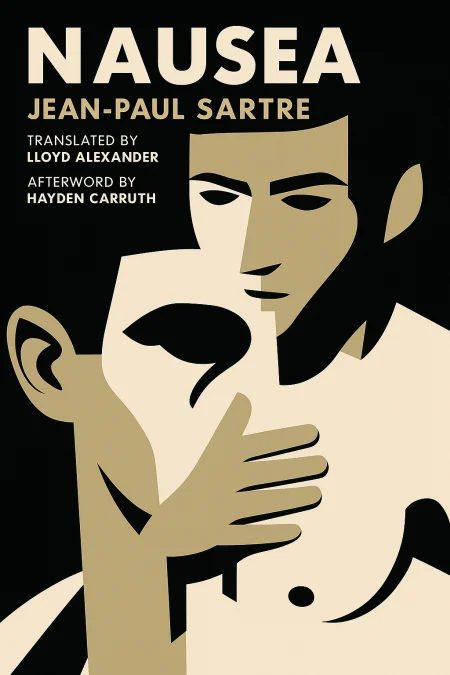
Nausea
Explore and Question the Very Essence of Existence
byJean-Paul Sartre, Lloyd Alexander, Hayden Carruth
Book Edition Details
Summary
Antoine Roquentin's world unravels like a surreal tapestry of existential dread, where the mundane seaport town is but a backdrop to his inner turmoil. Chronicling his relentless introspection in a personal diary, he confronts a haunting malaise that clings to his consciousness, an insidious nausea that permeates his very being. In this philosophical odyssey, Roquentin wrestles with the futility of existence and the quest for meaning, embodying the essence of Sartre's existentialism. With each entry, his battle against despair becomes a poignant reflection on freedom and alienation. Sartre's "Nausea" is not just a novel; it's a visceral exploration of human consciousness, a compelling invitation to ponder life's profound questions.
Introduction
Through the philosophical lens of phenomenology, this existential novel dissects the fundamental nature of human consciousness and its encounter with raw existence. The narrative serves as a laboratory for examining how consciousness experiences the world when stripped of familiar meanings and social constructs. Rather than offering comfort through traditional philosophical systems, the work confronts readers with the disturbing reality of existence as contingent, absurd, and fundamentally without predetermined purpose. The exploration reveals how human beings typically mask the anxiety of existence through projects, relationships, and social roles, yet ultimately must face the naked fact of being itself. This phenomenological investigation demonstrates how authentic self-awareness emerges only when one abandons the illusion that existence has inherent meaning or necessity. The rigorous analysis of consciousness forces readers to examine their own relationship with existence, questioning whether they live authentically or hide behind the safety of predetermined roles and values.
The Phenomenology of Existence: From Historical Research to Existential Discovery
The protagonist's initial scholarly pursuit of historical research serves as a metaphor for humanity's broader attempt to find meaning through intellectual projects and systematic understanding. His dedication to reconstructing the life of an eighteenth-century nobleman represents the human tendency to seek significance through connection with the past and through the illusion of objective knowledge. Yet this scholarly work gradually reveals its limitations as the historical figure becomes increasingly elusive and insubstantial. The breakdown of the historical project illuminates a crucial philosophical point: meaning cannot be discovered through external research or inherited from tradition. The past, rather than providing solid ground for understanding, dissolves under scrutiny into fragments and contradictions. Historical facts, seemingly objective and permanent, prove to be constructions that exist only through present consciousness. This dissolution forces a confrontation with immediate experience rather than mediated knowledge. The failure of scholarship becomes the gateway to direct phenomenological investigation. When the comfort of intellectual distance collapses, consciousness must face what is immediately present rather than what can be studied, categorized, or explained through historical narrative. The transition from historical research to existential awareness demonstrates how authentic philosophical inquiry emerges not from academic study but from the collapse of familiar interpretive frameworks that typically shield consciousness from direct encounter with existence.
Contingency and Absurdity: The Dissolution of Essence and Meaning
The philosophical breakthrough centers on recognizing the radical contingency of existence—the fact that things simply are, without necessity, purpose, or inherent justification. This revelation destroys the comfortable assumption that objects and experiences possess essential qualities that explain their presence in the world. Instead, existence appears as pure facticity, neither necessary nor impossible, but simply there without reason. Traditional categories of understanding—beauty, utility, significance—prove inadequate when confronted with the stark reality of things as they are. Objects lose their familiar identities and reveal themselves as excessive, overflowing the boundaries of human conceptual frameworks. A tree root becomes not a functional part of a living system but a manifestation of raw being that resists all attempts at categorization. The concept of absurdity emerges not as meaninglessness but as the collision between human need for rational explanation and the world's fundamental silence about its own existence. This absurdity is not a problem to be solved but the basic condition of existence that must be acknowledged. The world offers no inherent responses to human questioning about purpose or meaning. Recognition of contingency liberates consciousness from the false comfort of believing that existence follows necessary patterns or serves predetermined purposes. This liberation, while initially disturbing, clears the ground for authentic relationship with existence as it actually is rather than as human concepts would prefer it to be.
The Nausea as Revelation: Consciousness Confronting Pure Being
The physical sensation of nausea functions as the phenomenological marker of consciousness encountering existence without the mediation of familiar interpretive structures. This bodily response signals the breakdown of the normal barriers that separate consciousness from immediate experience of being. Rather than indicating illness or psychological disturbance, nausea reveals the authentic relationship between consciousness and existence. The revelation occurs when objects lose their comfortable opacity and reveal themselves as manifestations of pure existence. Familiar things become strange not because they have changed but because consciousness perceives them without the usual filters of utility, beauty, or significance. This unmediated perception exposes the contingent nature of all existence, including the existence of consciousness itself. The experience demonstrates that consciousness and world are not separate entities but are fundamentally interrelated. Consciousness exists as consciousness-of-something, while things appear as phenomena-for-consciousness. This recognition dissolves the traditional subject-object distinction that typically structures human experience and philosophical thinking. Through nausea, consciousness discovers its own contingency and freedom. Without predetermined essence or necessary nature, consciousness must create its own relationship with existence. This responsibility cannot be avoided through appeal to external authorities, natural laws, or inherited traditions. The confrontation with pure being reveals both the groundlessness and the radical freedom of human existence.
From Despair to Creation: Art as Response to Existential Absurdity
The recognition of art's unique capacity to transcend the contingency of ordinary existence offers a potential response to existential absurdity without denying its reality. Musical and literary creation demonstrates how consciousness can transform the raw material of existence into forms that possess internal necessity and coherence. Unlike historical research or philosophical system-building, artistic creation does not attempt to discover predetermined meaning but generates meaning through the creative act itself. The jazz melody represents a form of existence that justifies itself through its own internal logic rather than through reference to external purposes or explanations. This self-justifying quality suggests a model for human existence that acknowledges contingency while creating significance through committed action. The artist transforms personal experience of absurdity into work that possesses necessity within its own aesthetic framework. Creative work offers the possibility of retrospective justification for existence without requiring the discovery of predetermined purpose. The act of creation can potentially redeem the creator's past experience by incorporating it into meaningful form. This redemption occurs not through denial of contingency but through transformation of contingent experience into necessary artistic structure. The artistic response to absurdity demonstrates how human freedom can be exercised authentically. Rather than fleeing from the anxiety of existence or pretending that external authorities provide meaning, creative consciousness accepts responsibility for generating significance through its own committed projects. This represents not escape from existential reality but full engagement with the conditions of human existence.
Summary
The philosophical investigation reveals that authentic human existence requires abandoning the illusion that life possesses inherent meaning while simultaneously accepting responsibility for creating meaning through conscious choice and committed action. This paradoxical condition—groundless freedom coupled with unavoidable responsibility—defines the existential situation that consciousness must navigate without recourse to external guarantees or predetermined essences. The rigorous analysis of consciousness and its encounter with existence demonstrates that while human beings cannot discover absolute meaning, they can create relative meaning through authentic engagement with their existential situation, particularly through creative projects that transform contingent experience into forms possessing internal necessity and coherence.
Related Books
Download PDF & EPUB
To save this Black List summary for later, download the free PDF and EPUB. You can print it out, or read offline at your convenience.
By Jean-Paul Sartre
