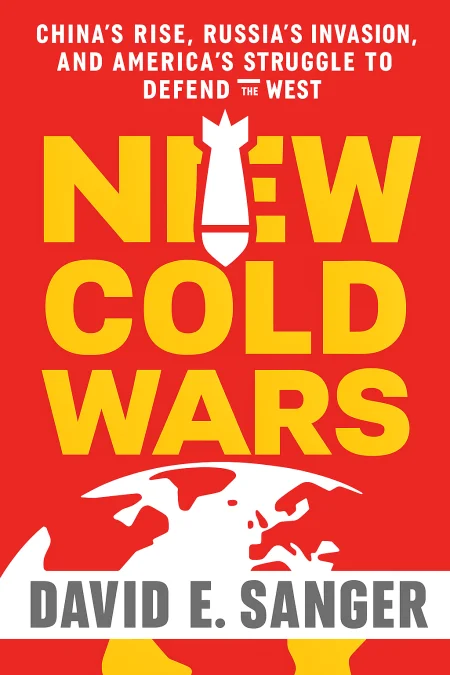
New Cold Wars
China's Rise, Russia's Invasion, and America's Struggle to Defend the West
Book Edition Details
Summary
In the high-stakes theater of modern geopolitics, "New Cold Wars" by Pulitzer Prize-winning journalist David E. Sanger paints a vivid portrait of America's fraught duel with formidable foes—Xi Jinping's China and Vladimir Putin's Russia. This gripping narrative unravels the intricate dance of diplomacy and power plays shaping our global landscape. With an eye for the dramatic and a journalist's knack for detail, Sanger leads readers through the labyrinthine corridors of the White House, the clandestine realms of intelligence agencies, and the tech titans at the heart of this struggle. The narrative pulses with urgency, confronting the reader with questions that could redefine the world: Will Putin's blunders spell doom, or will nuclear threats loom larger? Can America counteract China's technological rise, or will Taiwan become the flashpoint of conflict? As nations choose sides in this precarious balance, Sanger delivers an unforgettable chronicle of a new era of superpower rivalry.
Introduction
In the predawn darkness of February 24, 2022, as Russian missiles streaked across Ukrainian skies, the world witnessed the violent collapse of an era that had defined international relations for three decades. The post-Cold War dream of perpetual peace and democratic expansion died in the rubble of bombed Ukrainian cities, replaced by a harsh new reality that few American policymakers had prepared for. This moment crystallized a transformation that had been building for years, rooted in fundamental miscalculations about the nature of power, the durability of authoritarianism, and the limits of economic integration as a force for political change. This sweeping examination reveals how America's confident assumptions about the inevitable triumph of liberal democracy gave way to the emergence of simultaneous strategic competitions with both China and Russia. Through the lens of three critical decades, we witness the gradual erosion of post-Cold War optimism, the chaotic disruption of traditional engagement strategies, and the ultimate recognition that great power rivalry had returned with a vengeance. The narrative exposes how democratic leaders consistently underestimated authoritarian ambitions while overestimating the transformative power of trade and diplomacy. For policymakers grappling with an increasingly dangerous world, business leaders navigating economic decoupling, and citizens seeking to understand how we arrived at this precarious moment, this account provides essential insights into the forces reshaping global order. It illuminates the human decisions, technological innovations, and strategic miscalculations that transformed former partners into existential rivals, offering crucial lessons for navigating the treacherous waters of twenty-first century great power competition.
Post-Cold War Optimism and Strategic Miscalculations (1990s-2016)
The euphoria of Cold War victory created a dangerous complacency that would haunt American foreign policy for decades. As the Berlin Wall crumbled and the Soviet Union dissolved, policymakers embraced Francis Fukuyama's bold declaration about "the end of history," believing that liberal democracy and free markets had triumphed permanently over authoritarianism. This wasn't merely academic theorizing but became the foundation of engagement strategies with both Russia and China, based on the seductive assumption that economic integration would inevitably lead to political liberalization. The early signs seemed to validate this optimism. Vladimir Putin initially appeared eager to integrate with the West, hosting George W. Bush on a luxury yacht and speaking of partnership in the war on terror. China's leaders embraced market economics with unprecedented enthusiasm, joining the World Trade Organization in 2001 amid predictions that prosperity would bring freedom. American businesses celebrated these developments, convinced they were witnessing the birth of a more stable and prosperous world order built on shared economic interests. Yet beneath this surface cooperation, fundamental tensions were building that would eventually shatter these illusions. Putin's 2007 Munich Security Conference speech marked a turning point, as he openly challenged American "hyperpower" and warned against NATO expansion. His invasion of Georgia in 2008 revealed the hollowness of Western deterrence, while the annexation of Crimea in 2014 demonstrated that territorial conquest was far from obsolete. Meanwhile, Xi Jinping's rise to power coincided with China's increasingly assertive behavior in the South China Sea and systematic theft of Western technology through cyber espionage. The tragedy of this period lies not in the failure to predict authoritarian backsliding, but in the persistent refusal to adapt when the evidence became overwhelming. Obama's "reset" with Russia and continued engagement with China reflected a bipartisan faith that economic incentives would ultimately triumph over nationalist ambitions. This strategic patience provided both Putin and Xi with crucial time to consolidate power, modernize their militaries, and develop asymmetric capabilities that would later challenge American dominance. The post-Cold War dream was ending, but few in Washington were ready to wake up.
Trump's Disruption and the End of Engagement (2017-2021)
Donald Trump's presidency marked a jarring departure from decades of engagement orthodoxy, though not always in coherent ways. His administration deserves credit for finally recognizing China as a comprehensive strategic competitor, with officials developing sophisticated analyses of Beijing's long-term plans to displace American power. The 2017 National Security Strategy explicitly declared that "great power competition" had returned, marking the end of the post-9/11 focus on counterterrorism and the beginning of a more realistic assessment of authoritarian ambitions. Trump's approach to China combined genuine strategic insights with personal obsessions and contradictory impulses. His trade war imposed real costs on Beijing and his administration began restricting Chinese access to critical technologies, recognizing that economic competition had become inseparable from national security. Yet Trump himself remained fixated on trade deficits and bilateral deals, often undermining his own policies by publicly offering to drop charges against Huawei's CFO if it helped secure trade agreements or praising Xi Jinping's handling of Hong Kong protests to avoid jeopardizing negotiations. The administration's Russia policy proved even more schizophrenic. While Trump's advisors imposed more sanctions on Russia than Obama had and provided lethal weapons to Ukraine, the president himself consistently refused to criticize Putin directly. His 2018 Helsinki summit, where he sided with Putin over his own intelligence agencies regarding election interference, epitomized this contradiction. The Ukraine scandal that led to Trump's first impeachment revealed how personal interests could override strategic considerations, as he withheld military aid to pressure Zelensky into investigating political rivals. Despite these contradictions, Trump's team laid important groundwork for the more systematic approach that would follow. Export controls on semiconductors, efforts to bring chip manufacturing back to America, and initiatives to reduce dependence on Chinese supply chains all prefigured Biden's later policies. The tragedy was that Trump's erratic behavior and assault on democratic norms provided authoritarian rivals with powerful propaganda tools while preventing these initiatives from achieving their full potential. America was finally awakening to the challenge, but the messenger was deeply flawed.
Biden's Competition Framework and Ukraine Crisis (2021-2024)
Joe Biden entered office determined to restore American credibility and competence, but he inherited a world where the luxury of gradual policy adjustments had vanished. The SolarWinds cyberattack, discovered during the transition, provided an immediate reminder that Putin wasn't waiting for the new administration to settle in. Biden's team quickly abandoned the engagement paradigm that had defined Democratic foreign policy for decades, embracing what they called "strategic competition" with both China and Russia while seeking to establish guardrails to prevent conflict. The shift was most dramatic regarding China, as Biden's administration expanded Trump's technology restrictions and launched massive domestic investment programs in semiconductors and other critical industries. The March 2021 meeting with Chinese officials in Anchorage set the tone, with both sides abandoning diplomatic niceties for public confrontation. The message was clear: America would compete across all domains while building coalitions to constrain Chinese ambitions. The CHIPS Act and other industrial policies marked a fundamental departure from free-market orthodoxy, recognizing that economic and national security had become inseparable. With Russia, Biden initially sought to establish clear boundaries, meeting Putin in Geneva in June 2021 to address ransomware attacks and other cyber threats. The president handed Putin a list of critical infrastructure sectors that were off-limits, warning of severe consequences for future attacks. But Putin was already planning something far more ambitious than digital disruption, as intelligence flowing into the White House revealed the scope of his ambitions for Ukraine. The war that erupted on February 24, 2022, exposed both the limits and potential of American power in the new era. Biden's response combined unprecedented intelligence sharing with allies, massive military aid to Ukraine, and the most severe economic sanctions ever imposed on a major power. The administration's decision to publicly reveal Putin's invasion plans marked a revolutionary approach to information warfare, using transparency as a weapon against authoritarian deception. Yet the conflict also revealed the dangers of great power competition in a nuclear age, requiring careful calibration to help Ukraine defend itself while avoiding direct confrontation with Russia that could lead to catastrophic escalation.
Summary
The central tragedy of the post-Cold War era lies in a fundamental misreading of authoritarian psychology and ambition that persisted across multiple administrations and both political parties. American leaders convinced themselves that economic integration would inevitably lead to political liberalization, that Putin and Xi would prioritize prosperity over power, and that the liberal international order was so attractive that rivals would eventually join rather than challenge it. This wasn't mere naivety but reflected deeper assumptions about human nature and historical progress that proved dangerously wrong when confronted with leaders who viewed politics as zero-sum competition for civilizational dominance. The return of great power competition demands a more realistic assessment of authoritarian motivations and capabilities, recognizing that Putin's imperial ambitions and Xi's determination to displace American leadership represent core elements of how these leaders understand their historical missions. This reality doesn't mean abandoning diplomacy or embracing inevitable conflict, but it does require strategies based on strength and deterrence rather than wishful thinking about convergence through economic interdependence. Three crucial lessons emerge for navigating this new era of sustained competition. First, deterrence requires credibility backed by capability, as authoritarian leaders respect demonstrated power more than diplomatic promises or economic incentives. Second, alliance systems remain America's greatest strategic advantage, but they require constant tending and genuine partnership rather than unilateral demands or expectations of automatic support. Third, domestic renewal is inseparable from international competition, as a country that cannot govern itself effectively, maintain technological leadership, or inspire its own citizens cannot hope to lead others in the struggle between democratic and authoritarian visions of world order.
Related Books
Download PDF & EPUB
To save this Black List summary for later, download the free PDF and EPUB. You can print it out, or read offline at your convenience.
By David E. Sanger
