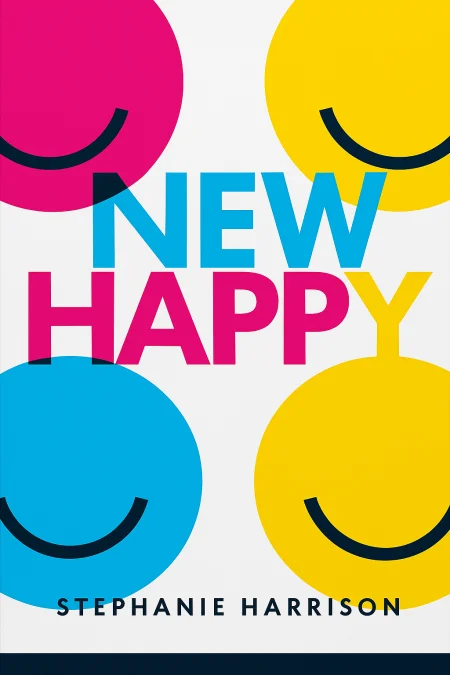
New Happy
Getting Happiness Right in a World That's Got It Wrong
Book Edition Details
Summary
In a world where happiness feels perpetually elusive, Stephanie Harrison flips the script with "New Happy." This groundbreaking guide disrupts the chase for fame and fortune, revealing a more profound truth: genuine joy springs from embracing your innate gifts and using them to uplift others. Drawing from a decade of rigorous research and adorned with captivating artwork, Harrison dismantles society's false promises and illuminates a transformative path to fulfillment. Whether you're at a crossroads or simply seeking more daily joy, this book invites you to redefine success and discover happiness in unexpected places. Redefine your journey and let "New Happy" be your compass to a life of meaning and connection.
Introduction
Modern society has constructed an elaborate mythology around happiness, one that promises fulfillment through achievement, perfection, and material accumulation. Yet despite unprecedented prosperity and opportunity, rates of depression, anxiety, and existential emptiness continue to climb. This paradox reveals a fundamental flaw in our understanding of what creates genuine human flourishing. The conventional wisdom suggests that happiness flows from external validation, competitive success, and individual accomplishment. However, this framework consistently fails to deliver the lasting satisfaction it promises, leaving millions trapped in cycles of striving that generate more suffering than joy. The core thesis challenges this dominant paradigm by proposing that authentic happiness emerges through a radically different pathway: the discovery and expression of one's unique gifts in service to others. This perspective synthesizes insights from positive psychology, neuroscience, philosophy, and cross-cultural wisdom traditions to construct a comprehensive alternative framework. Rather than viewing happiness as something to be acquired or achieved, this approach positions it as something to be expressed and shared. The methodology combines rigorous academic research with practical applications, offering both theoretical depth and actionable guidance for personal transformation.
The Fundamental Problem: How Old Happy Culture Creates Misery
Contemporary culture propagates three interconnected lies that systematically undermine human wellbeing. The first deception insists that individuals are fundamentally lacking, requiring constant improvement and perfectionism to achieve worthiness. This narrative creates an internal critic that judges every action against impossible standards, generating persistent feelings of inadequacy regardless of actual accomplishments. The relentless pursuit of an idealized self becomes a prison that prevents genuine self-acceptance and authentic expression. The second falsehood promises that happiness awaits at the completion of specific external goals. This "happiness-when" mentality transforms life into an endless deferral system where satisfaction always lies just beyond the next achievement, promotion, or acquisition. The psychological mechanism operates like a mirage, appearing real from a distance but dissolving upon approach. Research consistently demonstrates that extrinsic goals provide minimal lasting satisfaction while intrinsic motivations generate sustained wellbeing. The third lie perpetuates the illusion of fundamental separation between individuals. This worldview portrays human existence as a zero-sum competition where others' success diminishes one's own opportunities for happiness. Such thinking eliminates the possibility of genuine collaboration and mutual support, creating artificial scarcity in domains where abundance naturally exists. The separation myth directly contradicts both scientific evidence about human interdependence and the lived experience of meaningful relationships. These cultural messages combine to create what can be understood as systematic misdirection, channeling natural human desires for growth, accomplishment, and connection into pathways that cannot satisfy those very needs. The result is widespread psychological suffering disguised as normal adult life.
The Core Argument: True Happiness Comes from Using Gifts to Help Others
Genuine happiness emerges through the intersection of authentic self-expression and service to others. Every individual possesses three categories of gifts that reflect their unique contribution to the human community. Humanity gifts represent the capacity to extend love, compassion, and kindness to others through everyday interactions and relationships. These expressions of care create immediate positive feedback loops that benefit both giver and receiver while strengthening social bonds essential for psychological wellbeing. Talent gifts encompass the skills, abilities, and creative capacities that individuals develop through engagement with their natural interests and aptitudes. Unlike the external validation system promoted by conventional success culture, authentic talent development occurs through intrinsic motivation and flow states that generate energy rather than depleting it. When talents align with personal values and contribute meaningfully to others' lives, they become sources of sustainable satisfaction and continued growth. Wisdom gifts emerge from life experiences, both positive and challenging, that generate insights capable of helping others navigate similar circumstances. Personal struggles transform from mere suffering into sources of meaning when individuals recognize their potential to guide and support others facing comparable difficulties. This transformation represents a fundamental shift in perspective that converts pain into purpose through service. The integration of all three gift categories creates a unique constellation of contributions that no other individual can replicate. This irreplaceable combination provides both the foundation for authentic self-worth and the pathway for maximum positive impact. The simultaneous fulfillment of personal growth needs and service to others resolves the false dichotomy between self-care and altruism that paralyzes many well-intentioned individuals.
Supporting Evidence: The Science of Connection, Purpose, and Human Nature
Neuroscientific research reveals that human brains are fundamentally designed for connection and cooperation rather than competition and isolation. Mirror neurons create automatic empathetic responses that generate shared emotional experiences between individuals. The vagus nerve system activates during moments of compassion and care, producing measurable improvements in cardiovascular health, immune function, and stress resilience. These biological mechanisms demonstrate that helping behaviors literally improve physical wellbeing while generating positive emotional states. Longitudinal studies tracking happiness across decades consistently identify relationship quality and community contribution as the strongest predictors of life satisfaction. The Harvard Study of Adult Development, following participants for over eighty years, confirms that social connections matter more than wealth, fame, or individual achievements for sustained wellbeing. Additional research documents the "helper's high" phenomenon, wherein acts of service trigger neurochemical responses similar to those produced by exercise, meditation, and other recognized wellness practices. Cross-cultural analysis reveals that societies emphasizing interdependence and collective wellbeing demonstrate higher levels of individual happiness compared to cultures prioritizing competitive individualism. Traditional wisdom traditions across diverse geographical and historical contexts consistently identify self-transcendent purpose as essential for human fulfillment. This convergence of ancient insight and modern research provides robust support for service-oriented approaches to happiness. The evidence extends to workplace satisfaction, educational outcomes, and community resilience. Organizations that enable employees to contribute their unique strengths while serving meaningful purposes report higher engagement, creativity, and retention rates. Educational programs incorporating service learning demonstrate improved academic performance alongside increased student motivation and social awareness. Communities with strong social capital recover more quickly from disasters and maintain higher collective wellbeing during challenging periods.
Practical Implementation: Transforming Work, Community, and Global Impact
Professional life offers immediate opportunities for gift-based service through job crafting techniques that reshape existing roles to better utilize individual strengths and serve others' needs. Rather than waiting for perfect career alignment, individuals can identify ways to express their humanity, talent, and wisdom gifts within current positions. This might involve mentoring colleagues, improving processes that benefit customers, or volunteering for projects that address meaningful challenges. Community engagement provides another avenue for gift expression through local problem-solving and relationship building. Effective community service begins with identifying where happiness is being thwarted in one's immediate environment, whether through food insecurity, social isolation, environmental degradation, or lack of opportunity. Sustainable contribution occurs when individuals match their unique capabilities with genuine community needs, creating mutually beneficial relationships rather than one-sided charity models. Global impact emerges naturally from the accumulation of local contributions and the recognition that individual wellbeing depends upon collective flourishing. Rather than grandiose schemes to save the world, effective global service typically involves scaling successful local solutions or addressing worldwide challenges through specialized expertise. The key insight recognizes that personal happiness and global wellbeing are not competing priorities but complementary objectives achieved through the same fundamental process. Implementation requires patience and experimentation as individuals discover their unique gift combinations and optimal expression methods. The process involves continuous refinement rather than one-time career or lifestyle changes. Success indicators include increased energy, deeper relationships, sense of meaningful contribution, and sustainable motivation that persists through inevitable challenges and setbacks.
Summary
The revolutionary insight transforms happiness from a scarce resource to be hoarded into an abundant experience to be shared. When individuals discover and express their authentic gifts in service to others, they simultaneously fulfill their deepest personal needs while contributing to collective flourishing. This approach dissolves the false choice between self-interest and altruism by demonstrating their fundamental unity. The practical pathway involves identifying one's unique combination of humanity, talent, and wisdom gifts, then finding opportunities to express these capabilities in ways that genuinely help others. Research across multiple disciplines confirms that this service-oriented approach generates more sustainable satisfaction than conventional success strategies while creating positive ripple effects throughout communities and organizations. The implications extend beyond individual wellbeing to suggest new possibilities for addressing collective challenges through the coordinated expression of human gifts in service to shared flourishing.
Related Books
Download PDF & EPUB
To save this Black List summary for later, download the free PDF and EPUB. You can print it out, or read offline at your convenience.
By Stephanie Harrison
