
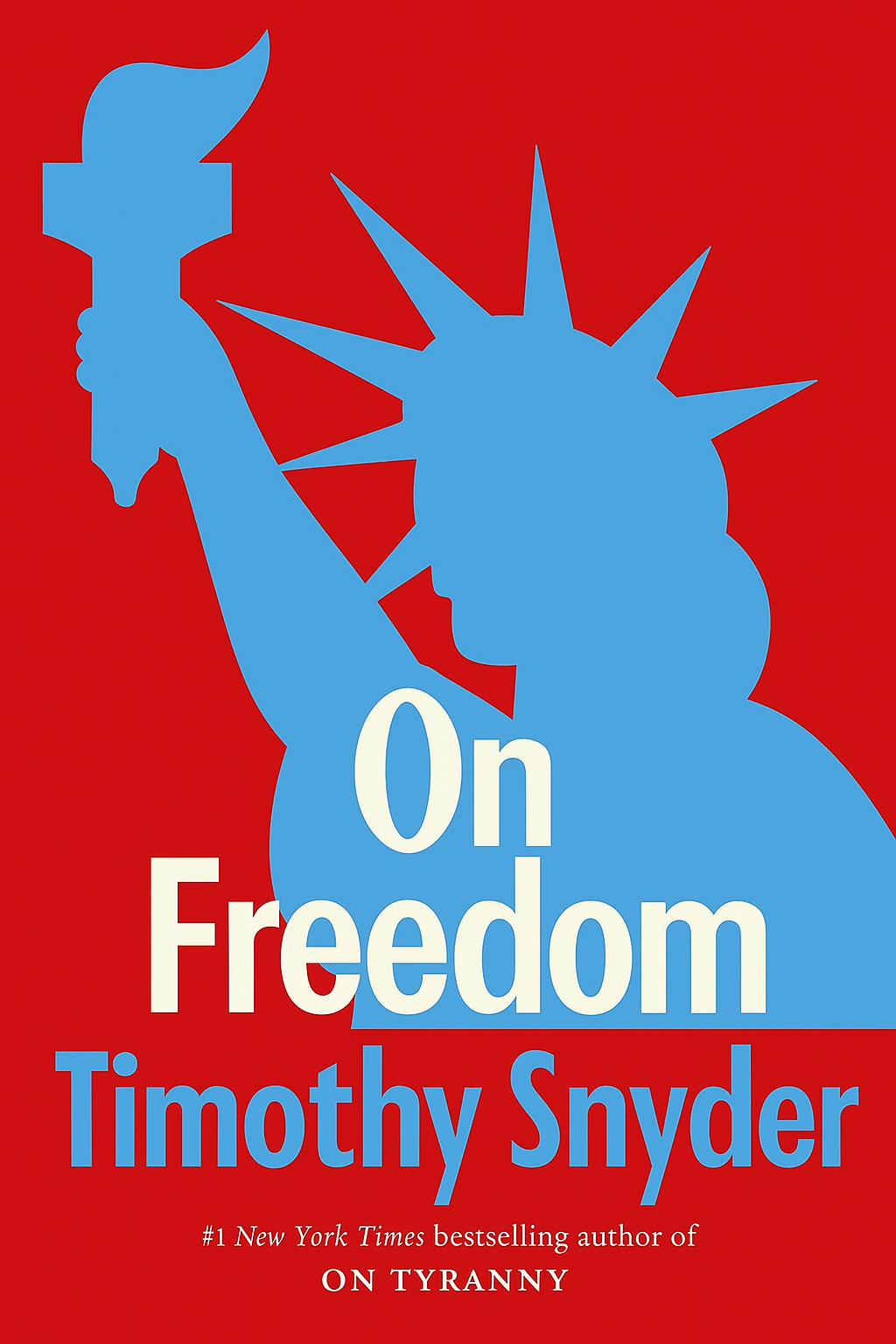
On Freedom
Explore Freedom’s Deeper Meaning Beyond Resistance and Control
Book Edition Details
Summary
In the turbulent tides of history and philosophy, Timothy Snyder crafts a riveting manifesto on freedom—unpacking its essence, its misconceptions, and its pivotal role in our survival. In "On Freedom," Snyder, renowned for his incisive insights into political upheavals, invites readers to reevaluate the cherished ideal of liberty. This book challenges the simplistic notion of freedom as mere independence from authority, proposing instead a dynamic vision of freedom as the power to choose, to build, and to thrive collectively. Through conversations with philosophers and contemporary thinkers, Snyder illuminates how true freedom fosters innovation and unity, bridging the ideological chasms of today. This work isn't just a call to action; it's a blueprint for crafting a future where generosity and grace reign. A must-read for those who dare to imagine a world where freedom is not just preserved but truly realized.
Introduction
Contemporary political discourse has reduced freedom to a hollow concept—merely the absence of constraints—leaving citizens adrift despite living in societies that proclaim themselves bastions of liberty. This fundamental misunderstanding creates a paradox where formal rights coexist with practical powerlessness, where technological advancement coincides with unprecedented manipulation of human behavior, and where market freedoms flourish alongside the systematic erosion of genuine agency. The challenge lies not in defending freedom against external enemies but in reconstructing what freedom actually means in the modern world. The framework presented here advances four interconnected forms of positive liberty that reveal freedom as an active, creative force requiring deliberate construction through collective effort. Drawing from phenomenological analysis, historical examination, and contemporary observations, this approach demonstrates how sovereignty, unpredictability, mobility, and factuality work together to create conditions for authentic human flourishing. Each form builds upon the others, creating a comprehensive vision that transcends the false choice between individual autonomy and collective security. The analysis proceeds through systematic examination of how these capacities develop, how they function in practice, and why their absence creates vulnerability to authoritarianism and exploitation.
The Four Pillars: Sovereignty, Unpredictability, Mobility, and Factuality
Sovereignty represents the foundational capacity for self-governance that emerges not from isolation but through recognition of others as fellow embodied beings sharing similar existential challenges. This form of freedom develops through childhood and youth as individuals learn to navigate between physical necessity and the realm of values, requiring substantial support from parents, teachers, and communities who provide the time, attention, and resources necessary for developing judgment and choice. The myth of self-made individuals obscures this fundamental dependence, creating false understanding that undermines the very conditions making freedom possible. Unpredictability emerges when sovereign individuals exercise their capacity for choice in ways that resist external control and manipulation. Drawing from experiences of Eastern European dissidents under communist rule, this form reveals how authentic freedom involves courage to act according to values even when such action appears risky or unconventional. The power of the powerless lies precisely in this unpredictability—the refusal to conform to probable behavioral patterns that authoritarian systems depend upon. Digital technologies pose particular threats to this dimension through algorithmic manipulation that transforms users from agents capable of surprising action into predictable consumers whose responses can be anticipated and directed. Mobility encompasses both physical movement through space and social movement through time and opportunity, requiring infrastructure, institutions, and policies that enable individuals to pursue chosen paths without being trapped by circumstances of birth or accidents of geography. True mobility demands more than formal rights; it requires material conditions that make movement possible. The American experience demonstrates how imperial expansion once provided mobility for some, but how transition to social mobility through education, healthcare, and economic opportunity offers more sustainable and inclusive models of freedom. Factuality grounds human agency in accurate understanding of the world as it actually exists, recognizing that without reliable knowledge of physical, social, and political reality, individuals cannot make meaningful choices or effectively pursue their values. The contemporary crisis of truth—manifested in conspiracy theories, propaganda, and deliberate misinformation—directly undermines human freedom by severing connections between intention and outcome. This form requires institutions and practices supporting careful observation, rigorous analysis, and honest communication about difficult truths, including educational systems, journalism, scientific research, and democratic deliberation that maintain shared factual foundations making collective freedom possible.
Against Negative Liberty: Why Market Freedom Fails Human Flourishing
The dominant conception of freedom as negative—defined primarily as absence of government interference—fundamentally misunderstands what freedom requires and how it functions in human life. This negative conception treats freedom as a natural state emerging automatically when barriers are removed, rather than as an achievement requiring active construction and maintenance through conscious effort and institutional design. The inadequacy becomes apparent when examining concrete examples of human development and social change, where children do not become free simply by being left alone but require years of careful attention, education, and support to develop capacities necessary for autonomous choice. Market fundamentalism represents a particularly problematic manifestation of negative liberty, conflating means of exchange with ends of human flourishing. Markets serve as useful coordination tools but cannot generate the forms of freedom that make life meaningful and dignified. The reduction of freedom to consumer choice obscures ways that market mechanisms systematically undermine conditions necessary for genuine liberty through concentration of economic power, commodification of essential human needs, and subordination of all values to profit maximization metrics. The digital economy exemplifies these dynamics in stark form, where technology companies create surveillance systems monitoring and manipulating human behavior on unprecedented scales while using market mechanisms to justify erosion of privacy and autonomy. Algorithmic decision-making systems encode existing biases while creating new forms of discrimination, with concentration of digital power in few corporations representing threats to freedom that cannot be addressed through market competition alone. The supposed efficiency masks systematic destruction of the unpredictability essential for human agency. Historical periods of greatest expansion in human freedom coincided with active efforts to build enabling institutions rather than simply removing constraining ones. Creation of public education systems, healthcare programs, labor protections, and civil rights legislation all represent positive constructions of freedom that expanded practical capacity of ordinary people to shape their own lives and communities. Contemporary challenges such as climate change, technological disruption, and global inequality require collective responses impossible within frameworks of purely negative freedom, demanding coordinated action based on shared values and common purposes that negative conceptions render conceptually invisible and politically illegitimate.
Democratic Government as Freedom's Foundation: From Recognition to Collective Action
Genuine freedom requires institutional frameworks that actively support development and exercise of human capacities rather than simply removing barriers to individual action. Democratic institutions serve this function when they create opportunities for meaningful participation, protect spaces for dissent and deliberation, and ensure power remains accountable to those it affects. However, democracy itself requires constant cultivation and cannot be maintained through procedural mechanisms alone, demanding recognition that freedom is both individual and collective, requiring coordination among people with different values and interests but sharing commitment to mutual recognition and support. The phenomenological analysis reveals that individual freedom emerges only through recognition of others as equally free beings, challenging atomistic assumptions underlying much liberal theory. This recognition begins with embodied experience of empathy—capacity to perceive others not as objects to be manipulated but as subjects with their own projects and purposes. Such recognition cannot be achieved through abstract reasoning alone but requires concrete encounters with others in their vulnerability and dignity, transforming political engagement from zero-sum competition for scarce resources into collaborative projects of expanding conditions enabling all people to flourish. Effective democratic institutions must address material conditions that enable or prevent meaningful participation in social life, recognizing that access to education, healthcare, economic security, and information represents prerequisites for genuine citizenship rather than optional benefits individuals must secure through market competition. Without such foundations, formal political equality becomes meaningless as practical inequalities determine who can actually exercise democratic rights. The design of liberating institutions must account for ways that concentrated wealth and power can undermine democratic processes even when formal procedures remain intact. The policy agenda emerging from this analysis centers on creating infrastructure of freedom through universal access to basic requirements for human development, including comprehensive healthcare systems treating health as public good, educational institutions cultivating critical thinking and creative capacity, and economic policies ensuring everyone has access to meaningful work and adequate income. The challenge of climate change illustrates necessity of collective action for preserving conditions of freedom for future generations, requiring coordinated government action that individual market choices alone cannot achieve. The reconstruction of democratic institutions must address ways concentrated wealth undermines political equality through campaign finance reform, progressive taxation, and antitrust enforcement to prevent oligarchic power structures while investing in public media and educational institutions providing factual foundations necessary for democratic deliberation.
Summary
The fundamental insight emerging from this analysis demonstrates that freedom represents not a natural endowment threatened by government but a collective achievement requiring conscious cultivation and institutional support. The four forms of freedom—sovereignty, unpredictability, mobility, and factuality—function as an integrated system enabling human beings to transcend mere survival and create lives of meaning and dignity. The systematic erosion of these capacities through digital manipulation, economic inequality, and political polarization represents the primary threat to liberty in the contemporary world, while the path forward requires abandoning false choices between individual freedom and collective action in favor of recognizing their fundamental interdependence. Only through intelligent design of institutions serving human flourishing rather than abstract efficiency can societies create conditions in which all people can experience genuine freedom, offering hope for addressing complex challenges of the twenty-first century while preserving democratic values that make such collective action possible.
Related Books
Download PDF & EPUB
To save this Black List summary for later, download the free PDF and EPUB. You can print it out, or read offline at your convenience.
By Timothy Snyder
