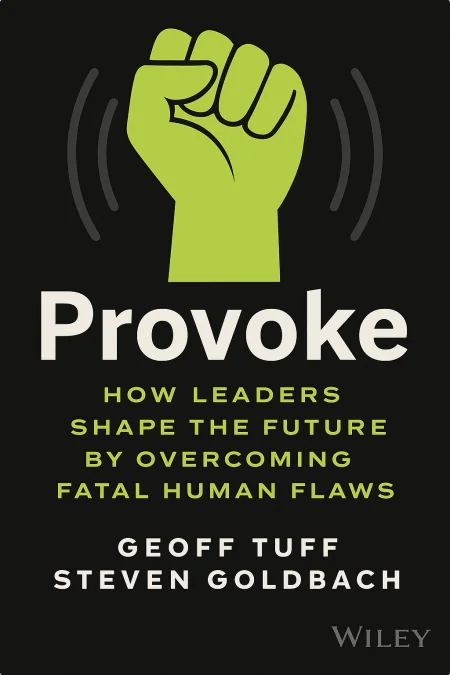
Provoke
How Leaders Shape the Future by Overcoming Fatal Human Flaws
Book Edition Details
Summary
When uncertainty looms, hesitation often feels like the safest path. Yet, Geoff Tuff and Steven Goldbach argue that true leadership thrives on a different philosophy in "Provoke: How Leaders Shape the Future by Overcoming Fatal Human Flaws." This isn't just another business manual—it's a bold manifesto for those ready to rewrite the rules. Tuff and Goldbach delve deep into the psychological barriers that tether us to inaction, unraveling how the very instincts meant to protect us can stifle innovation. Through their groundbreaking insights, they unveil five powerful models of provocation, each a catalyst to ignite transformative change. Learn how to identify pivotal moments when uncertainty transitions from "if" to "when" and harness these to pioneer the future. For visionaries across industries, "Provoke" is a clarion call to embrace the chaos, defy the status quo, and become architects of a bold, new reality.
Introduction
In an era of exponential change and mounting uncertainty, why do so many leaders find themselves paralyzed when facing emerging trends? The answer lies not in external market forces, but in the predictable cognitive biases and organizational dysfunctions that systematically blind us to opportunity. This exploration introduces a comprehensive framework for understanding how human psychology intersects with strategic decision-making, revealing the "fatal flaws" that cause individuals and organizations to miss critical inflection points in their industries. The central thesis revolves around recognizing the fundamental difference between "if" something will happen versus "when" it will happen—a distinction that determines whether leaders become passive observers or active shapers of their future. Through a systematic examination of cognitive biases, organizational behavior patterns, and strategic provocation methods, this work presents a theory of purposeful action that enables leaders to transcend natural human limitations. The framework addresses three core theoretical questions: How do predictable psychological patterns create systematic blindness to emerging trends? What strategic models can leaders employ to influence outcomes rather than merely react to them? How can organizations harness diversity and ecosystem thinking to expand their peripheral vision and decision-making capacity?
Predictable Patterns: Overcoming Fatal Human Flaws
The theory of predictable patterns reveals how cognitive biases create systematic organizational blindness, forming the psychological foundation that prevents effective leadership in uncertain environments. This framework identifies three primary categories of mental limitations: biases that prevent trend recognition, biases that inhibit action, and organizational structures that amplify these individual failings. The pattern recognition failure begins with availability bias, where leaders rely disproportionately on easily accessible mental examples, missing signals that fall outside their immediate experience. Egocentric bias compounds this by causing decision-makers to overweight information consistent with their existing worldview while discounting contradictory evidence. The affect heuristic creates a third blind spot, as trends that don't provoke immediate emotional responses—particularly small, early-stage developments—fail to capture attention despite their potential significance. Beyond recognition failures, action-inhibiting biases create a second layer of dysfunction. Status quo bias leads individuals to perceive any deviation from current conditions as inherently risky, while overconfidence bias causes leaders to underestimate the probability they might be wrong about emerging trends. These psychological tendencies interact with organizational factors like meeting cultures that discourage dissent, time scarcity that prevents deep thinking, and incentive systems that inadvertently punish the very behaviors organizations claim to value. The practical implications are profound. Companies repeatedly follow a predictable sequence: missing emerging trends, denying their significance, over-analyzing rather than acting, and finally responding with insufficient force when market momentum has already shifted. Understanding these patterns as systematic rather than random failures enables leaders to design countermeasures, creating the psychological and organizational conditions necessary for more effective strategic response in an uncertain world.
Principles of Provocation: Five Strategic Models
The provocation framework presents five distinct strategic approaches that leaders can employ depending on their position relative to emerging trends and their capacity to influence outcomes. This theoretical model recognizes that effective leadership in uncertainty requires matching strategic response to situational context, moving beyond one-size-fits-all approaches to embrace tactical flexibility. The foundational provocation, "Envision," involves continuous scenario planning that helps leaders understand where trends sit on the spectrum from possibility to inevitability. This differs from traditional forecasting by embracing multiple plausible futures simultaneously, using leading indicators to track which scenarios are gaining momentum. "Position" applies when trends remain in the "if" phase, requiring leaders to place strategic bets while maintaining flexibility to adjust as uncertainty resolves. This involves diversifying investments across potential outcomes while designing experiments that generate maximum learning with minimal commitment. The "when" phase provocations—Drive, Adapt, and Activate—assume trend inevitability but require different approaches based on the leader's capacity for influence. "Drive" applies when organizations possess sufficient control to directly shape outcomes, enabling them to accelerate favorable trends or redirect unfavorable ones. "Adapt" acknowledges limited external influence but maintains internal control, requiring business model evolution to align with emerging realities. "Activate" recognizes complex, multi-actor environments where success depends on orchestrating ecosystem responses rather than unilateral action. The power of this framework lies in its dynamic application. Leaders move between provocation types as situations evolve, treating strategic response as a continuous process rather than discrete planning exercises. Each provocation includes specific tools for hypothesis formation, testing protocols, and feedback mechanisms that enable rapid iteration. The model transforms uncertainty from a paralyzing force into a navigable challenge, providing structure for action even when perfect information remains unavailable.
Profiles of Provocateurs: Real-World Case Studies
The provocateur profiles demonstrate how individuals successfully apply provocation principles across different sectors and contexts, illustrating the universal applicability of the theoretical framework while highlighting the diverse styles effective leaders bring to uncertainty navigation. These cases reveal common patterns in how successful provocateurs think and operate, regardless of their specific domain or background. Deborah Bial's journey with The Posse Foundation exemplifies the "Drive" provocation in the nonprofit sector, showing how a single individual can reshape entire systems through persistent, purposeful action. Her approach demonstrates the power of combining deep empathy with systematic methodology, using merit-based principles to challenge existing diversity paradigms in higher education. Bial's success illustrates how provocateurs maintain unwavering commitment to core principles while remaining tactically flexible about implementation approaches. Ryan Gravel's Atlanta BeltLine project represents the "Adapt" provocation in urban planning, revealing how visionary leaders can transform entire cities by reimagining infrastructure possibilities. His experience shows how effective provocateurs balance detailed technical expertise with broad coalition-building, maintaining focus on long-term vision while navigating complex political and economic realities. The BeltLine case demonstrates how physical infrastructure changes can catalyze social transformation, creating spaces for human connection that transcend traditional community boundaries. Valerie Irick Rainford's corporate transformation work embodies the "Activate" provocation, showing how individuals can leverage data, relationships, and strategic positioning to drive systemic change within large organizations. Her data-driven approach to diversity advancement illustrates how provocateurs use objective measurement to create accountability and momentum. Rainford's transition from corporate executive to independent consultant demonstrates how experienced provocateurs can scale their impact by teaching others to apply similar principles. These profiles collectively show that successful provocateurs share certain characteristics: they maintain clear personal mission statements, they build diverse networks that provide multiple perspectives, they use experimentation and measurement to guide their actions, and they remain committed to long-term impact rather than short-term recognition. Most importantly, they demonstrate that provocation is a learnable skill set rather than an innate personality trait.
Summary
The essence of effective leadership in uncertainty lies in recognizing that the future is not something that happens to us, but something we actively create through purposeful action that overcomes our natural psychological limitations. The integration of cognitive bias awareness, strategic provocation models, and ecosystem thinking provides a comprehensive framework for navigating an increasingly complex world. This approach transforms uncertainty from a paralyzing force into a source of competitive advantage, enabling leaders to shape outcomes rather than merely respond to them. The long-term significance extends beyond individual leadership effectiveness to suggest new models for organizational design, decision-making processes, and collaborative problem-solving that could fundamentally alter how society addresses complex challenges and creates positive change.
Related Books
Download PDF & EPUB
To save this Black List summary for later, download the free PDF and EPUB. You can print it out, or read offline at your convenience.
By Geoff Tuff
