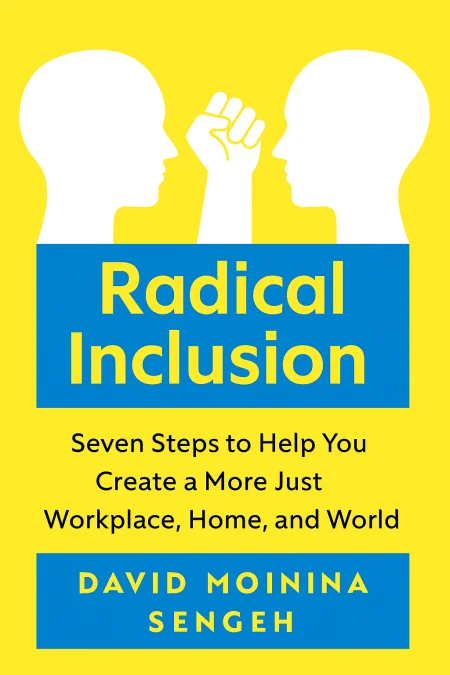
Radical Inclusion
Seven Steps to Help You Create a More Just Workplace, Home, and World
Book Edition Details
Summary
David Moinina Sengeh’s "Radical Inclusion" is a daring manifesto for transforming exclusionary norms into vibrant, inclusive communities. This isn’t just another feel-good read; it’s a riveting call to action that challenges the way we perceive belonging. Through Sengeh’s personal journey and compelling anecdotes, readers are offered a visionary roadmap to creating spaces where everyone feels valued. With actionable principles that resonate on a deeply human level, this book empowers you to confront exclusion, champion change, and redefine what it means to be inclusive in today’s world. Whether it’s in schools, workplaces, or neighborhoods, Sengeh’s wisdom inspires a profound shift toward equity and justice.
Introduction
Social exclusion operates as a pervasive force across all societies, manifesting in ways both obvious and subtle. Even those who occupy positions of privilege or power find themselves excluded at various points in their lives, creating a universal yet paradoxically isolating experience. This reality challenges the common assumption that exclusion only affects marginalized groups, revealing instead a complex web of barriers that can emerge based on disability, race, gender, pregnancy status, sexual orientation, or countless other factors. The systematic nature of exclusion often renders it invisible to those who enforce it, whether through direct action or passive complicity. When exclusion becomes institutionalized through policies, cultural norms, or organizational practices, it creates self-perpetuating cycles that are difficult to recognize and even harder to dismantle. The problem extends beyond individual prejudices to encompass structural inequities that shape access to education, healthcare, employment, and social participation. Addressing these entrenched patterns requires more than good intentions or surface-level reforms. Meaningful change demands a comprehensive approach that moves beyond identifying problems to implementing sustained action. The framework presented here offers a systematic methodology for recognizing exclusion, building coalitions, and creating lasting institutional change. Through examining real-world applications of these principles, readers can understand how theoretical concepts translate into practical strategies for promoting justice and equity in their own contexts.
The Seven Principles of Radical Inclusion Framework
Radical inclusion represents a fundamental shift from passive acceptance of exclusion to active dismantling of barriers that prevent full participation in society. This approach requires intentional and persistent action directed toward helping all people who have been marginalized, whether due to historical injustices, current policies, systemic inequities, or cultural practices that normalize exclusion. The framework operates on seven interconnected principles that function as both analytical tools and practical steps. The first principle demands precise identification and naming of exclusion, recognizing that addressing problems requires clearly defining their scope and impact. Without this foundational understanding, well-intentioned efforts often fail to target root causes or may inadvertently perpetuate existing inequities. The subsequent principles build systematically toward sustainable change. Listening to understand requires genuine engagement with all stakeholders, including those who benefit from current arrangements and those who suffer under them. Defining roles clarifies why specific individuals or organizations are positioned to drive change at particular moments, while coalition-building recognizes that systemic transformation requires collective action rather than individual heroism. The final principles address implementation challenges that often undermine reform efforts. Taking action moves beyond advocacy to concrete steps that remove barriers, while adapting to new norms acknowledges that change creates disruption requiring careful management. The commitment to continuously identify new exclusions prevents the complacency that allows progress to stagnate or reverse. This cyclical approach ensures that radical inclusion becomes an ongoing practice rather than a single achievement.
From Policy Change to Social Transformation in Sierra Leone
The challenge of overturning Sierra Leone's ban on pregnant girls attending school illustrates how deeply entrenched exclusionary policies reflect broader societal attitudes about gender, sexuality, and moral judgment. The policy, implemented by a previous government, prevented visibly pregnant students from attending classes or taking examinations, effectively ending their educational opportunities during crucial developmental years. Initial resistance to change came from multiple directions, revealing the complex web of justifications that sustain exclusionary practices. Religious leaders argued that allowing pregnant girls in schools would encourage immoral behavior among other students. Educators worried about practical challenges and potential disruption to learning environments. Parents and community members expressed concerns about mixed messages regarding teenage pregnancy and appropriate behavior for young women. The breadth of opposition demonstrated how exclusionary policies become normalized through repeated justification across different social institutions. Each stakeholder group developed rationales that seemed logical within their specific context, creating a reinforcing system where the policy appeared both necessary and natural. Religious arguments about morality combined with educational concerns about classroom management and community fears about changing social norms. However, deeper examination revealed fundamental contradictions in these justifications. The same pregnant girls banned from schools were welcomed in churches and mosques, suggesting that the exclusion was based on selective moral reasoning rather than consistent principles. The policy also demonstrated clear gender bias, as male students who were fathers faced no educational consequences for their role in pregnancies. These contradictions provided openings for challenging the policy's logical and ethical foundations.
Coalition Building and Sustained Action for Systemic Change
Effective coalition building requires identifying allies across different sectors while understanding that support may come from unexpected sources and opposition from familiar quarters. The process of overturning Sierra Leone's policy revealed how personal relationships, institutional positions, and individual experiences shape people's willingness to embrace or resist change. Early coalition efforts focused on engaging civil society organizations, development partners, and international bodies that had long opposed the ban. However, these external voices faced limitations in their ability to influence domestic policy, as their advocacy could be dismissed as foreign interference in national affairs. More effective were local voices, particularly women who had personal experience with the policy's impact and could speak authentically about its consequences. The most powerful coalition members proved to be those who occupied boundary positions between excluded and included groups. Teachers and school administrators who had initially supported the ban but gradually changed their perspectives became crucial bridges to resistant communities. Their credibility with skeptical audiences allowed them to present arguments for inclusion in terms that resonated with local concerns and values. Media engagement played a critical role in expanding the coalition beyond formal organizational structures. Radio shows, television appearances, and social media campaigns created opportunities for public dialogue that gradually shifted community attitudes. These platforms allowed for real-time responses to concerns and misconceptions while demonstrating growing support for policy change. The visibility of these debates also encouraged previously silent supporters to become more vocal advocates, creating momentum that skeptics found difficult to ignore.
Beyond Single Issues: Creating Lasting Inclusive Communities
Sustainable inclusion requires moving beyond addressing individual exclusions to creating institutional cultures and community norms that actively promote equity. The success of overturning one discriminatory policy provided opportunities to address broader patterns of exclusion affecting students with disabilities, rural populations, and economically disadvantaged families. The concept of radical inclusion emerged as an organizing principle that connected different advocacy efforts under a common framework. This approach recognized that various forms of exclusion share similar dynamics and that addressing them comprehensively creates stronger foundations for lasting change than tackling each issue in isolation. Educational institutions that embraced radical inclusion developed capacity to identify and address new forms of exclusion as they emerged. Implementation required ongoing vigilance against backsliding and resistance. Some religious leaders continued preaching against the policy changes, while certain school administrators found subtle ways to discourage pregnant students from enrolling. Community organizations that had initially opposed the changes needed sustained engagement to fully embrace new approaches and support vulnerable students. The most encouraging developments came from young people who had grown up with inclusive policies and internalized them as normal. Students who had never known schools that excluded pregnant girls became advocates for even broader inclusion, supporting classmates with disabilities and challenging discrimination based on other characteristics. Their leadership suggested that institutional changes could produce generational shifts in attitudes and expectations, creating self-reinforcing cycles of inclusion rather than exclusion.
Summary
The journey toward radical inclusion reveals that meaningful social change requires systematic approaches that address both individual attitudes and institutional structures. Exclusion operates through interconnected systems of policy, culture, and practice that must be challenged simultaneously rather than sequentially. The framework presented demonstrates how identifying exclusion, building coalitions, and taking sustained action can transform entrenched discrimination into expanding circles of belonging. Most significantly, the process shows that those who initially resist inclusion can become its strongest advocates when they understand its benefits for entire communities rather than just previously excluded groups. This transformation suggests that radical inclusion represents not just moral imperative but practical necessity for creating societies where all individuals can contribute their full potential to collective flourishing.
Related Books
Download PDF & EPUB
To save this Black List summary for later, download the free PDF and EPUB. You can print it out, or read offline at your convenience.
By David Moinina Sengeh
