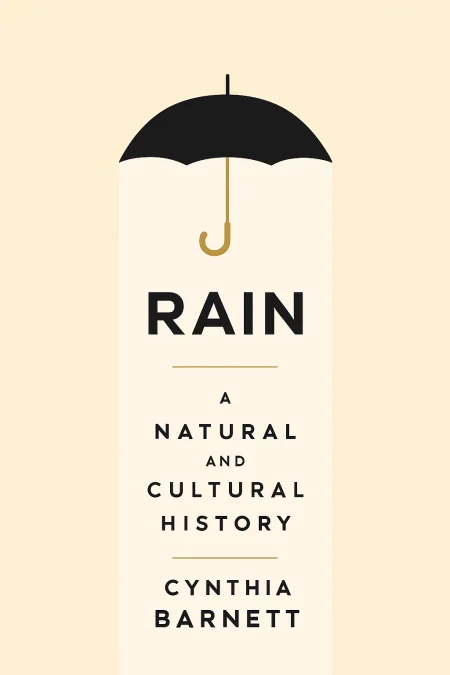
Rain
A Natural and Cultural History
Book Edition Details
Summary
In the relentless dance of droplets, Cynthia Barnett finds a story as ancient as the Earth itself—a saga of rain. From the primordial deluge that birthed oceans to the tempestuous storms reshaping our climate today, Barnett's "Rain" unravels the mystique of this elemental force. Journey through time and continents, where raindrops sculpt landscapes and influence cultures, as humanity's fascination with rain weaves a tapestry of science, history, and art. Feel the pulse of the storm through Jefferson’s meticulous drizzles, Morrissey’s melancholic skies, and India’s aromatic monsoon. As climate change alters this vital rhythm, Barnett invites readers into a conversation as universal as the rain itself—an exploration of both its beauty and its fury.
Introduction
Every day, billions of water droplets fall from the sky in a process so familiar we barely notice it, yet rain represents one of the most extraordinary phenomena in our universe. What makes Earth unique among all known planets is not just that we have water, but that we have managed to keep it cycling through our atmosphere for billions of years. While Mars lost its ancient oceans to space and Venus cooked away its water in a runaway greenhouse effect, Earth maintained the delicate balance that allows water to rise as vapor, condense in clouds, and fall back down as life-giving rain. This seemingly simple cycle has been the invisible architect of human history, determining where civilizations rise and fall, shaping our cultures and religions, and influencing everything from the foods we eat to the music we create. Understanding rain means understanding the hidden forces that have guided human development for millennia, and recognizing why this precious resource will be more critical than ever as we face an uncertain climatic future.
The Birth of Rain and Early Human Evolution
Rain is far older than humanity itself, born from one of the most dramatic events in Earth's early history. About 4.6 billion years ago, our planet was a molten hellscape bombarded by meteors and asteroids. These cosmic projectiles carried something precious locked within their rocky cores: water. As they crashed into the young Earth and volcanic activity churned the surface, water vapor began building up in the atmosphere. For millions of years, the planet was too hot for this vapor to condense, but eventually, as the bombardment slowed and temperatures dropped, the first rains began to fall. These weren't gentle spring showers but catastrophic deluges that lasted for thousands of years. The accumulated water vapor in the atmosphere was so dense that when it finally condensed, it created torrential storms that would make today's hurricanes look like light drizzles. These primordial rains cooled the Earth's surface, filled its craters and basins, and created the oceans that would become the cradle of life. The relationship between rain and human evolution runs deeper than most people realize. Our earliest ancestors evolved in the rain forests of East Africa during periods of abundant rainfall. But as climate patterns shifted and rains became less reliable, forests gave way to savannas, forcing our primate ancestors to adapt. They learned to walk upright to see over tall grasses, developed tools to help them survive in drier conditions, and evolved the large brains that would eventually distinguish humans from other species. Even today, our bodies carry evidence of this ancient relationship with rain. The wrinkled fingers we get after a long bath aren't just a quirky side effect of soaking in water, they're an evolutionary adaptation that gave our ancestors better grip in wet conditions. These "rain treads" on our fingertips helped early humans navigate slippery surfaces during the frequent downpours of their forest homes.
Civilizations Rise and Fall with the Rains
Throughout human history, the fate of civilizations has been intimately tied to rainfall patterns, though this connection often remains hidden until it's too late. The world's first great civilizations all emerged in river valleys where they could harness both the water itself and the fertile soils deposited by seasonal floods. Ancient Mesopotamia, Egypt, the Indus Valley, and early Chinese civilizations all depended on predictable patterns of rain and flooding to support their agriculture and growing populations. But rain's power to create civilizations is matched only by its power to destroy them. Around 4,200 years ago, a massive drought struck much of the inhabited world, lasting for centuries and bringing down some of humanity's greatest early achievements. The sophisticated cities of the Indus Valley were abandoned as rivers dried up and monsoons failed. In Mesopotamia, the world's first empire collapsed as agricultural lands turned to desert. Even mighty Egypt saw its Old Kingdom crumble as the Nile's floods became unreliable. The Maya civilization provides perhaps the most dramatic example of rain's power over human societies. For over a thousand years, the Maya built magnificent cities in the tropical lowlands of Central America, developing sophisticated systems of water management to survive in a region prone to both floods and droughts. Their civilization supported millions of people and created some of the most advanced art, architecture, and astronomical knowledge of the ancient world. Yet when a severe drought struck around 900 CE and persisted for three centuries, even their ingenious water systems couldn't save them. These historical examples reveal a crucial truth about human societies: we are far more vulnerable to changes in rainfall than we like to admit. Modern technology and global trade networks provide some buffer against local climate variations, but they cannot eliminate our fundamental dependence on the water cycle that has sustained human civilization for thousands of years.
The Quest to Control Weather and Water
Humans have never been content to simply accept whatever weather nature provides. From ancient rain dances to modern cloud seeding, we have persistently sought ways to control the skies and summon rain when we need it. This quest has produced some of history's most colorful characters and ambitious schemes, ranging from the merely ineffective to the genuinely dangerous. In the late 1800s, as drought devastated the American West, Congress actually funded experiments in "rainmaking by concussion." Robert St. George Dyrenforth, a Washington patent attorney, convinced lawmakers to let him try bombing the skies over Texas with mortars, dynamite, and enormous balloons filled with explosive chemicals. His theory was that the shock waves from these explosions would shake rain from the clouds. Despite his dramatic pyrotechnics, Dyrenforth produced no measurable increase in rainfall, earning him the nickname "Dryhenceforth." The early 20th century saw more sophisticated attempts at weather control, including Charles Hatfield, known as "the Rain Wizard," who claimed he could attract moisture from the atmosphere using secret chemical mixtures heated on tall towers. Hatfield's most famous success came in 1916 when San Diego hired him to fill their reservoirs. Shortly after he began his work, record-breaking rains flooded the city, burst a dam, and killed dozens of people. The city refused to pay his fee, arguing that such a destructive deluge must have been an "act of God" rather than the result of human intervention. Modern weather modification efforts are more scientifically grounded but still limited in their effectiveness. Cloud seeding, which involves introducing particles like silver iodide into clouds to encourage precipitation, can increase rainfall by perhaps 10-15 percent under ideal conditions. Countries around the world spend millions of dollars annually on these programs. Yet even our most advanced techniques can only work with existing weather patterns, not create rain from clear skies.
The Dust Bowl: When Rain Failed America
Imagine stepping outside one sunny afternoon only to watch the sky turn black as night in minutes, not from storm clouds, but from towering walls of dust stretching thousands of feet into the air. This was the terrifying reality for millions of Americans during the 1930s Dust Bowl, when the failure of rain transformed the Great Plains into a hellscape of swirling dirt and economic devastation. The term "black blizzard" perfectly captures the surreal horror of these storms that could turn day into night within minutes, creating walls of dirt that could stretch for hundreds of miles. The Dust Bowl wasn't simply a natural disaster but rather a catastrophic collision between human ambition and natural climate cycles that had operated for millennia. The Great Plains had evolved as grassland precisely because the region experienced periodic droughts that trees couldn't survive, but prairie grasses could. When European settlers arrived during an unusually wet period in the late 1800s and early 1900s, they plowed up millions of acres of native grassland to plant wheat and other crops, having no way of knowing they were farming during a temporary wet cycle. The timing couldn't have been worse. Just as farmers had destroyed the deep-rooted prairie grasses that anchored the soil, the climate shifted back toward its more typical dry pattern. Without this natural protection, the land became vulnerable to wind erosion on a massive scale. What had been sustainable grassland for thousands of years became an environmental disaster zone within a few decades of intensive farming. The drought that triggered the Dust Bowl was caused by changes in large-scale atmospheric circulation patterns, particularly shifts in the jet stream that altered where storm systems traveled. These circulation changes created feedback loops where airborne dust particles actually suppressed rainfall by interfering with cloud formation processes. The dust storms helped perpetuate the very drought conditions that created them, demonstrating how human land use decisions can transform a natural drought into an environmental catastrophe.
Summary
The story of rain reveals a fundamental truth about our planet and our species: we are all children of the water cycle, shaped by forces far greater and more ancient than human civilization itself. Rain made Earth habitable, drove human evolution, determined where our ancestors could build their cities, and continues to influence everything from global politics to personal creativity. As we face an era of climate change that is disrupting rainfall patterns worldwide, understanding our deep connection to rain becomes more crucial than ever. The same force that built civilizations can just as easily destroy them, and our future depends on learning to live within the limits of what the sky can provide. How might we redesign our cities and agricultural systems to work with natural rainfall patterns rather than against them? What can the rise and fall of ancient civilizations teach us about building resilience in an age of climate uncertainty? These questions will define much of human progress in the coming decades, as we grapple with the reality that for all our technological prowess, we remain utterly dependent on the ancient rhythm of water rising and falling from the sky.
Related Books
Download PDF & EPUB
To save this Black List summary for later, download the free PDF and EPUB. You can print it out, or read offline at your convenience.
By Cynthia Barnett
