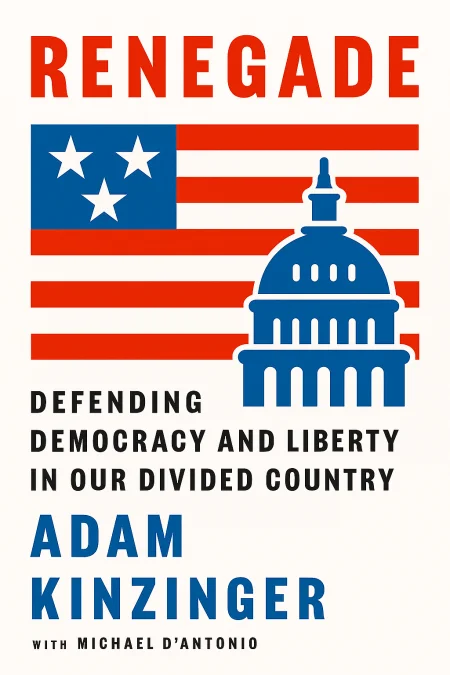
Renegade
Defending Democracy and Liberty in Our Divided Country
byAdam Kinzinger, Michael D'Antonio
Book Edition Details
Summary
A lone voice in a cacophony of partisanship, Adam Kinzinger emerges as a beacon of conviction amidst the stormy seas of American politics. "Renegade" unfolds a gripping narrative that traverses the intimate corridors of power, revealing the inner turmoil of a man caught between loyalty and conscience. Witness the searing intensity of January 6, 2021, as Kinzinger confronts the upheaval that challenges his party and his principles. This is not merely a political memoir; it's a testament to courage and integrity in an era fraught with division. With each page, Kinzinger invites readers into the heart of a democracy at the brink, offering a candid exploration of his faith-driven journey from local governance to the national stage. Prepare to be captivated by a story that defies the norms, urging a return to unity with an unflinching call to action.
Introduction
In the pantheon of American political courage, few moments rival the sight of a lone congressman, gun drawn, barricaded in his office as an armed mob stormed the Capitol on January 6, 2021. Adam Kinzinger, a decorated combat pilot turned Republican representative, found himself defending not just his physical safety, but the very soul of American democracy. That day marked the culmination of a remarkable transformation—from a small-town conservative who once embraced the Tea Party movement to one of the few Republicans willing to stand against Donald Trump's assault on democratic norms. Kinzinger's journey embodies the profound tensions within modern American conservatism. Raised in the heartland values of Illinois farm country and forged by military service in Iraq and Afghanistan, he entered Congress in 2010 as part of the Tea Party wave that promised to restore constitutional principles. Yet as his party increasingly embraced authoritarianism and conspiracy theories, Kinzinger faced an agonizing choice between political survival and democratic duty. His story reveals how ordinary citizens, even those within the system, must sometimes risk everything to preserve the foundations of free society. Through his eyes, we witness the price of integrity in an age of extremism, the weight of taking principled stands, and the enduring power of choosing country over party.
From Small-Town Conservative to Combat Pilot
Adam Kinzinger's roots ran deep in the Illinois soil that shaped America's heartland values. Born into a family where public service was a calling rather than a career, he learned early that character mattered more than personal advancement. His mother, Betty Jo, dedicated herself to teaching third-graders in increasingly diverse classrooms, while his father, Rus, worked tirelessly for organizations serving the homeless and disadvantaged. Their household embodied a practical Christianity focused on service rather than judgment, a faith that would later put Kinzinger at odds with the politicized evangelicalism that captured his party. The family's commitment to community engagement extended beyond charity work. When young Adam showed interest in politics, his parents encouraged his curiosity about governance and civic duty. By age twenty, he had already won election to the McLean County Board, displaying an early aptitude for the respectful discourse that once characterized American politics. His campaign emphasized pragmatic solutions over partisan rhetoric, earning him endorsement from The Pantagraph despite his youth and inexperience. The September 11 attacks transformed Kinzinger's sense of purpose from local service to national duty. Already committed to military aviation training, he witnessed firsthand how external threats could shatter American complacency. The burning towers crystallized his belief that freedom required active defense, not passive hope. This conviction would drive him through years of demanding flight training, where he mastered the complex art of aerial refueling—a mission requiring precision, courage, and absolute reliability under pressure. His path from civilian to combat pilot revealed character traits that would define his later political stands. Whether navigating a dangerous near-blackout during training or later intervening to stop a knife-wielding attacker in Milwaukee, Kinzinger demonstrated the calm decisiveness of someone who understood that leadership meant acting when others hesitated. Military service taught him that oaths were sacred commitments, not political conveniences—a lesson that would prove crucial when his party abandoned its own stated principles.
Rising Through the Tea Party Revolution
The 2010 midterm elections created a perfect storm for political newcomers like Kinzinger, who rode the Tea Party wave into Congress with a mandate to challenge the Washington establishment. Fresh from combat deployments in Iraq and Afghanistan, he brought military discipline and foreign policy expertise to a freshman class determined to shrink government and restore constitutional limits. His victory over incumbent Democrat Debbie Halvorson represented more than a partisan flip—it symbolized heartland America's rejection of big-government solutions to the 2008 financial crisis. Initially, the Tea Party movement aligned with Kinzinger's core beliefs about fiscal responsibility and constitutional governance. He supported efforts to reduce federal spending, opposed the Affordable Care Act, and advocated for a stronger national defense. His military background lent credibility to budget hawks who argued that even Pentagon spending deserved scrutiny. Unlike some colleagues who treated defense appropriations as untouchable, Kinzinger demonstrated intellectual honesty by questioning wasteful programs like unnecessary flight suit redesigns that cost taxpayers millions. However, cracks began appearing in the Tea Party coalition as ideological purity increasingly trumped practical governance. Kinzinger watched with growing alarm as some colleagues prioritized media attention over legislative achievement, turning congressional hearings into performance art designed for cable news consumption. The movement's early focus on fiscal discipline gradually gave way to cultural grievances and conspiracy theories that bore little resemblance to the constitutional conservatism he had embraced. The transformation accelerated as traditional Republican leaders like John Boehner struggled to manage an increasingly unmanageable caucus. Kinzinger found himself caught between loyalty to the Speaker who had mentored him and pressure from activists who demanded absolute opposition to any compromise with Democrats. This tension would define his congressional career, as he learned that principled conservatism sometimes required defying the very movement that had brought him to power. The Tea Party's evolution from fiscal watchdog to cultural warrior foreshadowed the even more dramatic transformation that would reshape the Republican Party under Donald Trump.
Breaking Point: January 6th and Its Aftermath
The morning of January 6, 2021, found Kinzinger preparing for what should have been a routine congressional session to certify electoral votes. Instead, he found himself checking his sidearm and barricading his office door as a mob of Trump supporters stormed the Capitol. The surreal scene—lawmakers cowering behind desks while chanting crowds hunted for the vice president—marked the violent culmination of months of election lies that Kinzinger had consistently refused to endorse. As the attack unfolded, Kinzinger experienced a moment of clarity that cut through years of partisan loyalty. Watching fellow Americans assault police officers while waving Trump flags, he realized his party had crossed a line from which there could be no return. The rioters weren't just attacking a building; they were attacking the democratic process itself, driven by lies that prominent Republicans had either promoted or failed to challenge. The contrast with his military service was stark—these weren't foreign enemies but fellow citizens who had been radicalized by their own leaders. The aftermath proved even more disturbing than the attack itself. Despite initially condemning Trump's role in inciting the violence, many Republican colleagues quickly retreated to partisan positions once the immediate danger passed. Kevin McCarthy's evolution from harsh Trump critic to supplicant exemplified the moral cowardice that disgusted Kinzinger. Watching supposed conservatives prioritize political survival over democratic principles, he understood that his party had become something fundamentally different from what he had joined. Kinzinger's decision to vote for Trump's impeachment made him a pariah within his own party but affirmed his commitment to principles over politics. Death threats, family condemnation, and political isolation followed, yet he felt liberated rather than defeated. January 6 had stripped away illusions about partisan loyalty, revealing that some truths transcended political calculations. His subsequent service on the January 6 committee represented not betrayal of conservative principles but their ultimate expression—the belief that no person, regardless of party or position, stands above the law and Constitution he had sworn to defend.
Defending Democracy Against His Own Party
Kinzinger's appointment to the House January 6 committee marked his complete break with Republican orthodoxy, transforming him from party loyalist to democracy's defender. Working alongside seven Democrats and one other Republican, Liz Cheney, he helped compile the most comprehensive investigation of a presidential coup attempt in American history. The committee's methodical approach—interviewing over a thousand witnesses and reviewing more than a million documents—revealed the systematic nature of Trump's assault on democratic institutions. The investigation exposed how Trump's lies about election fraud weren't spontaneous reactions to defeat but calculated attempts to maintain power through any means necessary. Kinzinger watched former colleagues who privately acknowledged Biden's legitimate victory publicly embrace Trump's fantasies, demonstrating how fear of political consequences could corrupt even intelligent people. The committee's hearings, watched by millions of Americans, laid bare the extent to which Republican leaders had prioritized party loyalty over constitutional duty. Kinzinger's role in the hearings—particularly his presentation of Trump's 187-minute dereliction of duty during the Capitol attack—showcased his ability to communicate complex legal and constitutional issues in accessible terms. His military background lent authority to his condemnation of Trump's behavior, as someone who understood the weight of command responsibility and the sacred nature of oaths. Unlike many politicians who spoke in abstract terms about democracy, Kinzinger had risked his life defending it and could speak with moral authority about its requirements. The personal cost of his stand was severe but ultimately liberating. Facing certain primary defeat, Kinzinger chose not to seek reelection, freeing himself to speak truth without political calculation. His post-congressional work with Country First, an organization promoting democratic values across party lines, represents his evolution from partisan warrior to democracy advocate. Rather than viewing his political career as ending in failure, Kinzinger sees it as preparation for a larger mission—helping America navigate the crisis of democratic legitimacy that threatens the constitutional order he spent his life serving.
Summary
Adam Kinzinger's journey from Tea Party congressman to democracy defender illustrates the profound moral courage required to place principle above political survival in an age of extremism. His transformation reveals that true conservatism sometimes demands rejecting those who claim its mantle, especially when they abandon the constitutional principles that give conservatism meaning. Through military service, political awakening, and ultimate sacrifice of his congressional career, Kinzinger demonstrated that defending democracy requires more than electoral participation—it demands active resistance to authoritarianism wherever it emerges. The lessons from Kinzinger's experience extend far beyond partisan politics to fundamental questions about citizenship and moral responsibility. His willingness to risk family relationships, political career, and personal safety for democratic principles offers a template for civic courage in dangerous times. Americans across the political spectrum can draw inspiration from his recognition that some battles transcend party loyalty, requiring individuals to stand for larger truths even when standing alone. In an era when democratic institutions face unprecedented challenges, Kinzinger's story reminds us that ordinary citizens, armed with conviction and courage, remain democracy's most reliable guardians against the forces that would destroy it.
Related Books
Download PDF & EPUB
To save this Black List summary for later, download the free PDF and EPUB. You can print it out, or read offline at your convenience.
By Adam Kinzinger
