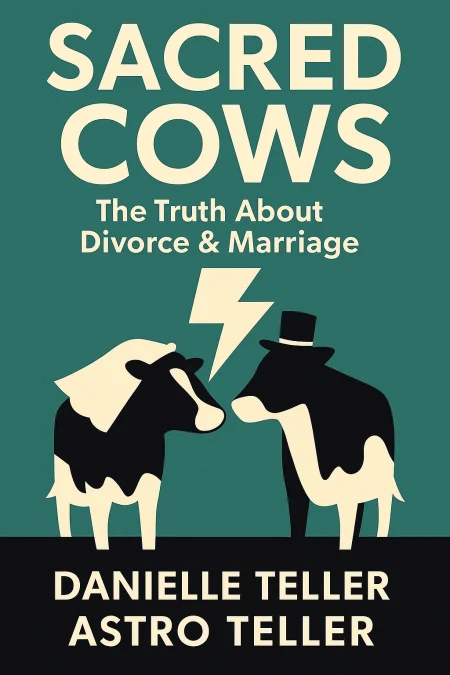
Sacred Cows
The Truth About Divorce & Marriage
byDanielle Teller, Astro Teller
Book Edition Details
Summary
Who says marriage must be the ultimate happily ever after? Drs. Astro and Danielle Teller tackle this age-old assumption head-on, debunking cultural myths with the wit and wisdom that only experience and expertise can bring. In "Sacred Cows," the Tellers dissect seven societal myths about marriage and divorce—playfully nicknamed the Holy Cow, the Expert Cow, and more—challenging readers to rethink what they've always accepted as truth. This is not a manifesto for marriage or a diatribe against divorce; instead, it's a liberating call to pursue genuine happiness and authenticity, whether you're coupled up or flying solo. Perfect for those wrestling with marital doubts, counselors seeking fresh insights, or anyone ready to question conventional wisdom, "Sacred Cows" offers a refreshing, data-driven perspective on an institution often shrouded in sanctity and misconception.
Introduction
Marriage and divorce occupy a unique space in contemporary discourse, simultaneously celebrated and stigmatized depending on the circumstances. What masquerades as conventional wisdom about these life choices often reveals itself to be a collection of unexamined assumptions that shape decisions in profound ways. These assumptions function like sacred cows—ideas so deeply embedded in cultural consciousness that they resist critical examination, despite their potential to cause unnecessary suffering. The phenomenon becomes particularly apparent when observing how society treats identical situations differently based solely on marital status. A person leaving an unsatisfying relationship receives understanding and support, yet the same person leaving an unsatisfying marriage encounters judgment and pressure to reconsider. This inconsistency reveals the presence of cultural myths that prioritize the preservation of marriage as an institution over the wellbeing of individuals within marriages. The exploration ahead employs logical analysis to examine these deeply held beliefs, testing their consistency and validity against real-world experiences. By identifying and challenging these sacred cows, individuals facing difficult decisions about their relationships can navigate these choices free from the distortion of cultural prejudices that may not serve their actual interests or happiness.
The Cultural Mythology That Stigmatizes Divorce
Contemporary society maintains a peculiar double standard regarding relationship dissolution. When unmarried couples separate, the decision typically receives acceptance or even approval, particularly when one partner expresses unhappiness. Yet identical circumstances within marriage trigger entirely different responses, accompanied by pressure to persevere regardless of personal cost. This disparity reveals the presence of cultural mythology that treats marriage as inherently superior to other relationship forms, regardless of the actual quality of the relationship itself. The mythology manifests most clearly in the language surrounding divorce, where terms like "failure" automatically attach to ended marriages while successful relationships that conclude amicably receive no such designation. This linguistic framing creates an artificial hierarchy that measures relationship success solely by duration rather than by the happiness, growth, or mutual respect experienced by participants. The assumption underlying this framework suggests that staying married represents moral virtue while divorcing indicates moral deficiency. Statistical manipulation frequently reinforces these cultural biases, with selective reporting that emphasizes divorce rates during economic downturns while ignoring broader trends showing steady decline in divorce rates over decades. Such reporting serves to maintain anxiety about marriage stability while avoiding examination of the complex factors that actually influence relationship satisfaction and longevity. The sacred cow emerges in the insistence that marriage commitment should supersede personal happiness without acknowledging that such a position represents a specific value system rather than universal truth. Alternative value systems that prioritize individual flourishing or mutual happiness receive dismissal rather than recognition as equally valid approaches to human relationships.
Examining False Assumptions About Marriage Success and Failure
Professional expertise in marriage counseling and relationship advice frequently operates on unproven assumptions about what constitutes effective intervention. The therapeutic industry promotes various techniques for improving marriages while providing limited evidence that these approaches produce meaningful long-term changes in relationship satisfaction or stability. This gap between professional confidence and actual effectiveness creates false hope for couples experiencing fundamental incompatibilities. Research methodologies in marriage and divorce studies suffer from significant design flaws that undermine the reliability of their conclusions. Selection bias pervades much of the existing literature, as researchers attempt to compare populations that differ in multiple ways beyond marital status. Studies claiming to demonstrate the superior outcomes of marriage over divorce typically fail to control for the numerous factors that influence both relationship choices and life satisfaction independently. The complexity of human relationships resists the kind of standardized interventions that work in other domains. Unlike medical treatments that address specific biological mechanisms, relationship interventions must navigate the intricate interplay of personality, history, circumstances, and emotional compatibility that varies dramatically between couples. The assumption that universal techniques can address diverse relationship problems reflects a fundamental misunderstanding of human psychology and interpersonal dynamics. Professional bias toward marriage preservation influences both research design and clinical practice in ways that may not serve client interests. Therapists and researchers who view divorce as inherent failure approach their work with predetermined goals that limit their ability to help individuals make decisions based on their actual circumstances rather than professional ideologies about relationship success.
Deconstructing Expert Claims and Children's Welfare Arguments
Claims about the impact of divorce on children rely heavily on studies that cannot establish causal relationships between family structure and child outcomes. The most frequently cited research compares children from divorced families with children from intact families without adequately controlling for the many factors that influence both divorce likelihood and child development. Socioeconomic status, parental mental health, conflict levels, and numerous other variables confound these comparisons in ways that make definitive conclusions impossible. The magnitude of observed differences between children from divorced and intact families, even when statistically significant, remains small enough to provide little predictive value for individual families. Effect sizes typically measure fractions of standard deviations, meaning that knowing a child's family structure provides virtually no information about that child's likely academic performance, social adjustment, or future relationship success. Selection bias fundamentally undermines the validity of research in this area because parents who divorce differ systematically from parents who remain married in ways that extend far beyond their marital decisions. Parents with certain personality traits, mental health challenges, or life circumstances face both higher divorce risk and greater difficulty providing optimal child-rearing environments regardless of their marital status. The ethical complexity of randomized studies on family structure makes definitive research practically impossible, leaving the field dependent on observational data that cannot establish causation. Without the ability to randomly assign families to different structures and follow outcomes over time, researchers cannot definitively demonstrate that divorce itself causes the modest differences observed in child outcomes across family types.
Reframing Personal Agency in Relationship Decisions
Individual decision-making about marriage and divorce occurs within a context of social pressures that may not align with personal interests or circumstances. Cultural messages about commitment, sacrifice, and perseverance in marriage often fail to acknowledge that these values, while potentially admirable, represent choices rather than moral imperatives. The assumption that staying married always demonstrates superior character ignores the possibility that remaining in destructive or unfulfilling relationships might represent the less courageous choice. The concept of personal agency becomes complicated when social institutions consistently frame individual happiness as selfish while portraying marriage preservation as virtuous. This framing ignores situations where ending a marriage might serve everyone's interests, including children who benefit from seeing their parents model authentic relationships rather than dutiful performance of marital roles. False dichotomies pervade discussions of marriage and divorce, presenting choices as either selfish abandonment or noble sacrifice. Such framing obscures the reality that relationship decisions typically involve complex tradeoffs where multiple legitimate values compete for priority. The wisdom of any particular choice depends heavily on specific circumstances that outside observers cannot fully understand or evaluate. Recognition of personal agency requires acknowledging that individuals possess greater insight into their own situations than external advisors, regardless of the professional credentials or good intentions of those advisors. While input from others can provide valuable perspective, the responsibility for living with the consequences of relationship decisions ultimately rests with the individuals involved rather than with society's preferred outcomes.
Summary
The persistent cultural mythology surrounding marriage and divorce serves institutional interests rather than individual wellbeing, creating unnecessary guilt and confusion for people navigating difficult relationship decisions. These sacred cows maintain their influence through selective use of statistics, professional bias, and moral frameworks that privilege marriage preservation over personal happiness without acknowledging the value assumptions underlying such priorities. By recognizing these myths as cultural constructs rather than universal truths, individuals can approach relationship decisions with greater clarity and self-compassion, making choices based on their actual circumstances rather than on societal pressures that may not serve their interests. The ultimate insight reveals that authentic human flourishing requires the freedom to make relationship choices guided by personal values and circumstances rather than by cultural orthodoxies that treat all situations identically.
Related Books
Download PDF & EPUB
To save this Black List summary for later, download the free PDF and EPUB. You can print it out, or read offline at your convenience.
By Danielle Teller
