
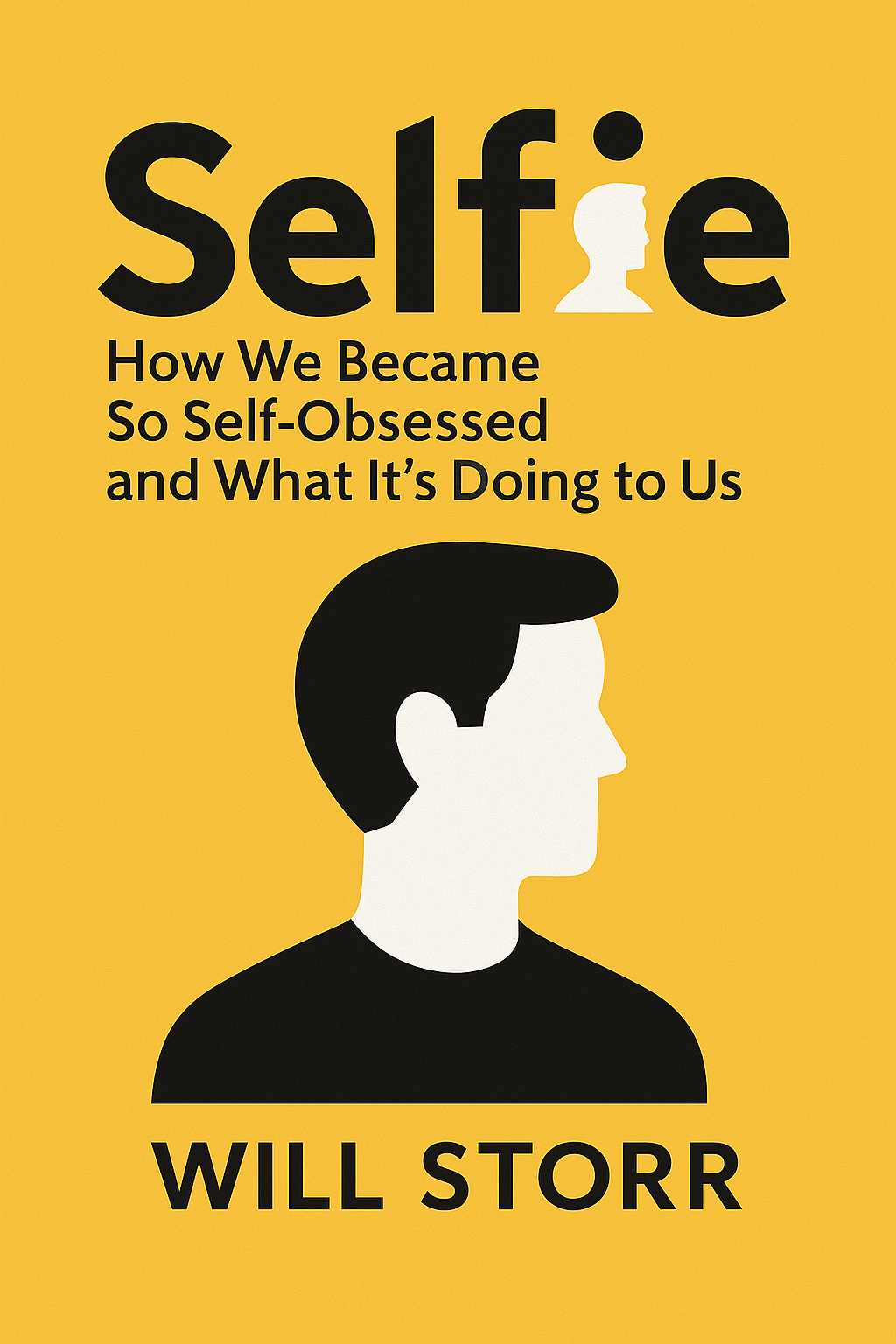
Selfie
How We Became So Self-Obsessed and What It’s Doing to Us
Book Edition Details
Summary
In an era where the mirror seems to dictate our worth, "Selfie" by Will Storr peels back the glossy veneer of self-obsession. It's a daring expedition through time, tracing the roots of our relentless quest for perfection from the philosophers of Ancient Greece to today’s digital age of Instagram filters. Storr, a masterful storyteller, unravels how history’s whispers have shaped our modern identity crisis, weaving a narrative that exposes the societal pressures leading to an epidemic of insecurity and isolation. With piercing insight, he challenges the unattainable ideal of the 'perfect self' and questions why we’re so bewitched by it. This is not just a book; it's a mirror reflecting back at us the contours of a culture obsessed with image over substance.
Introduction
Contemporary Western society finds itself ensnared in a peculiar paradox: despite unprecedented prosperity and technological advancement, rates of anxiety, depression, and psychological distress continue to escalate, particularly among younger generations. This troubling phenomenon points to a deeper cultural transformation that has fundamentally altered how individuals understand themselves and their place in the world. The modern epidemic of perfectionism represents not merely a collection of individual psychological problems, but rather the inevitable outcome of centuries of philosophical, religious, and economic evolution that has systematically redefined human nature and potential. The investigation reveals how ancient Greek ideals of individual excellence merged with Christian concepts of moral perfectibility, later amplified by Enlightenment rationalism and capitalist frameworks that commodify human worth. These historical currents converged in the digital age with psychological movements promising unlimited self-transformation, creating a toxic synthesis of unrealistic expectations and personal responsibility. Understanding this genealogy becomes essential for recognizing why individual suffering reflects broader systemic failures rather than personal inadequacies, challenging fundamental assumptions about success, self-worth, and the very nature of human flourishing in the twenty-first century.
From Ancient Excellence to Modern Obsession: The Historical Evolution of Perfectionist Culture
The transformation of Western selfhood began with ancient Greek civilization's revolutionary departure from tribal identity toward individual excellence, fundamentally altering humanity's understanding of personal potential and responsibility. Greek city-states pioneered the concept of the individual as a discrete entity capable of rational thought, moral choice, and perfectible achievement independent of collective identity. This marked a dramatic shift from earlier societies where worth derived from fulfilling predetermined social roles within stable community structures. The Greek ideal of kalokagathia combined physical beauty, intellectual prowess, and moral virtue into a unified vision of human excellence that could be pursued through disciplined effort and rational inquiry. Competitive institutions, from athletic contests to philosophical debates, institutionalized the pursuit of individual distinction while establishing measurable standards for human achievement. This cultural innovation created both unprecedented opportunities for personal transcendence and the psychological burden of constant self-evaluation against idealized standards. Medieval Christianity inherited and transformed these Greek foundations by relocating perfection from the human to the divine realm, making moral perfectibility simultaneously more urgent and more impossible. The Christian emphasis on original sin positioned all humans as fundamentally flawed beings requiring constant vigilance and improvement, while monastic traditions developed elaborate systems of self-denial and spiritual discipline designed to purge worldly desires. This theological framework established patterns of introspection, moral striving, and self-criticism that would persist long after the decline of religious authority. The Renaissance and Enlightenment periods further amplified individualistic tendencies by celebrating human reason, creativity, and the potential for unlimited progress through knowledge and effort. These intellectual movements created the ideological groundwork for modern concepts of self-improvement and personal responsibility, suggesting that individuals could transcend their circumstances through proper application of will and intelligence, thus laying the foundation for contemporary perfectionist culture.
The Toxic Convergence: How Christianity, Psychology, and Neoliberalism Amplified Self-Optimization Pressures
The emergence of modern psychology initially maintained Christianity's pessimistic view of human nature while secularizing its therapeutic methods, replacing religious confession with clinical interpretation but preserving the assumption that normal human experience required expert intervention and correction. Psychoanalytic theory positioned the unconscious as a repository of shameful impulses and repressed desires, reinforcing the notion that individuals harbored dark aspects of personality that demanded constant monitoring and professional treatment. The Human Potential Movement of the 1960s attempted to reverse this negativity by proclaiming the inherent goodness and unlimited potential of the authentic self, yet paradoxically intensified perfectionist pressures by suggesting that personal transformation was not only possible but morally obligatory. Encounter groups and therapeutic communities promised liberation from neurotic inhibition through radical honesty and emotional expression, but often produced increased fragmentation and self-doubt by encouraging participants to reject aspects of their personality that might represent healthy adaptations to social reality. Neoliberal economic theory fundamentally reconceptualized human beings as self-optimizing economic units, transforming ancient ideals of individual excellence into market-driven imperatives for personal success and competitive advantage. This philosophy extended beyond economics to encompass a comprehensive worldview where personal worth became measurable through market performance, and individual responsibility replaced social solidarity as the primary organizing principle of society. The psychological implications of this convergence prove profound and destructive, creating conditions where human worth becomes contingent on impossible standards of achievement, authenticity, and self-mastery. The neoliberal emphasis on individual responsibility obscures structural inequalities while creating a culture where those who struggle are viewed as personally deficient rather than victims of broader social and economic forces, resulting in widespread anxiety and self-blame among populations attempting to navigate increasingly precarious circumstances.
Digital Acceleration: How Technology Transformed Perfectionism into a Mental Health Crisis
Digital technology created unprecedented opportunities for self-presentation and social comparison, transforming everyday life into continuous performance spaces where individuals curate idealized versions of themselves for public consumption while measuring their worth against carefully edited representations of others' apparent success and happiness. Social media platforms exploit fundamental aspects of human psychology by providing infinite streams of comparative content that trigger competitive instincts originally designed for small tribal groups. The architectural design of digital platforms explicitly gamifies human interaction through quantifiable metrics like likes, shares, and follower counts, creating measurable standards of social worth that encourage constant optimization and strategic self-presentation. This system transforms personal relationships and individual achievements into competitive enterprises where success becomes defined by external validation rather than intrinsic satisfaction or genuine human connection. The quantified self movement, enabled by digital technology, promises scientific precision in personal improvement but reduces complex human experiences to simplistic metrics that can be monitored and optimized. Sleep quality, mood, productivity, and social connections become data points requiring enhancement rather than aspects of rich, multifaceted existence that naturally fluctuate and resist systematic control. The psychological consequences of digital perfectionism manifest in epidemic rates of anxiety, depression, and social isolation, particularly among younger users who have developed their identities within these technological systems. The constant availability of comparison and measurement creates perpetual self-consciousness that undermines spontaneous experience and authentic human connection, while the pressure to maintain flawless online personas creates exhausting cycles of performance and evaluation that rarely deliver promised satisfaction or security.
Beyond the Optimization Myth: Reclaiming Human Limitation and Authentic Flourishing
Contemporary neuroscience and psychology demonstrate that personality traits, cognitive abilities, and emotional patterns are largely determined by genetic inheritance and early developmental experiences, contradicting cultural mythology that individuals can become anything they choose through sufficient effort and determination. This scientific understanding offers both humility and relief from the impossible burden of unlimited self-transformation while providing a foundation for authentic self-acceptance and realistic goal-setting. Recognition of inherent human limitation does not constitute resignation but rather enables individuals to pursue meaningful objectives that align with their actual capabilities rather than chasing culturally imposed ideals that may be fundamentally incompatible with their nature. This approach reduces the psychological violence of constant self-criticism while opening possibilities for genuine satisfaction and contribution within realistic parameters of human potential and constraint. The path beyond perfectionism requires developing sustainable approaches to excellence that prioritize collective well-being over individual achievement, emphasizing relationships and activities that provide meaning independent of performance metrics. Practical resistance to perfectionist culture involves limiting exposure to social media comparison, cultivating non-competitive pursuits, and practicing self-compassion when confronting inevitable failures and limitations. Communities and institutions can support this transformation by celebrating diverse forms of human contribution beyond market success, providing safety nets that reduce the consequences of failure, and fostering environments where vulnerability and interdependence are valued over individual optimization. This collective approach recognizes that authentic human flourishing depends not on transcending limitations but on embracing them with compassion while pursuing meaningful goals within the bounds of genuine human nature.
Summary
The contemporary crisis of perfectionism emerges from a specific historical trajectory that transformed ancient Greek ideals of individual excellence through Christian moral imperatives, Enlightenment rationalism, and neoliberal economics into modern demands for constant self-optimization, amplified exponentially by digital technology that creates unprecedented opportunities for comparison and performance. This cultural evolution has produced psychological conditions fundamentally incompatible with human nature, generating widespread anxiety, depression, and social fragmentation as individuals struggle to meet impossible standards of achievement, authenticity, and control. Liberation from these destructive patterns requires both individual recognition of inherent human limitation and collective resistance to cultural systems that demand personal perfection, ultimately revealing that authentic flourishing depends not on transcending our constraints but on embracing them with compassion while building communities that support diverse forms of human contribution and connection. The core insight demonstrates that the pursuit of impossible ideals represents not personal failure but the logical outcome of cultural systems that have systematically misunderstood the nature of human potential, pointing toward more sustainable approaches that honor both individual aspiration and fundamental human interdependence.
Related Books
Download PDF & EPUB
To save this Black List summary for later, download the free PDF and EPUB. You can print it out, or read offline at your convenience.
By Will Storr
