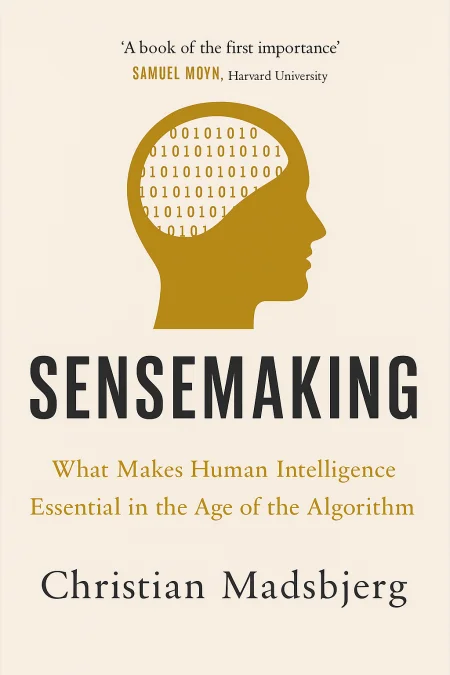
Sensemaking
What Makes Human Intelligence Essential in the Age of the Algorithm
Book Edition Details
Summary
In a landscape where numbers reign supreme and algorithms dictate decisions, Christian Madsbjerg's "Sensemaking" presents a daring counter-narrative. It's not just a book—it's a manifesto for those tired of data dictating every move. Madsbjerg champions the art of understanding through the lens of human culture, asserting that our greatest achievements don't spring from spreadsheets, but from the rich tapestries of language, history, and societal nuance. Through vivid profiles of visionaries like George Soros and Bjarke Ingels, he unveils a method that blends the practical with the philosophical, offering five transformative principles to reconnect with what truly matters. This book is a clarion call for leaders, creatives, and thinkers ready to rise above the mechanical hum of modernity and reclaim the profound insights of human experience.
Introduction
Modern society faces a critical crossroads between algorithmic thinking and human wisdom. While data science and artificial intelligence promise to solve complex problems through computational power, an essential dimension of understanding remains overlooked: the capacity to interpret cultural meaning and navigate human complexity. The contemporary obsession with STEM education and big data analytics has systematically devalued humanistic inquiry, creating a dangerous gap in our ability to comprehend the social contexts that shape behavior, innovation, and leadership. This exploration challenges the prevailing Silicon Valley ideology that reduces human experience to quantifiable metrics. Through philosophical frameworks, ethnographic methodology, and real-world case studies, a compelling argument emerges for recovering the interpretive arts that have guided human civilization for millennia. The analysis draws on phenomenology, anthropology, and practical wisdom to demonstrate why cultural intelligence cannot be replaced by algorithmic processing. By examining how master practitioners in business, politics, and creative fields synthesize multiple forms of knowledge, the investigation reveals that our most pressing challenges require not just technical solutions, but profound insights into what makes us human. The journey ahead demands intellectual courage to embrace complexity over simplification, context over abstraction, and meaningful interpretation over mere optimization.
The Crisis of Algorithmic Thinking and Silicon Valley Ideology
Silicon Valley's dominant worldview has fundamentally altered how society approaches problem-solving, innovation, and human understanding. This technological paradigm operates on the premise that all challenges can be reduced to engineering problems solvable through data analysis and algorithmic optimization. The culture celebrates disruption as inherently valuable, treating past knowledge as obsolete baggage that impedes progress. This mindset systematically dismisses the accumulated wisdom embedded in humanistic traditions, viewing experience and context as inefficiencies rather than essential sources of insight. The ideology's core assumptions reveal dangerous limitations when applied to human systems. Big data analytics excels at identifying correlations but cannot explain causation or cultural meaning. The famous failure of Google Flu Trends illustrates this fundamental flaw: algorithmic predictions collapsed when divorced from real-world understanding of human behavior. Similarly, the obsession with "frictionless" technology eliminates the productive resistance that often signals important boundaries or meaningful differences in social contexts. The consequences extend far beyond technology companies. Educational institutions increasingly prioritize quantitative metrics over qualitative understanding, while business leaders mistake numerical representations for actual reality. This reductionist approach creates a dangerous blind spot: leaders lose touch with the human circumstances underlying every market shift, political movement, and organizational challenge. When decision-makers cannot interpret cultural patterns or empathize with different worldviews, they become vulnerable to disruption by those who possess deeper contextual intelligence. The alternative requires recognizing that human behavior operates according to non-linear dynamics that resist algorithmic capture. Complex social phenomena emerge from cultural contexts, historical experiences, and shared meanings that cannot be reduced to data points. Effective leadership in an interconnected world demands the interpretive skills traditionally cultivated through liberal arts education, not just technical proficiency in data manipulation.
Cultural Understanding Through Thick Data and Phenomenology
Human behavior cannot be understood through individual psychology alone but must be analyzed within the cultural contexts that shape meaning and action. Phenomenology offers a rigorous methodology for investigating how people actually experience their worlds, moving beyond abstract theories to examine the lived reality of social existence. This approach reveals that seemingly personal choices emerge from shared cultural structures that operate below the threshold of conscious awareness. The distinction between thick and thin data proves crucial for genuine understanding. Thin data captures the traces of human action - clicks, purchases, movements - but provides no insight into the meanings that motivate behavior. Thick data encompasses the cultural textures that make actions intelligible: the stories people tell, the rituals they perform, the aesthetic preferences that signal identity. Understanding why people choose organic food requires grasping their relationship to health, nature, and social status, not merely tracking purchase patterns. Effective cultural analysis demands escaping the artificial constraints of laboratory settings to observe human behavior in natural contexts. Just as lions hunt differently in zoos versus savannas, people behave differently when removed from their authentic social environments. Focus groups and surveys strip away the very contexts that give actions their meaning. True understanding emerges from ethnographic immersion that captures the full complexity of how people navigate their worlds. Master practitioners intuitively employ phenomenological methods when making strategic decisions. Successful entrepreneurs immerse themselves in customer cultures rather than relying solely on market research. Political leaders develop sensitivity to cultural moods that polls cannot capture. Creative professionals draw inspiration from deep engagement with different worldviews and aesthetic traditions. This cultural intelligence provides competitive advantage precisely because it cannot be commoditized or automated - it requires human presence and interpretive skill.
The Creative Process: Grace, Mastery, and Meaningful Interpretation
Creativity fundamentally differs from manufacturing processes, despite popular misconceptions about innovation. Genuine insights arrive through grace rather than will - they emerge from sustained engagement with complex problems rather than forced brainstorming sessions. The design thinking methodology popular in Silicon Valley exemplifies the misguided attempt to systematize creativity through step-by-step processes that ignore the essential role of cultural knowledge and domain expertise. Master practitioners across disciplines describe remarkably similar experiences of creative breakthrough. Ideas come to them rather than being generated through conscious effort. This phenomenon reflects the reality that creativity requires both technical mastery and receptive openness to possibilities that exist beyond current understanding. The most innovative architects, entrepreneurs, and artists cultivate the ability to remain productively uncertain, allowing insights to emerge from their deep engagement with specific contexts and challenges. The progression from novice to expert follows predictable patterns that cannot be short-circuited through methodologies or frameworks. Beginning practitioners rely on rules and procedures, gradually developing pattern recognition skills through accumulated experience. Masters transcend conscious analysis entirely, responding fluidly to complex situations through embodied knowledge that integrates multiple forms of understanding. This expertise cannot be captured in algorithms because it depends on perspective, judgment, and care about meaningful outcomes. Abductive reasoning provides the logical foundation for genuine innovation. Unlike deductive or inductive approaches that work within established parameters, abductive thinking generates new explanations for puzzling phenomena. This process requires tolerance for ambiguity and the intellectual courage to pursue insights that cannot be immediately validated. The most significant breakthroughs in business, science, and art emerge through this type of interpretive leaping that synthesizes disparate observations into coherent new understanding.
Human Intelligence as the Ultimate Competitive Advantage
Human intelligence possesses unique capabilities that cannot be replicated by artificial intelligence, regardless of computational advances. While machines excel at optimization and pattern recognition within defined parameters, humans alone can interpret meaning, navigate cultural complexity, and exercise judgment about what matters most in specific contexts. These distinctly human capacities become increasingly valuable as automation handles routine cognitive tasks. The case studies of negotiators, politicians, teachers, and entrepreneurs reveal sophisticated forms of social intelligence that operate through empathic understanding and contextual sensitivity. These practitioners develop connoisseurship in reading cultural signals, managing group dynamics, and timing interventions for maximum effectiveness. Their success depends not on following prescribed procedures but on synthesizing multiple forms of knowledge to navigate unique situations with wisdom and care. The cultivation of perspective emerges as the highest form of human intelligence. Unlike information processing, which can be automated, perspective requires taking a stand about what constitutes meaningful differences in complex situations. Master practitioners develop aesthetic judgment that enables them to recognize quality, beauty, and significance in ways that transcend mechanical evaluation. This capacity for interpretation and evaluation cannot be reduced to computational processes because it depends on caring about outcomes and understanding cultural contexts. The future belongs not to those who can compete with machines at information processing but to those who can do what machines cannot: interpret meaning, navigate ambiguity, and create new possibilities through deep engagement with human reality. The liberal arts provide essential training for these capabilities because they cultivate the interpretive skills, cultural knowledge, and aesthetic sensitivity required for leadership in an complex world where the most important challenges are fundamentally human rather than technical.
Summary
The fundamental argument demonstrates that human flourishing requires recovering the interpretive arts that technological thinking has systematically devalued, because the most pressing challenges of our time demand cultural intelligence that no algorithm can provide. Rather than viewing technology as humanity's successor, wisdom lies in recognizing machines as tools that serve human purposes defined through the meaning-making capabilities that remain uniquely ours. The path forward requires intellectual courage to embrace the productive complexity of humanistic inquiry while using technological power to support rather than replace the interpretive work that makes life meaningful and organizations effective.
Related Books
Download PDF & EPUB
To save this Black List summary for later, download the free PDF and EPUB. You can print it out, or read offline at your convenience.
By Christian Madsbjerg
