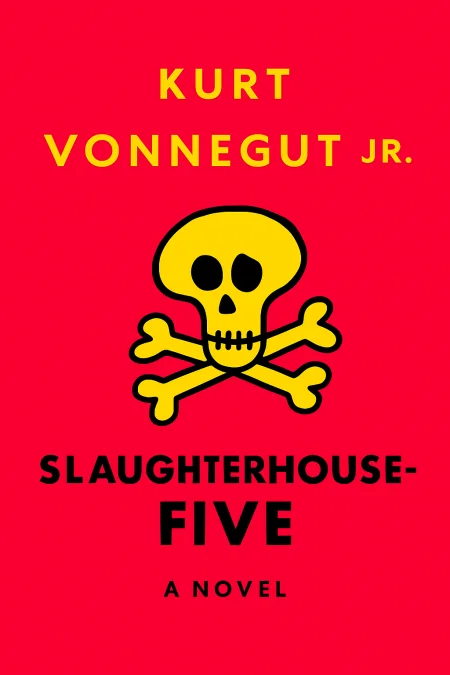
Slaughterhouse-Five
A Novel
Book Edition Details
Summary
In a tapestry woven from the threads of history, satire, and science fiction, "Slaughterhouse-Five" presents the extraordinary life of Billy Pilgrim, a man adrift in the currents of time. With his journey starting in the ashes of Dresden, this barber’s son and alien abductee navigates a world riddled with the absurdities of war and the chaos of existence. Kurt Vonnegut’s masterpiece defies traditional storytelling, offering a kaleidoscopic view of fate and free will. Through dark wit and raw honesty, Vonnegut captures the soul's resilience amidst destruction, making this novel a timeless beacon for those questioning the madness of their era. Unmatched in its inventive narrative and poignant critique, "Slaughterhouse-Five" remains a powerful reminder of the human capacity to endure, laugh, and challenge the status quo.
Introduction
In the winter of 1945, as Allied bombers approached the defenseless city of Dresden, an awkward young American soldier named Billy Pilgrim huddled in an underground meat locker, unknowingly about to witness one of the most devastating air raids in human history. What makes this moment extraordinary is not just the scale of destruction that followed, but how one man's experience of war would later unravel his entire sense of time, reality, and human meaning. This haunting account explores three profound questions that continue to shape our understanding of modern conflict: How do ordinary individuals survive the psychological aftermath of witnessing mass destruction? What happens when the machinery of war becomes so efficient that it erases the boundary between military necessity and civilian massacre? And perhaps most troubling of all, how do societies justify and forget acts of tremendous violence once they serve the victor's narrative? Through the fractured memories and time-traveling consciousness of its protagonist, this work offers readers an unflinching examination of how war destroys not just cities and bodies, but the very fabric of human consciousness. It speaks directly to anyone grappling with trauma, questioning official narratives of heroism and necessity, or seeking to understand how individuals cope when confronted with the incomprehensible scale of modern violence. The story refuses to offer easy answers or comfortable moral positions, instead presenting war as a chaotic, dehumanizing force that reduces both victims and perpetrators to their most basic survival instincts.
From Innocent to Infantry: Billy Pilgrim's Journey to War (1922-1944)
Billy Pilgrim entered the world in 1922 as the only child of an Ilium barber, shaped like a Coca-Cola bottle and destined for a life of quiet mediocrity. His early years painted the picture of countless young American men who would later find themselves thrust into the machinery of global conflict with no preparation for its realities. Billy's path to war began not with patriotic fervor or military ambition, but through the mundane process of conscription that swept up an entire generation during World War Two. The transformation from civilian to soldier reveals the arbitrary nature of wartime service. Billy had been studying optometry, a profession dedicated to helping people see more clearly, when the draft interrupted his education and sent him to basic training. The irony was profound: a man whose calling involved correcting vision would soon witness scenes so horrific that they would permanently distort his perception of reality and time itself. His training as a chaplain's assistant placed him in the peculiar position of being expected to provide spiritual comfort while carrying no weapons and possessing no real power to help anyone. The journey to the front lines stripped away Billy's civilian identity layer by layer. His father's death in a hunting accident during this period served as an ominous preview of the random, meaningless violence that would define his wartime experience. Unlike the heroic narratives often associated with military service, Billy's introduction to combat came through confusion, separation from his unit, and immediate capture behind enemy lines. He wandered the frozen forests of Luxembourg not as a warrior but as a lost child, sustained only by the brutal pragmatism of fellow soldiers who viewed him as both burden and responsibility. This early phase of Billy's story illuminates a crucial truth about modern warfare: it transforms ordinary people into participants in extraordinary violence, often without their understanding or consent. The gap between civilian life and military reality proved so vast that many soldiers, like Billy, never truly bridged it, remaining forever suspended between the innocent world they had known and the incomprehensible brutality they were forced to witness. This disconnection would become the foundation for all the psychological fractures that would follow.
The Dresden Firebombing: Witnessing History's Greatest Massacre (February 1945)
On the night of February 13, 1945, Billy Pilgrim and his fellow prisoners found themselves in the underground meat locker of Dresden's slaughterhouse when Allied forces began their systematic destruction of the city. What unfolded over the next fourteen hours represented one of the most concentrated acts of civilian killing in European history, yet it remained largely hidden from public consciousness for decades after the war ended. The bombing was not a military necessity but a demonstration of Allied air power against a city filled primarily with refugees, cultural treasures, and civilians who posed no threat to the war effort. The mechanics of the attack revealed the evolution of warfare into something approaching industrial slaughter. Wave after wave of bombers dropped incendiary devices designed not merely to destroy buildings but to create a firestorm that would consume everything organic in the city. The temperature reached levels hot enough to melt human bodies into unrecognizable remnants, while the lack of oxygen in the burning city suffocated those who survived the initial explosions. Dresden became a preview of the atomic age, demonstrating how modern military technology could erase entire populations with clinical efficiency. Billy's perspective from the underground shelter provided a unique vantage point for understanding both the scale of destruction and its fundamental meaninglessness. The sounds filtering down to the prisoners resembled giant footsteps as bombs fell in systematic patterns across the city above. The randomness of survival became apparent: those in deep shelters lived while those in shallower protection died, not through any moral calculation or military logic, but purely through chance. The meat locker that saved Billy's life had been designed for animals awaiting slaughter, a detail that would haunt him with its symbolic appropriateness. When the prisoners emerged the next day, Dresden had been transformed into a lunar landscape of twisted metal and ash. The absence of any remaining military targets made clear that the bombing had achieved something beyond strategic necessity. It had demonstrated the capacity of modern nations to commit acts of destruction so complete that they fundamentally altered the moral landscape of warfare itself. This moment planted the seeds of psychological trauma that would eventually shatter Billy's grip on linear time and rational thought.
Post-War Trauma and the Search for Meaning (1945-1968)
Billy's return to civilian life illustrated the impossible task facing veterans who had witnessed the extremes of modern warfare. Unlike soldiers of previous conflicts, who could process their experiences within established frameworks of heroism and national purpose, Billy carried memories that defied conventional understanding. The scale and senselessness of what he had seen in Dresden created a psychological wound that no amount of time or success could heal, leading to his eventual retreat into elaborate fantasies involving alien abduction and time travel. The symptoms of Billy's trauma manifested in ways that his society was unprepared to recognize or address. His frequent weeping, his detachment from normal social interactions, and his inability to maintain consistent relationships all pointed to what would later be understood as post-traumatic stress disorder. However, the medical and psychiatric establishment of the 1940s and 1950s lacked the conceptual tools to understand how witnessing mass civilian casualties could permanently alter a person's psychological functioning. Instead, Billy's problems were attributed to childhood experiences or personal weakness rather than the natural human response to inhuman events. Billy's construction of elaborate alternative realities involving the planet Tralfamadore represented his mind's attempt to create a framework for understanding experiences that exceeded normal human comprehension. The aliens in his visions taught that all moments in time exist simultaneously and that death is merely a temporary state, philosophies that allowed Billy to process the massive loss of life he had witnessed without descending into complete despair. These fantasies served as psychological defense mechanisms that enabled him to function in a society that preferred not to examine too closely the methods used to achieve victory in the war. The broader social context of the 1950s and 1960s complicated Billy's healing process. American society's investment in portraying World War Two as a moral crusade made it difficult for veterans like Billy to discuss experiences that complicated this narrative. The bombing of Dresden represented the kind of moral ambiguity that challenged comfortable assumptions about American righteousness and the clear distinction between good and evil in wartime. Billy's inability to reconcile his memories with society's preferred version of events contributed to his increasing psychological isolation and eventual mental breakdown.
Time, Memory, and the Eternal Present of Human Suffering
Billy's experience of becoming "unstuck in time" represents the profound disruption that extreme trauma inflicts upon human consciousness and memory. Rather than processing experiences in linear sequence, his mind began to move freely between past, present, and future, suggesting that certain events are so overwhelming that they shatter the normal structures through which humans organize reality. This temporal displacement allowed him to revisit moments of beauty and peace while also forcing him to relive scenes of horror with perfect clarity, creating a psychological state where healing and suffering existed simultaneously. The concept of being "trapped in amber" that Billy learned from his Tralfamadorian captors offered a metaphor for how traumatic memories preserve themselves with crystalline perfection across decades. Unlike normal memories that fade and transform over time, the images from Dresden remained as vivid and immediate in Billy's consciousness during the 1960s as they had been in 1945. This eternal present of trauma meant that Billy continued to experience the bombing not as a historical event but as an ongoing reality that shaped every moment of his subsequent life. Billy's attempts to share his experiences with the public through radio appearances and letters to newspapers revealed the profound disconnect between those who had witnessed the extremes of modern warfare and those who preferred sanitized versions of historical events. His message about the true nature of time and the persistence of all moments encountered resistance not because it was false, but because it threatened comfortable assumptions about progress, meaning, and the possibility of leaving the past behind. Society's rejection of Billy's testimony reflected a broader unwillingness to confront the moral complexities of victory achieved through massive civilian casualties. The alien philosophy that Billy embraced represented both a coping mechanism and a profound critique of human civilization's approach to violence and meaning. The Tralfamadorian belief that moments of beauty should be contemplated while moments of horror should be ignored offered a form of selective attention that contrasted sharply with human tendencies to glorify warfare while forgetting its true costs. Billy's adoption of this perspective allowed him to survive psychologically while simultaneously serving as a living reminder of experiences that society preferred to forget.
Summary
This haunting chronicle reveals the central contradiction of modern warfare: societies that pride themselves on moral superiority routinely employ methods of violence so extreme that they permanently damage both victims and perpetrators. The firebombing of Dresden exemplified this paradox, demonstrating how military technology had evolved beyond traditional concepts of proportionality and discrimination to enable acts of destruction that approached genocide in scale and indiscriminacy. Billy Pilgrim's psychological fragmentation serves as a metaphor for how entire civilizations process traumatic experiences that exceed their moral and conceptual frameworks, often through elaborate forms of denial and selective memory. The enduring relevance of Billy's story lies in its unflinching examination of how ordinary individuals cope when confronted with evidence that their society is capable of tremendous evil in service of perceived good. His retreat into fantasies of alien abduction and temporal displacement represents the broader human tendency to construct alternative realities rather than confront uncomfortable truths about the nature of power and violence. The book's refusal to offer redemption or meaning in suffering challenges readers to examine their own complicity in systems that perpetuate violence while maintaining comfortable distance from its consequences. Perhaps most importantly, it suggests that true healing requires acknowledging the full scope of human capacity for both creation and destruction, refusing the false comfort of simplified moral narratives that obscure the real costs of maintaining civilization through violence.
Related Books
Download PDF & EPUB
To save this Black List summary for later, download the free PDF and EPUB. You can print it out, or read offline at your convenience.
By Kurt Vonnegut Jr.
