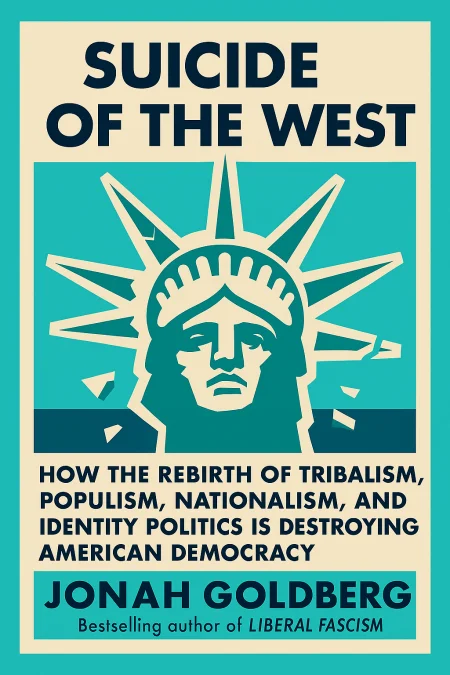
Suicide of the West
How the Rebirth of Tribalism, Populism, Nationalism, and Identity Politics is Destroying American Democracy
Book Edition Details
Summary
In the heart of modern democracy's twilight, Jonah Goldberg's "Suicide of the West" unveils a gripping narrative where the very threads of liberty fray under the weight of forgotten ideals. A tapestry woven with political insight, historical depth, and cultural critique, this thought-provoking work argues that the guardians of freedom stand at a precipice, as populism and nationalism gnaw at the roots of Western civilization. Goldberg paints a vivid picture of a society intoxicated by its own success, teetering on the brink of a return to chaos. Yet, within this narrative lies a rallying cry: a plea to reclaim the revolutionary spirit that once transformed England and America into beacons of hope. A daring exploration of identity and governance, this book is an urgent call to remember that true liberty demands vigilance and gratitude—lest we lose it all to the shadows of our past.
Introduction
Western civilization faces an existential paradox: the very prosperity and freedom that define modern democratic societies may contain the seeds of their own destruction. The extraordinary achievements of the past three centuries—unprecedented wealth creation, individual liberty, scientific progress, and peaceful cooperation across vast populations—represent a dramatic departure from humanity's natural state of tribal conflict, authoritarian rule, and material scarcity. These accomplishments emerged not through inevitable progress but through a delicate constellation of ideas, institutions, and cultural practices that remain fundamentally at odds with human evolutionary psychology. The analysis reveals how our deepest instincts, evolved over millennia for survival in small kinship groups, systematically undermine the artificial constructs of liberal democracy and free markets. Tribal loyalty, zero-sum thinking, deference to strongmen, and nepotistic preferences create constant pressure against the impersonal rules, abstract principles, and voluntary cooperation that enable large-scale civilization. This tension manifests across contemporary political movements, from identity politics to populist nationalism, all representing different expressions of humanity's retreat from Enlightenment ideals toward more primitive forms of social organization. Understanding this fundamental conflict between human nature and civilizational achievement becomes crucial for grasping why democratic norms erode, why institutional trust declines, and what might be required to preserve the fragile miracle of modernity for future generations.
The Unnatural Miracle: Western Prosperity Against Human Instincts
The transformation that began in eighteenth-century England and spread throughout the Western world represents the most dramatic departure from natural human conditions in our species' entire history. For approximately 200,000 years, Homo sapiens lived in circumstances closely resembling those of hunter-gatherer ancestors: material scarcity, tribal warfare, and hierarchical dominance by physically powerful individuals. Archaeological evidence reveals homicide rates in pre-agricultural societies fifty times higher than modern developed nations, while historical records document slavery, torture, and arbitrary rule as normal features of human organization across cultures and continents. The emergence of secure property rights, rule of law, religious tolerance, and market-based exchange required overcoming deeply embedded psychological tendencies that had served survival for millennia. Humans evolved to favor kinship networks over strangers, to engage in zero-sum competition for limited resources, and to submit to dominant personalities who could provide protection and leadership. The miracle of modernity demanded suppressing these instincts in favor of abstract principles, impersonal rules, and voluntary cooperation with unknown individuals. Several interconnected developments created the foundation for this transformation: the Protestant Reformation's emphasis on individual conscience, English common law's protection of property rights, the scientific revolution's validation of empirical inquiry, and the gradual acceptance of commercial activity as morally legitimate. These changes generated feedback loops that reinforced each other, producing unprecedented innovation and wealth creation. The philosophical revolution was equally profound, establishing concepts of individual human dignity, natural rights, and governmental legitimacy derived from popular consent rather than force or divine appointment. The artificial nature of these arrangements makes them perpetually vulnerable to corruption by natural human tendencies. Unlike biological evolution, which operates through genetic inheritance, civilizational progress depends on cultural transmission that can be disrupted or abandoned within a single generation. The prosperity that followed was neither inevitable nor self-sustaining, requiring constant effort to maintain institutions that contradict humanity's deepest instincts while providing the framework for unprecedented human flourishing.
Corruption's Logic: How Tribalism Undermines Liberal Institutions
Human nature operates as a constant gravitational force pulling against the artificial constructs that enable modern civilization. The psychological mechanisms that facilitated small-group survival—nepotism, tribal loyalty, zero-sum thinking, and deference to alpha personalities—systematically undermine the impersonal rules and universal principles necessary for large-scale cooperation. This corruption manifests not as individual moral failure but as the predictable reassertion of evolutionary programming that served human ancestors for millennia. Nepotism exemplifies how natural instincts corrupt institutional integrity. Throughout history, successful organizations have struggled against the tendency to favor family members and tribal allies over merit-based selection. The Catholic Church's requirement of priestly celibacy, the Ottoman Empire's use of enslaved administrators, and imperial China's employment of eunuchs all represented attempts to break cycles of hereditary privilege that naturally emerge when people can transmit advantages to offspring. Modern democratic institutions face identical pressures through political dynasties, regulatory capture, and crony capitalism that demonstrate kinship networks' persistent power. Tribal psychology transforms political disagreement into existential conflict. Humans evolved to distinguish between in-group members deserving loyalty and out-group members representing potential threats. This binary classification served survival in small bands but becomes destructive when applied to complex societies requiring cooperation across ethnic, religious, and ideological boundaries. Political parties increasingly function as tribal identities rather than policy coalitions, while social media amplifies tendencies to view disagreement as evidence of moral corruption rather than honest intellectual difference. The corruption process operates through accumulated small compromises that gradually transform institutional character. Each individual decision to favor personal connections over abstract rules appears reasonable in isolation, but cumulative effects convert merit-based systems into patronage networks. Bureaucratic agencies develop interests separate from public missions, creating self-perpetuating systems resistant to reform and accountability. The result is institutional capture by insider networks that exploit complexity and diffuse costs to secure advantages unavailable through democratic processes.
Modern Manifestations: Identity Politics and Administrative State Capture
Contemporary political movements across the ideological spectrum demonstrate humanity's retreat from universalist principles toward tribal organization. Identity politics on both left and right represents the return of kinship-based thinking that liberal democracy was designed to transcend. Rather than evaluating ideas and policies on merit, political discourse increasingly revolves around group membership and tribal loyalty, with each faction viewing others as existential threats to their way of life. Progressive movements organize around demographic categories, demanding special treatment based on race, gender, or other immutable characteristics. This approach fundamentally contradicts Enlightenment ideals of judging individuals by character and actions rather than group membership. When activists argue that merit-based systems perpetuate bias or that color-blind policies maintain injustice, they reject foundational principles of liberal equality in favor of tribal preferences. Populist movements exhibit parallel tendencies, appealing to ethnic or cultural solidarity while demonizing outsiders and elites through rhetoric of authentic versus cosmopolitan identity. The administrative state exemplifies institutional corruption through its transformation from neutral policy implementation to partisan political weapon. Bureaucratic agencies originally designed to execute democratically determined policies have evolved into quasi-independent power centers that create law through regulation, enforce it through investigation, and adjudicate disputes through administrative courts. This concentration of legislative, executive, and judicial functions in unelected bodies represents precisely the arbitrary power that constitutional government was designed to prevent. Cultural institutions have similarly succumbed to tribal dynamics as universities, media organizations, and professional associations abandon intellectual diversity for ideological conformity. The concept of objective truth yields to group-based epistemologies that validate different ways of knowing based on identity categories. Academic freedom, journalistic objectivity, and scientific inquiry suffer when institutional loyalty takes precedence over truth-seeking and open debate. Professional licensing, regulatory capture, and revolving doors between government and industry demonstrate how special interests exploit governance complexity to secure advantages while imposing diffuse costs on broader society.
Defending the Miracle: Constitutional Principles and Cultural Transmission
Preserving liberal civilization requires conscious effort to maintain artificial institutions against constant pressure from natural human tendencies. This defense begins with recognition and gratitude for extraordinary achievements of recent centuries, which have lifted billions from poverty, extended lifespans, and created unprecedented opportunities for individual flourishing. Without appreciation for what has been accomplished, there remains little motivation to undertake difficult work of institutional maintenance and cultural transmission necessary for continuation. Constitutional principles provide frameworks for channeling human nature constructively rather than attempting its elimination. The American founders understood that ambition, self-interest, and factional conflict were inevitable features of human behavior, designing systems that would harness these forces for public benefit through checks and balances, separation of powers, and federalism. The key insight involved creating institutional incentives for cooperation and restraint without requiring fundamental changes in human psychology, recognizing that power must be constrained regardless of who exercises it. Mediating institutions between individuals and the state serve as crucial buffers against both atomization and centralization. Families, religious congregations, voluntary associations, and local communities provide venues for meaningful participation and mutual aid that satisfy tribal instincts while building habits of cooperation and civic responsibility. The decline of these institutions creates vacuums that political movements and government programs attempt to fill, but they cannot provide the same sense of belonging and purpose that emerges from organic community relationships. Cultural transmission becomes the ultimate defense mechanism, requiring education that teaches each generation why artificial arrangements deserve preservation despite conflicts with natural impulses. This demands honest acknowledgment of both achievements and costs of modernity, along with practical wisdom about maintaining institutions that enable human flourishing while remaining vigilant against corruption that constantly threatens to undermine them. The stakes involve not merely political dysfunction but potential return to poverty, violence, and oppression that characterized most of human history before this extraordinary departure from natural conditions.
Summary
The fundamental insight reveals that human prosperity and freedom depend on maintaining artificial institutions that directly contradict our deepest evolutionary instincts, making civilization itself an ongoing act of resistance against human nature. The remarkable achievements of recent centuries represent not inevitable progress but a fragile miracle requiring constant vigilance and conscious effort to preserve against the systematic reassertion of tribal loyalties, nepotistic preferences, and authoritarian impulses that served survival for millennia before modernity. Understanding this dynamic provides both sobering recognition of challenges facing liberal democracy and practical guidance for preserving institutions that have enabled unprecedented human flourishing, with the alternative being not merely political dysfunction but return to the natural state of scarcity, violence, and oppression that characterized most of human existence before this unnatural miracle emerged.
Related Books
Download PDF & EPUB
To save this Black List summary for later, download the free PDF and EPUB. You can print it out, or read offline at your convenience.
By Jonah Goldberg
