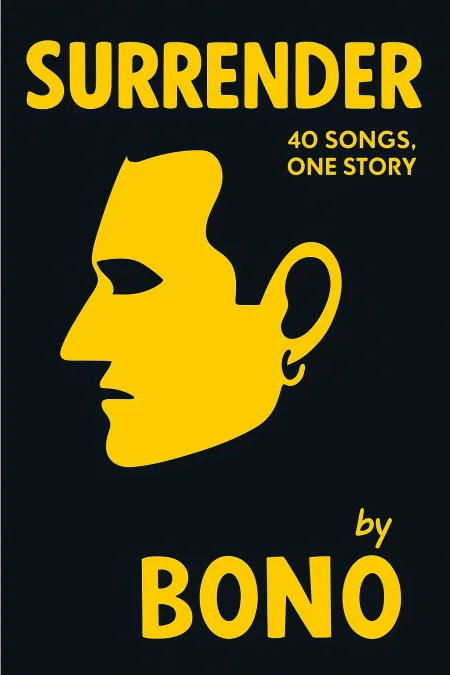
Surrender
40 Songs, One Story
byBono
Book Edition Details
Summary
He’s spent decades commanding stadiums, lobbying world leaders, and pouring heartbreak into lyrics that defined generations—but in Surrender: 40 Songs, One Story, Bono finally hands the microphone to himself. What emerges isn’t just a rock star memoir; it’s a raw, slyly funny, and deeply human reckoning with fame, faith, grief, and love. Told through forty U2 songs—each anchoring a chapter and accompanied by his own sketches—this isn’t a victory lap. It’s the backstage pass to his soul. From the loss of his mother at fourteen to the global stages of activism, Bono traces a life spent wrestling with the word he once resisted: surrender. The result is disarmingly intimate, richly reflective, and unmistakably his voice—at last, unfiltered.
Introduction
In the sterile corridors of Mount Sinai Hospital, a man lies on an operating table, his eccentric heart requiring urgent repair. As surgeons work to mend the physical chambers that have sustained him through decades of soaring melodies and stadium performances, Paul David Hewson—better known to the world as Bono—finds himself confronting the deeper chambers of memory and meaning that have shaped his extraordinary journey. From the working-class streets of Dublin's Northside to the global stages that have witnessed some of music's most transcendent moments, this is the story of a boy who lost his mother at fourteen and found his voice in the healing power of song. Through the lens of forty songs that chronicle both personal transformation and cultural revolution, we witness the evolution of an artist who refused to accept the boundaries between sacred and secular, between local and universal, between the intimate whisper of personal pain and the anthemic roar of collective hope. This memoir reveals how four Dublin teenagers—armed with little more than raw talent and boundless faith—became one of the world's most enduring bands, while their lead singer embarked on a parallel journey from suburban rebel to global activist, learning that the greatest performances happen not just on stage, but in the quiet moments when we choose to surrender our smaller selves to something larger.
From Dublin Streets to Global Stages
The suburbs of North Dublin in the 1960s were hardly the breeding ground for global superstars, yet it was here that young Paul Hewson began his transformation. Growing up on Cedarwood Road, he was shaped by the peculiar tensions of Irish life—Catholic and Protestant, traditional and modern, insular and cosmopolitan. His mother Iris's sudden death when he was fourteen shattered his world, leaving him with a rage that would fuel both his music and his activism for decades to come. The silence that enveloped 10 Cedarwood Road after her passing became both wound and catalyst, driving the young man toward the healing power of music and the surrogate family he would find in three other Dublin teenagers. The formation of U2 began with a simple notice posted on a school bulletin board by Larry Mullen Jr., seeking musicians for a band. What emerged from those early rehearsals in Larry's kitchen was something unprecedented—four teenagers who would remain together for over four decades, creating music that spoke to both intimate personal struggles and vast global concerns. The chemistry was immediate but not easy; Bono's intensity and ambition often clashed with his bandmates' more measured approaches, yet this tension became the engine of their creativity. They possessed more ambition than skill, more vision than experience, yet from this unlikely beginning would emerge a force that would reshape popular music. Their early years were marked by a fierce determination to be different from the punk bands surrounding them. While their contemporaries sang of nihilism and destruction, U2 reached for something transcendent. Songs like "I Will Follow" and "Gloria" announced a band unafraid of earnestness, of hope, of the very emotions that punk had declared dead. This willingness to be uncool, to risk sentimentality in service of genuine feeling, would become their signature. Their concerts became communal experiences that transcended mere entertainment, with Bono's stage presence evolving from awkward enthusiasm to commanding charisma as he learned to turn every venue into a laboratory for the kind of communion between performer and audience that would define their legacy. The leap from Dublin clubs to international recognition came through relentless touring and an almost mystical belief in their destiny. By the time they released "The Joshua Tree" in 1987, they had achieved something remarkable—massive commercial success without compromising their core values or their commitment to addressing the world's injustices through their art. The album captured the tension between America as dream and America as reality, exploring themes of spiritual seeking and political disillusionment that resonated far beyond their Irish origins, establishing them as artists capable of speaking to universal human experiences while maintaining their distinctive voice.
The Activist Rock Star: Music Meets Mission
The transformation from rock star to global advocate began with a simple recognition: fame is currency, and like any currency, its value depends on how it's spent. Bono's journey into activism wasn't a calculated career move but an organic evolution of his deepest convictions. The pivotal moment came during U2's participation in Live Aid in 1985, followed by their journey to Ethiopia, where the reality of extreme poverty struck with devastating clarity. Standing among the refugee camps, witnessing suffering on an almost unimaginable scale, Bono experienced what he would later describe as a spiritual awakening—a recognition that his platform came with profound responsibility. This revelation launched a decades-long campaign that would see Bono navigating the corridors of power with the same intensity he brought to the stage. His work with the Jubilee 2000 campaign to cancel Third World debt marked his entry into the complex world of international development, where he discovered that good intentions were not enough. Effective advocacy required mastering the tedious details of economics, politics, and diplomacy. He spent countless hours studying World Bank reports, learning the language of policy makers, and building relationships across the political spectrum. This willingness to do his homework earned him credibility with world leaders who might otherwise have dismissed him as another celebrity dilettante. Perhaps most remarkably, he learned to work with people he had once considered enemies. His collaboration with conservative politicians like Jesse Helms and his friendship with figures across the ideological spectrum demonstrated a pragmatic wisdom: in the fight against poverty and disease, there are no permanent enemies, only temporary obstacles to overcome. This approach required him to set aside his own political preferences in service of larger humanitarian goals, a sacrifice that not all his supporters understood or appreciated. His meetings with presidents and prime ministers, his testimony before Congress, and his collaborations with activists, scientists, and politicians revealed a man willing to work within the system to achieve revolutionary change. The establishment of organizations like DATA, ONE, and RED demonstrated Bono's evolution from passionate advocate to strategic architect of change. He understood that sustainable progress required more than celebrity endorsements; it demanded evidence-based advocacy, coalition building, and the patient work of policy transformation. His ability to translate complex policy issues into compelling narratives, to make the abstract personal and the distant immediate, became his greatest weapon in the fight against indifference. Through it all, he remained grounded by his understanding that fame was merely currency, valuable only when spent on worthy causes, never losing his edge as a performer while gaining respect as a serious advocate for the world's poorest people.
Love, Loss, and the Search for Home
Beneath the public persona of the globe-trotting rock star and activist lies a more intimate story of love, family, and the eternal human search for belonging. Bono's relationship with Ali Hewson, which began in their teenage years and has endured through four decades of extraordinary circumstances, provides the emotional anchor for his entire narrative. Their love story, played out against the backdrop of global fame, offers profound insights into the challenges and rewards of maintaining authentic relationships in an inauthentic world. Ali's grounding influence and fierce independence provided the stability necessary for someone whose professional life involved constant travel and public scrutiny, their relationship evolving from teenage romance to mature partnership that weathered the challenges of fame, family, and the competing demands of art and activism. The couple's four children grew up in the unique environment of having a father whose work took him from concert stages to refugee camps, from recording studios to the halls of power. Bono's struggle to balance his various callings with his responsibilities as a husband and father reveals the human cost of extraordinary ambition. His candid reflections on missed moments, the guilt of absence, and the constant negotiation between public duty and private devotion provide some of the most poignant insights into the price of pursuing multiple missions simultaneously. The loss of friends like Greg Carroll in a motorcycle accident served as stark reminders of mortality and the fragility of the bonds that sustain us, deepening the band's music and adding layers of grief and gratitude that enriched their emotional palette. Faith, too, plays a central role in this personal journey, though Bono's spirituality defies easy categorization. Raised in the Protestant tradition but married to a Catholic, he has always existed in the spaces between certainties, finding God not in doctrine but in doubt, not in answers but in questions. His famous declaration that he still hasn't found what he's looking for becomes not a statement of failure but of ongoing pilgrimage, a recognition that the search itself might be the destination. The band's relationship with faith remained complex and evolving, never settling into easy answers or comfortable certainties, learning to be "in the world but not of it" and discovering that their music itself was a form of prayer—a way of making the invisible visible and giving voice to the voiceless. The loss of his father, Bob Hewson, and the later revelation of family secrets forced Bono to confront his own understanding of identity, forgiveness, and the complex nature of human relationships. These personal reckonings, played out against the backdrop of global success, reveal a man constantly wrestling with the tension between who he is and who he's called to be. In the end, his search for home leads him back to the simple truth that love, in all its forms, remains the most powerful force for transformation, whether expressed through the bonds of marriage, the loyalty of friendship, or the compassion that drives one to fight for strangers on the other side of the world.
Summary
Bono's life story ultimately reveals that true surrender is not about giving up but about giving over, about finding the courage to use whatever gifts we possess in service of something greater than ourselves. His journey from a grieving Dublin teenager to a global icon demonstrates that the most profound changes often begin with personal loss, that our deepest wounds can become our greatest sources of strength and compassion, and that authenticity is more powerful than perfection. The memoir offers essential lessons for anyone seeking to make their mark on the world: first, that one can work within existing systems while maintaining revolutionary ideals, speaking truth to power while building bridges across ideological divides; second, that lasting change requires not just passion but persistence, not just vision but the practical wisdom to translate dreams into achievable goals. This story will resonate particularly with those who believe in the transformative power of music, the possibility of using fame for noble purposes, and the idea that ordinary people can indeed accomplish extraordinary things when guided by love, faith, and an unwavering commitment to justice, reminding us that we all have the capacity to surrender our smaller selves in service of our larger purpose.
Related Books
Download PDF & EPUB
To save this Black List summary for later, download the free PDF and EPUB. You can print it out, or read offline at your convenience.
By Bono
