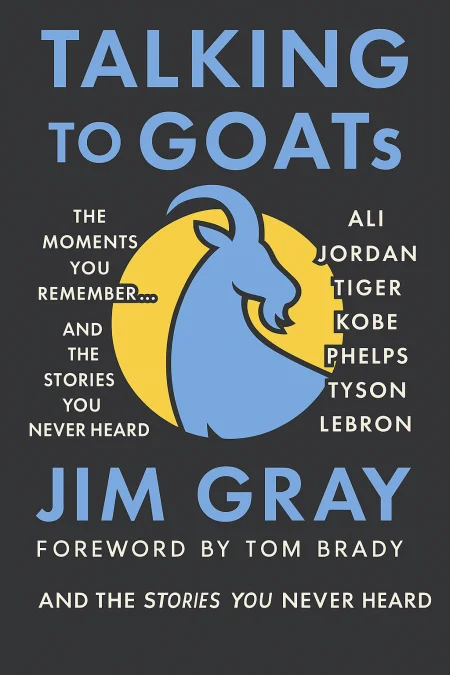
Talking to GOATs
The Moments You Remember and the Stories You Never Heard
Book Edition Details
Summary
In the pulsating heart of sports history lies Jim Gray's untold story—a mesmerizing odyssey through four decades of unforgettable moments and legendary figures. As a twelve-time Emmy Award-winning sports broadcaster, Gray has been the trusted confidant of icons like Muhammad Ali, Tom Brady, Kobe Bryant, and LeBron James. His memoir is not just a chronicle of interviews; it's a thrilling backstage pass to the triumphs and tribulations that have shaped the world of sports. From the adrenaline-charged arenas to the scandal-laden shadows, Gray's perspective is both insider and storyteller, capturing the essence of human emotion at its peak. Whether standing ringside with Mike Tyson in a moment of infamy or unraveling the intricate dance of fame and power, his narrative is a masterclass in the art of inquiry and a testament to the societal shifts driven by sport. In "Talking to GOATs," every page is an electrifying encounter with greatness, as Gray invites you into the arena where legends are born and history is made.
Introduction
The summer of 1984 painted a vivid picture of American sports at a crossroads. As Carl Lewis soared through the Los Angeles Olympic air, capturing four gold medals in front of adoring home crowds, few could have predicted that within a decade, questions about performance enhancement would cast shadows over athletic achievement. This moment crystallized a fundamental tension that would define sports for the next forty years: the eternal struggle between authentic greatness and manufactured excellence. Through the intimate perspective of a veteran broadcaster who witnessed these transformations firsthand, we discover how sports became far more than entertainment. They evolved into a cultural battleground where issues of race, integrity, and power played out in real time before millions of viewers. Three profound questions emerge from this journey: How do we separate genuine heroism from carefully crafted public personas? What happens when the pursuit of victory overrides moral boundaries? And why do certain athletic moments transcend sports to become defining chapters in American social history? This chronicle speaks to sports enthusiasts seeking deeper understanding, history lovers curious about cultural evolution, and anyone fascinated by how individual choices ripple through society. The stories within reveal both the intoxicating proximity to greatness and the sobering reality that our most celebrated figures remain beautifully, frustratingly human. It's an exploration of how touching greatness changes not just the athletes who achieve it, but the entire culture that witnesses their rise and fall.
The Golden Era: Ali, Magic and Authentic Greatness (1970s-1980s)
The 1970s and 1980s represented a golden age when sports heroes possessed an unfiltered authenticity that seems almost impossible in today's media landscape. This was the era of Muhammad Ali's principled sacrifice of his prime years for his beliefs, Magic Johnson's genuine joy transforming basketball culture, and athletes who answered every question without calculating the brand implications of their words. Ali embodied this era's defining characteristic: complete authenticity in public discourse. He never underwent media training or relied on publicists to manage his message. When he spoke about wanting to help the poorest people in Ethiopia and Afghanistan, it wasn't a calculated public relations move designed to enhance his marketability. It was the genuine conviction of a man who had already proven his willingness to sacrifice millions of dollars and his heavyweight title for his principles. His stand against the Vietnam War cost him three and a half years of his athletic prime, yet he never wavered in his commitment to his beliefs. Magic Johnson represented another facet of this golden era's appeal: the organic relationship between athletes and their audiences. He approached interviews with genuine enthusiasm, never guarding himself behind layers of handlers or carefully crafted talking points. There were no social media strategies, no brand management teams, just raw human connection that created a different kind of fame. This accessibility allowed fans to feel they truly knew their heroes, not just their carefully curated public personas. The athletes of this era established templates for modern sports celebrity while maintaining an innocence that would soon be lost forever. They demonstrated that greatness could coexist with humility, that standing for principles mattered more than protecting commercial interests, and that sports could serve as vehicles for meaningful social progress. Their legacy created expectations that would prove increasingly difficult for future generations to meet, as the pressures of modern media and corporate sponsorship made such unguarded authenticity nearly impossible to sustain.
The Scandal Years: Steroids, Corruption and Broken Trust (1990s-2000s)
The 1990s and 2000s marked a seismic shift as sports entered an era defined by systematic deception, institutional corruption, and the gradual erosion of trust between athletes and the public who had elevated them to heroic status. This period began with Ben Johnson's steroid disgrace at the 1988 Olympics and culminated in revelations that fundamentally altered how society viewed athletic achievement and the organizations that governed professional sports. Pete Rose's gambling scandal epitomized the complex relationship between athletic greatness and personal integrity that would define this era. His refusal to acknowledge betting on baseball games while managing the Cincinnati Reds represented more than individual dishonesty. It symbolized a broader cultural shift where winning at any cost became not just acceptable, but expected. His famous confrontation with a broadcaster during the 1999 World Series exposed the uncomfortable truth that some of our greatest heroes were also our most deeply flawed individuals, capable of jeopardizing the very sports that had made them legends. The steroid epidemic that followed represented an even more devastating betrayal of sporting values and public trust. From Barry Bonds' transformation into a home run machine to Marion Jones' tearful confession after years of denying performance-enhancing drug use, the era was characterized by systematic deception that reached every level of professional athletics. Athletes, coaches, team officials, and even league commissioners looked the other way as performance-enhancing drugs became endemic throughout professional sports. The pursuit of records, television ratings, and profits consistently overshadowed concerns about fairness, health, and the integrity of competition itself. These scandals taught a harsh but necessary lesson about the dangers of blind faith in athletic institutions and the heroes they promote. The damage inflicted during these years extended far beyond individual careers or tarnished records. It fundamentally altered the relationship between sports and society, creating a skepticism that would influence how future generations of fans approached athletic achievement and the claims of greatness made by athletes and their promoters.
The Perfection Era: Brady's Dynasty and Scientific Excellence (2000s-2010s)
The new millennium ushered in an era dominated by the scientific pursuit of perfection, exemplified by figures like Tom Brady, Tiger Woods, and Serena Williams who redefined the boundaries of athletic longevity and excellence through unprecedented levels of preparation, technological innovation, and obsessive attention to every detail of performance optimization. Brady's transformation from the 199th pick in the NFL draft to seven-time Super Bowl champion embodied this new paradigm of athletic achievement. His journey wasn't simply about natural talent or traditional training methods. It represented a complete reimagining of athletic longevity through meticulous attention to diet, sleep patterns, recovery protocols, and mental preparation techniques. The TB12 method became a blueprint for extending careers and maximizing performance, demonstrating that modern athletes could compete at the highest levels well into their forties through scientific approaches to physical and mental conditioning. This era also revealed the psychological costs of pursuing perfection in the public eye. Tiger Woods' spectacular rise and equally dramatic fall illustrated how the pressure to maintain flawless public images could lead to devastating personal consequences. His story became a cautionary tale about the impossibility of sustaining perfection in all aspects of existence, showing how the pursuit of athletic excellence could become both motivating and ultimately destructive when extended to every area of life. The modern perfection era established new standards for athletic achievement while simultaneously revealing the human costs of such relentless pursuit of excellence. Athletes like Brady, Woods, and Williams showed that perfection, while touchable for brief moments, remains ultimately unattainable as a permanent state. Perhaps the most profound lesson from this period is that the most human characteristic of our greatest athletes is their relentless pursuit of something they can never completely possess, and that this very impossibility is what makes their achievements so compelling and their failures so devastating.
Player Empowerment: LeBron's Decision and Athletic Activism (2010s-2020s)
The 2010s witnessed a fundamental shift in the balance of power between athletes and the institutions that had traditionally controlled their careers, public narratives, and social influence. This transformation reached its symbolic peak with LeBron James' decision to join the Miami Heat, announced through a live television special that forever changed how athletes communicate directly with their audiences and exercise control over their own destinies. LeBron's "Decision" represented far more than a simple free agency announcement or career move. By controlling every aspect of the broadcast, from the format to the charitable beneficiaries, James demonstrated that superstar athletes no longer needed to accept traditional pathways for major career decisions. The intense backlash he faced, particularly from Cleveland fans and media members who felt betrayed by the spectacle, revealed deep-seated cultural expectations about athlete loyalty and humility that were rapidly becoming obsolete in an era of player empowerment and global celebrity. The formation of player-driven super teams accelerated throughout the decade, as elite athletes began orchestrating their own partnerships rather than waiting for front offices to construct championship contenders around them. This shift culminated in James' return to Cleveland in 2014, where he delivered the city's first major sports championship in 52 years, proving that player empowerment could serve both individual ambition and community healing when exercised thoughtfully and with genuine commitment to larger purposes. Beyond team construction, athletes increasingly used their platforms to address social and political issues that extended far beyond sports. Colin Kaepernick's kneeling protest during the national anthem sparked nationwide debates about patriotism, police brutality, and the appropriate role of sports figures in political discourse. The formation of athlete-led voting initiatives and social justice organizations demonstrated how sports figures could mobilize their influence and resources for causes that would outlast their playing careers, establishing a new model for athletic leadership that encompassed both competitive excellence and social responsibility.
Summary
The evolution of American sports over these four decades reveals a central tension between society's desire for heroic figures and the complex reality of human nature under intense public scrutiny. From the authentic greatness of Ali and Magic through the corruption scandals that shattered institutional trust to the scientific pursuit of perfection and finally to the era of player empowerment and social activism, we observe a consistent pattern: the higher we elevate our athletes, the more profound the impact of their choices becomes on the broader culture. The most significant lesson from this journey is that sports serve as an accurate mirror for broader societal transformations. The civil rights struggles of the 1970s played out dramatically on athletic fields and in boxing rings, the win-at-all-costs mentality of the 1990s reflected broader cultural shifts toward moral relativism and institutional corruption, and the modern obsession with optimization and perfection mirrors our contemporary relationship with technology, data, and self-improvement. Understanding sports history provides crucial insights into understanding ourselves and our evolving values as a society. Moving forward, we must embrace a more nuanced and realistic view of athletic greatness that celebrates extraordinary achievement while acknowledging human complexity and moral ambiguity. Rather than seeking perfect heroes who can never disappoint us, we should appreciate the moments when ordinary people touch greatness through dedication, sacrifice, and authentic commitment to excellence. The real victory lies not in maintaining impossible standards of perfection, but in continuing to strive for excellence while remaining genuinely human, using whatever platform we possess to contribute positively to the communities and causes that extend far beyond our individual achievements.
Related Books
Download PDF & EPUB
To save this Black List summary for later, download the free PDF and EPUB. You can print it out, or read offline at your convenience.
By Jim Gray
