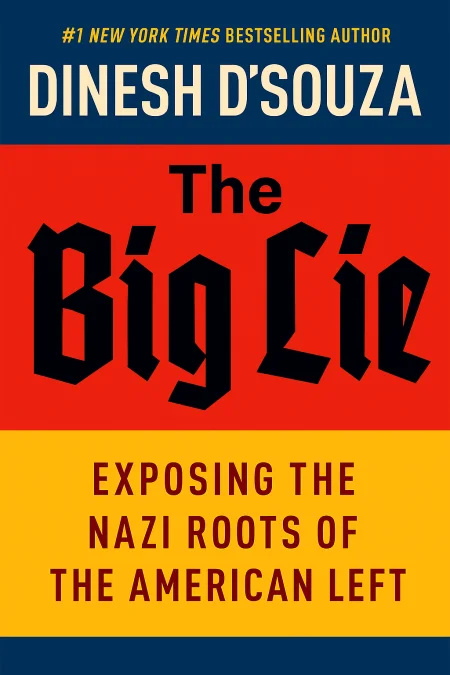
The Big Lie
Exposing the Nazi Roots of the American Left
Book Edition Details
Summary
Whispered accusations of fascism swirl in the political winds, yet Dinesh D'Souza's "The Big Lie" dares to flip the script. In a landscape where conservatives are branded as the new face of authoritarianism, D'Souza provocatively argues that the real fascist menace lurks within the Democratic Left. Through a lens both historical and contemporary, he unveils unsettling parallels between today's progressive agenda and the doctrines that once fueled Nazi ideology. Challenging the mainstream narrative, D'Souza promises a revelation: the accusers are, in fact, echoing the very extremism they claim to oppose. This bold exposition invites readers to question everything they thought they knew about the political spectrum's true colors.
Introduction
American political discourse has reached a fever pitch of accusation and counter-accusation, with charges of fascism flying from all directions. Yet beneath the rhetorical chaos lies a profound historical deception that has shaped our understanding of political movements for decades. This systematic inversion of historical truth has created a dangerous blind spot in our collective consciousness, allowing genuine authoritarian impulses to masquerade as their opposite while painting their opponents with the very crimes they themselves have committed. The mechanism of this deception operates through what can only be described as a "big lie" - a systematic campaign to relocate fascism and Nazism from their actual historical origins on the political left to an imagined home on the right. This relocation serves multiple purposes: it provides moral camouflage for contemporary left-wing authoritarianism while simultaneously delegitimizing conservative opposition through guilt by association. The sophistication of this operation rivals anything conceived in the propaganda ministries of the 20th century's most notorious regimes. Through rigorous historical analysis and ideological examination, we can trace the genuine intellectual and practical connections between historical fascist movements and contemporary American progressivism. This investigation reveals not merely surface similarities but deep structural parallels in methods, goals, and underlying philosophy. The implications of these discoveries extend far beyond academic debate, touching the very foundations of how we understand political legitimacy and moral authority in our current moment.
Fascism's True Identity: Leftist Origins and Progressive Foundations
The foundational myth of modern political discourse rests on a simple but false premise: that fascism and Nazism emerged from the political right and represent the ultimate expression of conservative authoritarianism. This narrative has become so deeply embedded in academic orthodoxy and popular consciousness that questioning it seems almost heretical. Yet the historical record tells a dramatically different story, one that reveals fascism as fundamentally a leftist phenomenon, born from socialist movements and nurtured by progressive intellectuals. The intellectual genealogy of fascism traces directly back to revolutionary socialism and its crisis of confidence in the early 20th century. When Marx's predictions of inevitable proletarian revolution failed to materialize in advanced capitalist nations, socialist thinkers faced a profound theoretical crisis. Rather than abandoning their collectivist vision, key figures like Georges Sorel developed new approaches that combined socialist economics with nationalist appeal. This synthesis recognized that workers responded more powerfully to ethnic and national identity than to abstract class consciousness. Giovanni Gentile, the philosophical architect of fascism, explicitly grounded his theory in socialist principles while rejecting what he saw as the outdated individualism of classical liberalism. His vision of the all-powerful state subsuming individual identity directly parallels the contemporary progressive dream of comprehensive government control over society. The fascist conception of corporate state control over private enterprise finds its modern expression in the regulatory capture and government direction of industry that characterizes today's progressive economic agenda. The transformation of socialism into fascism was not a betrayal of leftist principles but their logical evolution under changing historical circumstances. Revolutionary syndicalists and nationalist socialists found common ground in their shared opposition to bourgeois democracy and free-market capitalism. Their fusion created a new form of leftist politics that promised to achieve socialist goals through different means, replacing international class struggle with national struggle against competing nations and internal enemies.
Historical Evidence: Democratic Party's Nazi-Inspired Policies and Practices
The historical connections between American progressivism and Nazi Germany extend far beyond ideological similarities to include direct policy inspiration and mutual admiration. Nazi legal theorists explicitly studied American segregation laws, anti-miscegenation statutes, and eugenic sterilization programs as models for their own racial legislation. The Nuremberg Laws themselves were directly modeled on Democratic Party-sponsored legislation that had been operating in the American South for decades before Hitler came to power. American progressive intellectuals and Democratic politicians expressed open admiration for both Mussolini's fascist experiment and Hitler's early achievements. Franklin Roosevelt's New Deal administrators studied Italian fascist economic policies and sought to implement similar programs of state-directed capitalism in America. The National Recovery Administration represented the most ambitious attempt to establish fascist-style economic coordination in American history, complete with symbolic displays reminiscent of Nazi mass rallies and enforcement mechanisms designed to pressure businesses into compliance. The Democratic Party's long history of racial terrorism through the Ku Klux Klan provided operational templates for Nazi political violence. The systematic intimidation, symbolic displays of power, and targeted violence against designated enemies that characterized Klan operations in the post-Civil War South directly prefigured the brownshirt tactics that brought Hitler to power. Even the transition from chaotic vigilante violence to systematic state-sponsored discrimination followed nearly identical patterns in both contexts. Progressive eugenics programs in America preceded and inspired Nazi efforts to eliminate "unfit" populations through sterilization and eventually extermination. Margaret Sanger's Planned Parenthood emerged from this eugenic tradition, promoting the elimination of "undesirable" populations through birth control and selective reproduction. The continuity between Progressive Era eugenics and contemporary abortion advocacy demonstrates how leftist population control efforts have maintained their essential character while adapting their public presentation to changing moral sensibilities.
The Left's Propaganda Machine: How Progressives Rebranded Fascism
The most audacious aspect of the progressive deception involves the complete inversion of fascism's historical identity through sustained propaganda efforts spanning multiple generations. This rebranding operation required controlling the commanding heights of cultural production - universities, media organizations, and entertainment industry - to systematically rewrite the historical record and reshape public consciousness. Academic historians played a crucial role in this transformation by redefining fascism away from its substantive ideological content toward superficial characteristics that could be associated with political conservatism. Herbert Marcuse and Theodor Adorno of the Frankfurt School pioneered techniques for identifying "authoritarian personalities" through psychological profiles that targeted traditional religious and social values rather than actual fascist sympathies. Their work provided academic legitimacy for treating conservative beliefs as inherently dangerous while exempting leftist authoritarianism from similar scrutiny. The coordination of messaging across academic, media, and entertainment platforms created what can only be called a modern Gleichschaltung - the systematic alignment of cultural institutions behind a unified ideological agenda. This coordination operates not through direct state control but through shared ideological commitment and social pressure mechanisms that effectively exclude dissenting voices from mainstream cultural discourse. The result is a closed information environment that rivals anything achieved by historical fascist regimes. Progressive control of historical narrative has enabled the systematic concealment of embarrassing connections between American leftism and European fascism. The enthusiastic support that New Deal Democrats expressed for Mussolini, the direct policy borrowings between Nazi Germany and progressive America, and the ideological kinship between fascist intellectuals and American progressives have all been carefully airbrushed from standard historical accounts. This historical amnesia serves the crucial function of enabling contemporary progressives to pose as anti-fascist crusaders while employing recognizably fascist methods.
Fighting Back: A Conservative Strategy for Modern Denazification
The struggle against contemporary left-wing fascism requires understanding that we face not merely political opposition but a comprehensive assault on the foundations of constitutional government and individual liberty. The progressive movement has successfully captured the institutions of cultural transmission and uses them to wage systematic warfare against traditional American principles. Responding to this challenge demands recognition that normal democratic politics may be insufficient to address an opponent that rejects democratic norms. The first element of effective resistance involves ruthlessly exposing the big lie through sustained counter-propaganda efforts. Conservative movements must develop their own institutional infrastructure capable of competing with progressive dominance in education, media, and entertainment. This requires not merely responding to leftist narratives but creating compelling alternative narratives that reveal the true nature of progressive authoritarianism and its historical antecedents. Legal and political strategies must focus on dismantling the regulatory and administrative apparatus through which progressive fascism operates. The bureaucratic state serves as the primary instrument of leftist control, enabling unelected officials to implement political agendas regardless of electoral outcomes. Constitutional restoration requires dramatic reduction in federal power, restoration of state sovereignty, and elimination of the regulatory mechanisms that enable government control over private enterprise and individual choice. The most challenging aspect of anti-fascist resistance involves confronting leftist street violence and cultural intimidation with appropriate force. Historical experience demonstrates that fascist movements only respond to strength, not reasoned argument or moral suasion. Conservative movements must be prepared to meet violence with violence, legal intimidation with legal counter-attack, and cultural exclusion with their own forms of social pressure. The alternative is gradual submission to an opponent that recognizes no limits on its own behavior while demanding absolute restraint from its enemies.
Summary
The revelation of fascism's genuine leftist origins fundamentally transforms our understanding of contemporary political alignments and moral authority. What emerges from careful historical analysis is not merely an academic correction but a recognition that the very forces claiming to defend democracy against fascist resurgence are themselves the inheritors and practitioners of fascist methods. This inversion of political reality has created a situation where genuine democrats must fight against those who claim democratic legitimacy while employing authoritarian tactics. The stakes of this struggle extend beyond partisan advantage to encompass the survival of constitutional government and individual liberty in America. Only by recognizing the true nature of the threat and responding with appropriate determination can free citizens hope to preserve the foundations of their political system against this sophisticated assault.
Related Books
Download PDF & EPUB
To save this Black List summary for later, download the free PDF and EPUB. You can print it out, or read offline at your convenience.
By Dinesh D'Souza
