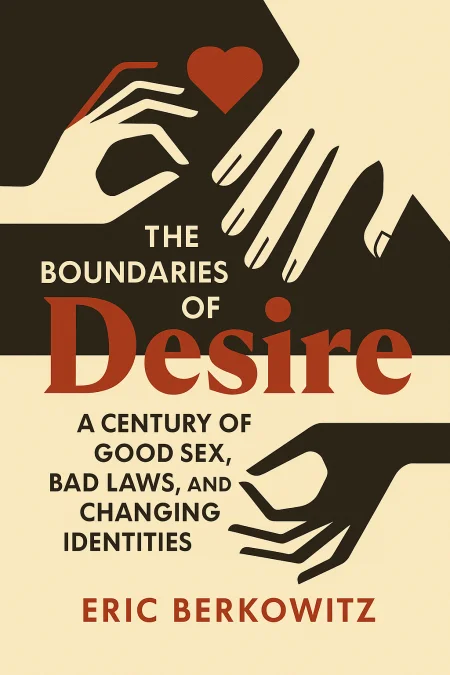
The Boundaries of Desire
A Century of Bad Laws, Good Sex and Changing Identities
Book Edition Details
Summary
In the ever-shifting landscape of sexual morality and legality, "The Boundaries of Desire" offers a riveting exploration into the tumultuous history of sex laws in America. The narrative plunges into the past century, a time when sharing birth control information was deemed obscene and marital rape was legally permissible. Amidst this backdrop of legal upheaval, Eric Berkowitz masterfully weaves together gripping human stories, illustrating how the law often lags behind societal change. By spotlighting real people caught in the crossfire of these contentious issues, Berkowitz exposes the hypocrisy and blind spots that persist within our justice system. As debates rage on about consent, identity, and rights, this book challenges readers to reconsider what justice truly means in the realm of human desire.
Introduction
In 1895, Oscar Wilde stood trial for "gross indecency," marking a pivotal moment when private sexual conduct became a matter of public law. His conviction would echo through the next century as Western societies grappled with fundamental questions: Who decides what constitutes acceptable sexual behavior? How should the law balance individual freedom with social order? And why do our moral certainties about sex shift so dramatically across time and place? This exploration reveals how sex law has served as both mirror and sculptor of social values, reflecting deep anxieties about power, identity, and change while simultaneously shaping the very behaviors it seeks to regulate. From the medicalization of homosexuality to the criminalization of birth control, from the creation of sex offender registries to battles over pornography, the past century demonstrates that sexual regulation often says more about those making the rules than those breaking them. The story challenges comfortable assumptions about progress and enlightenment, showing how scientific authority can be as oppressive as religious dogma, how laws designed to protect the vulnerable often harm them most, and how moral panics repeatedly transform ordinary citizens into dangerous criminals. For anyone seeking to understand how personal liberty intersects with social control, how fear shapes policy, or why sexual freedom remains perpetually contested, this historical journey offers essential insights into the forces that continue to shape our most intimate lives.
From Sin to Sickness: Medical Authority and Sexual Control (1900-1950)
The early twentieth century witnessed a profound transformation in how Western societies understood and regulated sexual behavior. What had once been framed as moral transgression against divine law increasingly became medical pathology requiring scientific intervention. This shift from sin to sickness would prove far more consequential than its advocates imagined, creating new forms of oppression wrapped in the authority of modern medicine. The period began with Victorian sexual morality still largely intact, but emerging fields of psychology and sexology were already challenging traditional frameworks. Figures like Richard von Krafft-Ebing catalogued hundreds of sexual "perversions" in clinical detail, while Sigmund Freud's theories about the universality of sexual desire began filtering into popular consciousness. The homosexual, previously understood as someone who committed sinful acts, was reconceptualized as a distinct type of person suffering from psychological inversion or nervous system defects. This medicalization initially appeared progressive, offering treatment rather than punishment. However, it created new categories of sexual deviance and empowered medical professionals to determine normalcy. The eugenics movement seized upon these scientific frameworks to justify forced sterilizations of thousands deemed sexually unfit, while psychiatric institutions became warehouses for those whose desires fell outside approved boundaries. Women who had children outside marriage were labeled "feebleminded," and homosexuals were subjected to experimental treatments ranging from hormone therapy to lobotomies. The two world wars accelerated these trends while revealing their contradictions. Military psychiatrists developed elaborate screening procedures to exclude homosexuals, even as the exigencies of warfare made such exclusions impractical. By 1950, the stage was set for even more dramatic transformations as the authority of science became fully entrenched in sexual regulation, promising rational solutions to age-old moral questions while creating entirely new forms of systematic oppression.
Liberation and Backlash: Rights Revolution Meets Moral Panic (1950-1980)
The decades following World War II brought unprecedented challenges to established sexual hierarchies, as civil rights movements, scientific advances, and cultural upheavals converged to reshape the legal landscape. This period saw both the entrenchment of sexual surveillance and the emergence of powerful liberation movements that would ultimately transform Western law and society. The Cold War years began with intensified persecution of sexual minorities, as homosexuals were branded security risks and purged from government service. The infamous Lavender Scare paralleled the Red Scare, with thousands losing their livelihoods based on the unfounded belief that sexual "deviants" were inherently disloyal and vulnerable to blackmail. Sexual psychopath laws proliferated, allowing indefinite confinement of those deemed dangerous, while sex offender registries emerged as tools of social control. The irony was stark: as America proclaimed itself the leader of the free world, it systematically oppressed its own citizens for private consensual behavior. Yet this same period witnessed the birth of organized resistance. The 1969 Stonewall riots marked a turning point, transforming shame into pride and secrecy into visibility. The women's liberation movement challenged male sexual privilege, demanding reproductive autonomy and an end to marital rape exemptions. Birth control became widely available, fundamentally altering the relationship between sex and reproduction. Scientific authorities began questioning their own assumptions, with the American Psychiatric Association's 1973 decision to declassify homosexuality as a mental illness representing a watershed moment in the medicalization of sexuality. The sexual revolution of the 1960s and 1970s created new possibilities and new anxieties. As traditional boundaries dissolved, conservative forces mobilized to defend what they saw as the foundations of civilization. The emergence of the religious right as a political force ensured that sexual liberation would face sustained opposition, setting the stage for the culture wars that would define the following decades.
Digital Age Contradictions: Modern Sex Law's Complex Legacy (1980-Present)
The final decades of the twentieth century and the opening of the twenty-first have been marked by increasingly polarized battles over sexual values, complicated by technological revolutions that have fundamentally altered how sexuality is experienced, expressed, and regulated. This era reveals both the persistence of age-old moral conflicts and the emergence of entirely new challenges that existing legal frameworks struggle to address. The AIDS crisis of the 1980s provided ammunition for those seeking to reverse sexual liberation, as disease became a weapon in moral warfare. Religious conservatives framed the epidemic as divine judgment while blocking public health measures that might have saved lives. Simultaneously, feminist antipornography campaigns allied with conservative moralists, creating strange bedfellows united in their belief that sexual expression posed fundamental threats to social order. The result was a new wave of restrictive legislation and moral panic that criminalized vast swaths of consensual adult behavior. The digital revolution has created unprecedented challenges for sexual regulation. The internet has made pornography ubiquitous while creating new forms of exploitation and abuse. Teenagers engaging in "sexting" find themselves labeled as child pornographers, while revenge porn destroys lives with the click of a button. Sex offender registries have expanded to include hundreds of thousands of people, many posing no danger to anyone, creating a permanent caste of sexual outcasts. The law struggles to distinguish between genuine threats and moral panics, often criminalizing the vulnerable while failing to protect those most at risk. Yet this same period has witnessed remarkable advances in sexual equality. Same-sex marriage has achieved legal recognition across much of the Western world, while transgender rights have gained unprecedented visibility and protection. The #MeToo movement has challenged entrenched patterns of sexual abuse and harassment, forcing a reckoning with power dynamics long ignored by legal systems. These victories remain fragile and contested, as evidenced by ongoing battles over reproductive rights, LGBTQ+ protections, and the boundaries of sexual expression.
Summary
The century-long evolution of sex law reveals a fundamental tension between the human desire for sexual autonomy and society's need to regulate intimate behavior for perceived collective benefit. This history demonstrates that sexual regulation is never really about sex alone, but serves as a battleground for broader conflicts over power, identity, and social change. Those who control sexual norms control the most intimate aspects of human experience, making sexuality a perpetual site of political struggle. The recurring pattern is clear: moral panics create new categories of sexual criminals, scientific authority legitimizes oppression through claims of objectivity, and marginalized groups bear the heaviest costs of sexual regulation. Yet this same history shows that seemingly immutable sexual hierarchies can be challenged and transformed when courage meets opportunity. The movements that achieved marriage equality, reproductive rights, and protection from sexual violence succeeded by refusing to accept that existing arrangements were natural or inevitable. For contemporary readers, this history offers three crucial insights. First, we must remain skeptical of claims that sexual regulation is based on objective science or timeless morality, recognizing instead how such laws reflect the prejudices and power structures of their time. Second, we should resist the temptation to criminalize sexual behavior that merely offends our sensibilities, focusing legal intervention on genuine harm rather than moral disapproval. Finally, we must remember that sexual freedom is not a luxury but a fundamental aspect of human dignity, requiring constant vigilance to protect and expand.
Related Books
Download PDF & EPUB
To save this Black List summary for later, download the free PDF and EPUB. You can print it out, or read offline at your convenience.
By Eric Berkowitz
