
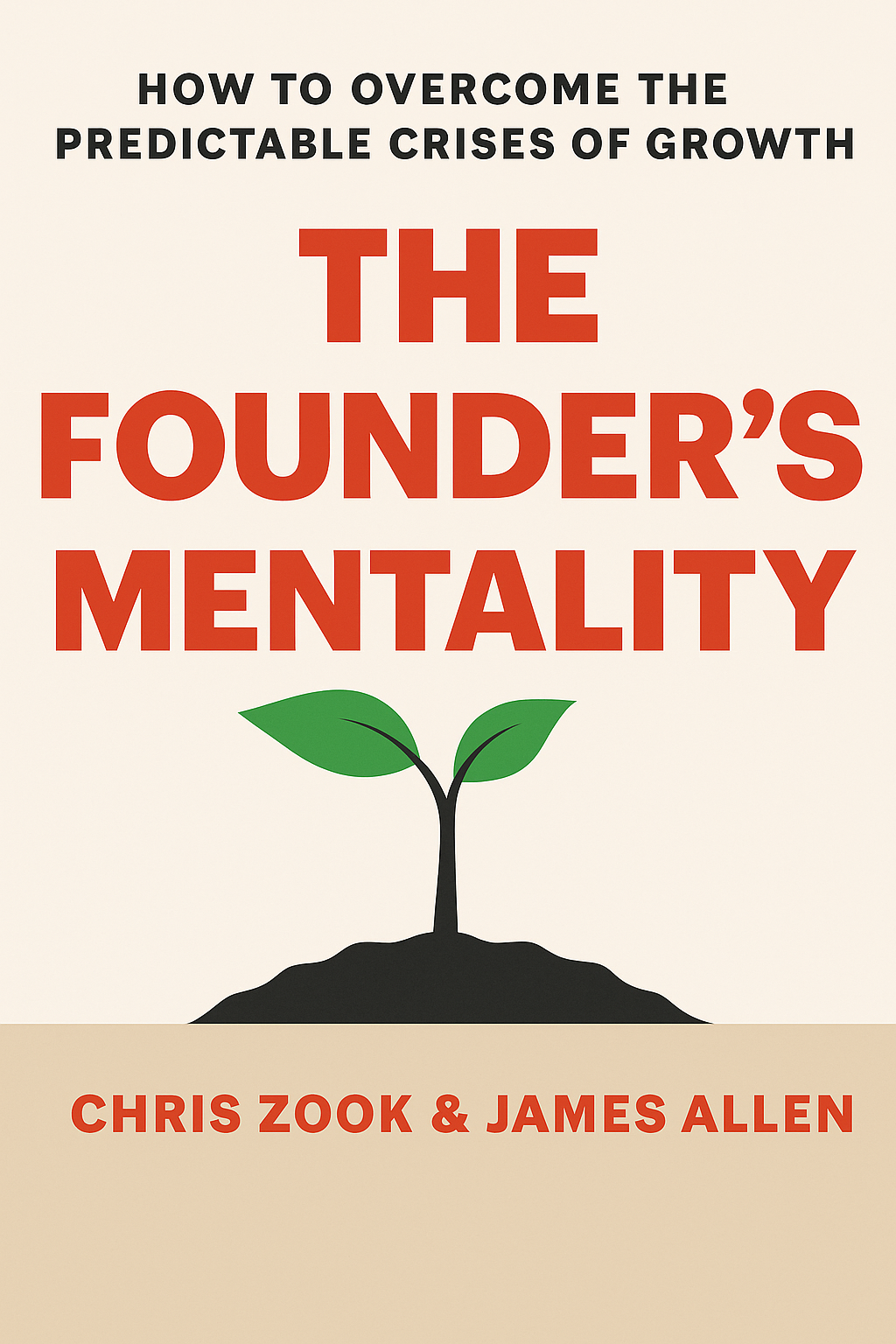
The Founder's Mentality
How to Overcome the Predictable Crises of Growth
Book Edition Details
Summary
In the dynamic world of business, where growth often feels like an elusive dream, "The Founder's Mentality" uncovers the secret recipe for enduring success. Authors Chris Zook and James Allen, drawing on their extensive research at Bain & Company, reveal that internal barriers—not market conditions—are the true culprits stifling company growth. The book explores the "founder's mentality," a powerful trifecta of attributes: a mission-driven insurgency, an owner's unyielding mindset, and an obsession with the frontline. Through vivid case studies and strategic insights, Zook and Allen invite leaders to reclaim these foundational principles, promising not just survival but thriving in any business climate. This book isn't just for entrepreneurs—it's a rallying cry for any leader ready to reignite the passion and purpose that fuels unstoppable growth.
Introduction
Why do some companies sustain extraordinary growth for decades while others falter after initial success? This fundamental question drives organizations worldwide as they struggle with the paradox that growth itself creates the very complexity that ultimately destroys their ability to grow. The founder's mentality represents a comprehensive framework for understanding how companies can maintain their entrepreneurial vitality while achieving significant scale. This theoretical construct encompasses three core elements: an insurgent mission that challenges industry norms, an obsession with front-line operations and customer experience, and an owner's mindset that prioritizes long-term value creation over short-term gains. The framework addresses critical questions about organizational evolution, leadership sustainability, and the preservation of competitive advantage across different growth phases. It provides structured insights into why internal dysfunction, rather than external competition, becomes the primary barrier to sustained success, and offers actionable strategies for maintaining organizational health during periods of rapid expansion and maturity.
The Three Pillars of Founder's Mentality
The founder's mentality framework rests on three interconnected pillars that distinguish exceptional companies from their competitors. Each pillar represents a fundamental orientation that drives behavior, decision-making, and organizational culture throughout different stages of growth. The insurgent mission forms the first pillar, characterized by a company's relentless focus on disrupting established industry practices on behalf of underserved customers. This goes beyond traditional mission statements to embody a genuine sense of purpose that energizes employees and guides strategic decisions. Companies with strong insurgent missions demonstrate what researchers term "spikiness" – an exaggerated focus on specific capabilities that create meaningful differentiation. They maintain limitless horizons, constantly seeking new ways to extend their core advantages into adjacent markets while staying true to their founding principles. Front-line obsession constitutes the second pillar, manifesting as deep engagement with customer-facing operations and unwavering attention to operational details. This obsession creates three distinct advantages: superior customer relationships, empowered front-line employees who feel ownership of outcomes, and continuous learning from direct market feedback. Organizations exhibiting front-line obsession invest heavily in training, empower decision-making at the customer interface, and ensure senior leadership maintains regular contact with operational realities. The owner's mindset represents the third pillar, encompassing a sharp focus on cash flow and costs, bias toward rapid action, and systematic aversion to bureaucracy. This mindset treats every dollar as personal money, prioritizes speed in decision-making, and maintains organizational structures that enable quick resource reallocation. Companies with strong owner mindsets typically exhibit flatter hierarchies, merit-based advancement systems, and clear accountability measures that connect individual performance to overall business success.
Overcoming Growth Crisis: From Overload to Free Fall
Growth creates predictable crises that follow recognizable patterns, each requiring distinct responses based on the founder's mentality framework. Understanding these crisis patterns enables leaders to anticipate challenges and implement preventive measures before problems become existential threats. Overload represents the first major crisis, typically occurring when successful companies struggle to manage rapid expansion while maintaining operational excellence. This crisis manifests through several warning signs: unscalable founders who become bottlenecks, loss of front-line voices in decision-making, erosion of accountability as organizations add layers, and talent dilution as companies hire quantity over quality. The westward winds of overload push companies away from their founding principles toward bureaucratic complexity. Stall-out constitutes the second crisis, characterized by sudden deceleration in growth rates and loss of competitive momentum. Companies experiencing stall-out often find themselves trapped by complexity doom loops, where increasing organizational intricacy slows decision-making and reduces agility. The curse of matrix management creates competing priorities and diluted accountability, while customer experiences become fragmented across departments. Most critically, companies lose connection to their original mission, leaving employees disengaged and competitors better positioned to serve customers. Free fall represents the most severe crisis, typically triggered by external disruptions but rooted in internal weaknesses that prevent adequate response. Unlike stall-out, free fall demands immediate comprehensive action across multiple dimensions simultaneously. Companies in free fall face obsolete business models, collapsed competitive positions, and existential threats to survival. Recovery requires fundamental refounding rather than incremental improvement, demanding new leadership teams, simplified business models, and massive investments in next-generation capabilities.
Building Scale Insurgency Through Leadership Excellence
Scale insurgency represents the ultimate achievement in organizational development – maintaining entrepreneurial vitality while capturing the benefits of significant size and market power. This state requires leaders who master the internal game of strategy, focusing on organizational health as the foundation for external competitive success. Effective scale insurgent leaders demonstrate Janusian thinking, simultaneously pursuing seemingly contradictory objectives such as maintaining insurgent speed while building systematic processes. They excel at saying no to preserve focus, recognizing that strategic discipline requires rejecting attractive opportunities that dilute core competencies. These leaders embrace the power of concentrated resource allocation, making disproportionate investments in key capabilities rather than spreading resources evenly across initiatives. The hidden killers of organizational speed become primary targets for scale insurgent leaders. They systematically eliminate excess complexity, neutralize energy vampires who slow decision-making, clarify decision rights to prevent committee paralysis, and maintain flat organizational structures. Monday meetings and similar rapid-cycle problem-solving mechanisms ensure obstacles are addressed before they compound into larger issues. Leadership development receives exceptional attention in scale insurgent organizations, with senior executives investing significant time in talent identification, coaching, and retention. These companies create mini-founder experiences that give promising employees entrepreneurial challenges within the larger organization, maintaining the developmental pipeline necessary for continued growth. They recognize that sustainable competitive advantage ultimately depends on human capital quality and organizational learning capacity. Most importantly, scale insurgent leaders share leadership responsibilities throughout the organization rather than centralizing all strategic thinking at the top. They create conditions where employees at all levels can exhibit founder-like thinking, taking ownership of problems and opportunities within their spheres of influence. This distributed leadership model ensures organizational resilience and maintains entrepreneurial energy across large, complex operations.
Implementing the Founder's Mentality Framework
Successful implementation of the founder's mentality requires systematic attention to both diagnostic assessment and intervention design. Organizations must honestly evaluate their current state across all three pillars while developing specific action plans tailored to their growth stage and competitive context. The diagnostic process begins with comprehensive surveys measuring employee and customer perceptions of organizational health. Companies must establish baseline metrics for insurgent mission clarity, front-line empowerment levels, and owner mindset behaviors. This assessment reveals gaps between leadership intentions and organizational reality, highlighting areas requiring immediate attention versus longer-term development efforts. Implementation strategies vary significantly based on crisis type and organizational readiness. Companies in overload benefit from Monday meetings that accelerate problem-solving, franchise player councils that amplify front-line voices, and zero-based budgeting approaches that maintain cost discipline. Organizations experiencing stall-out require more dramatic interventions, including complexity reduction campaigns, leadership team renewal, and fundamental business model simplification. The most successful implementations integrate multiple intervention streams simultaneously rather than addressing pillars sequentially. This approach recognizes the interconnected nature of the three pillars and prevents isolated improvements from being overwhelmed by unchanged organizational dynamics. Regular monitoring and adjustment ensure interventions remain relevant as organizations evolve and market conditions change. Private ownership transitions represent an increasingly important implementation option, providing the patient capital and reduced external pressure necessary for fundamental organizational renewal. This approach has proven particularly effective for companies requiring multi-year transformation efforts that public market pressures might otherwise prevent.
Summary
The founder's mentality framework reveals that sustainable competitive advantage flows from maintaining entrepreneurial vitality while capturing the benefits of scale – a balance that requires constant vigilance against the internal forces that naturally erode organizational health during growth. This comprehensive theory demonstrates that success in the external game of strategy depends fundamentally on mastering the internal game of organizational development, culture preservation, and leadership excellence across all levels of the company. By providing leaders with practical tools for diagnosing and addressing predictable growth crises, this framework offers hope that more organizations can achieve the rare distinction of scale insurgency, ultimately creating more value for stakeholders while maintaining the human energy and customer focus that drive meaningful innovation in competitive markets.
Related Books
Download PDF & EPUB
To save this Black List summary for later, download the free PDF and EPUB. You can print it out, or read offline at your convenience.
By James Allen
