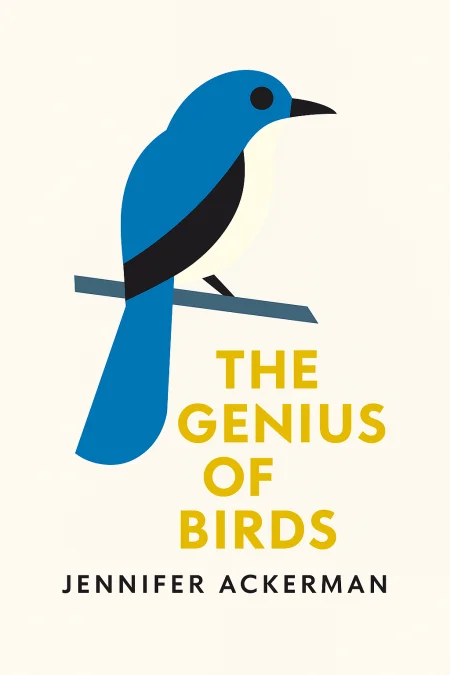
The Genius of Birds
Behold the brilliance of birds!
Book Edition Details
Summary
In the vibrant tapestry of life, birds soar as unexpected scholars of nature. Jennifer Ackerman's "The Genius of Birds" unveils a world where feathers meet intellect, challenging our very definition of smart. Traveling from remote jungles to bustling cities, Ackerman weaves a narrative that reveals the astonishing capabilities of these avian prodigies. With a flair for storytelling and a scientist's keen eye, she illuminates how birds master tool-making, navigate vast distances, and compose songs with a complexity that rivals human music. This book doesn't just inform; it redefines what it means to be intelligent, celebrating the avian mind in a way that will forever change your view of our feathered friends.
Introduction
Picture this: you're walking through a park when you notice a crow methodically dropping nuts onto the pavement, waiting for cars to crack them open, then swooping down to collect its meal once traffic clears. What you're witnessing isn't just clever behavior—it's a glimpse into one of nature's most underestimated forms of intelligence. For centuries, we've dismissed birds as simple creatures driven purely by instinct, their small brains seemingly incapable of complex thought. Yet groundbreaking research is revealing that these feathered creatures possess cognitive abilities that rival and sometimes surpass those of primates, challenging everything we thought we knew about intelligence itself. The avian mind operates on principles entirely different from our own, yet achieves remarkable feats of problem-solving, communication, and navigation that would impress any human observer. From parrots that understand abstract concepts to migratory birds that navigate across continents with GPS-like precision, the world of bird intelligence opens our eyes to the diverse pathways evolution has taken to create clever minds. As we explore the hidden genius of birds, we'll discover not only their extraordinary capabilities but also gain profound insights into the very nature of intelligence, learning, and what it truly means to think.
Tool Mastery and Problem-Solving: Engineering in the Bird World
The New Caledonian crow stands as nature's most accomplished engineer, crafting sophisticated tools that would make any human craftsperson proud. These remarkable birds don't simply use sticks they find lying around—they actively manufacture hooks from twigs, create stepped tools from leaves, and even use multiple tools in sequence to solve complex problems. What makes this achievement truly extraordinary is that tool-making was once considered the defining characteristic that separated humans from all other animals, yet these crows demonstrate engineering skills that rival those of our closest primate relatives. The process of tool creation reveals cognitive abilities that go far beyond simple trial and error. When a crow encounters a deep crevice containing insect larvae, it doesn't randomly grab any available stick. Instead, it carefully selects materials of appropriate length and diameter, strips away unnecessary branches, and may even craft a hook at the tip to better extract its prey. This behavior demonstrates an understanding of cause and effect, the ability to plan ahead, and most remarkably, the capacity to modify tools based on the specific requirements of each task. The birds appear to have a mental template of what makes an effective tool, suggesting they can visualize solutions before implementing them. Perhaps most fascinating is how these skills are transmitted across generations. Young crows don't inherit their tool-making abilities through genetic programming alone—they must learn through months of observation, practice, and experimentation under parental guidance. This cultural transmission of knowledge creates regional "technologies," where different crow populations develop distinct tool designs and manufacturing techniques. Just as human cultures have evolved different approaches to solving similar problems, these birds demonstrate that technological innovation isn't unique to humans but represents a broader principle of intelligent problem-solving. The implications extend far beyond corvid behavior, forcing us to reconsider our assumptions about intelligence and consciousness. If a bird with a brain no larger than a walnut can demonstrate such sophisticated engineering skills, what does this tell us about the nature of intelligence itself? These discoveries suggest that complex cognition can emerge through evolutionary pathways entirely different from our own, opening new perspectives on how minds can develop to meet environmental challenges.
Social Intelligence and Vocal Learning: Communication Beyond Instinct
The social world of birds reveals cognitive sophistication that parallels the complex intelligence of mammals while achieving these capabilities through distinctly avian pathways. Consider the western scrub jay, a bird that engages in what can only be described as Machiavellian intelligence. These jays not only cache food for future use but also employ elaborate deception to protect their stores from potential thieves. When a jay notices another bird watching it hide food, it will later return alone to move the cache to a new location. Even more remarkably, only jays that have themselves stolen food from others show this protective behavior, suggesting they can put themselves in the position of a potential pilferer and anticipate what that individual might do. This ability to understand the mental states of others represents a cognitive achievement that places birds among the most socially sophisticated animals on Earth. Male Eurasian jays appear to anticipate their mates' food preferences, offering treats that their partners haven't recently eaten rather than simply sharing their own current favorites. This behavior suggests an understanding of another individual's desires and mental state, a form of empathy that requires the ability to think about thinking—what scientists call theory of mind. The vocal learning abilities of birds provide another window into their remarkable social intelligence. Unlike most animals, whose calls are genetically programmed, many bird species must learn their songs through a process strikingly similar to how human children acquire language. Young songbirds go through distinct phases of vocal development, from early babbling-like subsong to the gradual refinement of adult song patterns. This learning process requires sophisticated neural machinery, with specialized brain circuits that show remarkable similarities to human language areas. What makes avian vocal learning particularly fascinating is its cultural dimension. Bird songs function as more than simple communication—they serve as markers of group identity, with regional dialects that help individuals recognize members of their local community. These cultural traditions can persist for decades, creating acoustic landscapes where different populations maintain distinct musical signatures. Some species even incorporate songs learned on distant wintering grounds into their breeding repertoires, creating a kind of acoustic passport that documents their travels and experiences across vast geographical ranges.
Navigation and Spatial Cognition: Mental Maps Across Continents
The navigational abilities of birds represent perhaps the most awe-inspiring cognitive achievements in the natural world. Every autumn, a tiny blackpoll warbler weighing less than half an ounce embarks on a nonstop flight from eastern North America to South America, covering over 1,500 miles of open ocean without landmarks, GPS, or any technological assistance. This feat requires not just extraordinary physical endurance but a suite of cognitive abilities that integrate multiple sources of information into precise navigational strategies that put human technology to shame. The mental maps that birds construct and maintain operate on scales both vast and minute, representing a form of spatial intelligence that challenges our understanding of animal cognition. At the largest scale, migratory birds appear to possess continent-spanning maps that incorporate magnetic field variations, star patterns, polarized light cues, and even infrasonic signals from distant geographical features. At the smallest scale, hummingbirds remember the locations of hundreds of individual flowers, tracking not just where they are but when each was last visited and when it's likely to have replenished its nectar. What makes avian navigation particularly remarkable is its flexibility and redundancy. Birds don't rely on a single navigational system but instead integrate multiple sources of information, switching between different strategies as conditions change. A pigeon might use magnetic cues on an overcast day, switch to solar navigation when the sun emerges, and rely on familiar landmarks as it approaches home territory. This cognitive flexibility allows birds to maintain their navigational accuracy even when individual cue systems are disrupted, demonstrating a level of adaptive intelligence that enables them to thrive in an ever-changing world. The neural basis of these remarkable spatial abilities lies in brain structures that have been shaped by millions of years of evolutionary pressure. Birds that engage in complex spatial tasks possess enlarged hippocampal regions specialized for spatial memory and processing. Even more remarkably, these brain areas can change size seasonally and with experience, growing larger when spatial demands increase and shrinking when they decrease. This neuroplasticity reveals that bird brains are not fixed structures but dynamic systems that adapt to cognitive challenges, providing insights into how intelligence itself can be shaped by environmental demands.
Summary
The exploration of avian cognition reveals a profound truth about intelligence: there are many pathways to building a clever mind, and evolution has crafted solutions far more diverse and sophisticated than we ever imagined. Birds achieve remarkable cognitive feats not through large, energy-expensive brains like mammals, but through neural efficiency, specialization, and the precise matching of mental abilities to environmental challenges. From crows that engineer tools with the precision of human craftspeople to songbirds that learn and transmit cultural traditions across generations, these discoveries force us to abandon our human-centric view of intelligence and recognize that sophisticated minds can emerge through entirely different evolutionary pathways. This new understanding raises fascinating questions about the nature of consciousness, creativity, and problem-solving that extend far beyond ornithology. If birds with walnut-sized brains can demonstrate planning, empathy, and cultural learning, what does this tell us about the fundamental requirements for complex cognition? How might these insights inform our development of artificial intelligence or help us better understand the cognitive abilities of other species we've yet to study thoroughly? For readers curious about the boundaries of intelligence and the remarkable diversity of life on Earth, the study of avian cognition offers a humbling reminder that extraordinary minds exist all around us, often in the most unexpected forms, challenging us to look at the natural world with fresh eyes and deeper appreciation.
Related Books
Download PDF & EPUB
To save this Black List summary for later, download the free PDF and EPUB. You can print it out, or read offline at your convenience.
By Jennifer Ackerman
