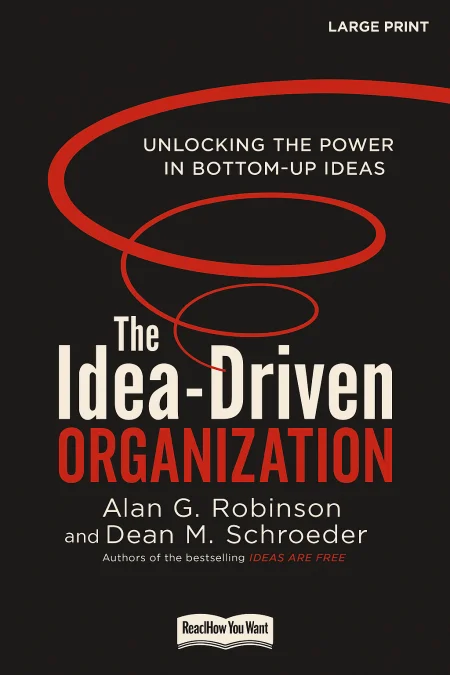
The Idea-Driven Organization
Unlocking the Power of Bottom-Up Ideas
byAlan G. Robinson and Dean M. Schroeder
Book Edition Details
Summary
Within the bustling corridors of modern enterprise, innovation often gets lost in translation, stifled by the very structures meant to harness it. But what if the most transformative ideas were not the domain of ivory-towered executives, but the lifeblood of the workforce? Robinson and Schroeder illuminate a path where the brilliance of frontline employees—those who breathe life into products and services—becomes the engine of change. Through vivid anecdotes and actionable strategies, they reveal how companies can cultivate an ecosystem of idea-driven dynamism, inspiring leaders to foster a culture where a cascade of ideas flows upward, not just from the top down. This book unravels the art of crafting a management team attuned to grassroots innovation, ensuring that every voice is heard and every idea has the power to ignite lasting success.
Introduction
Most organizations today face a profound paradox: while leadership teams pour enormous resources into innovation initiatives and improvement programs, they systematically ignore the most powerful source of performance enhancement available to them. This blind spot represents not just a missed opportunity, but a fundamental misunderstanding of how sustained organizational excellence actually emerges. The reality is that roughly 80 percent of an organization's improvement potential lies not in top-down strategic initiatives, but in the creative insights and practical knowledge of front-line employees who interact directly with processes, customers, and operational realities every day. The theoretical framework presented here challenges the dominant management paradigm by proposing a systematic approach to organizational transformation through bottom-up idea generation and implementation. This framework addresses several critical questions: How can organizations systematically capture and leverage the collective intelligence of their workforce? What structural and cultural changes are necessary to transform from command-and-control hierarchies to idea-driven systems? How do small, incremental improvements compound into breakthrough innovations and competitive advantages? The framework offers a comprehensive model for understanding the relationship between organizational alignment, leadership behavior, systematic processes, and sustained performance improvement. It provides both the theoretical foundation and practical methodology for creating organizations that can consistently outperform their traditionally managed counterparts by factors of several hundred percent in terms of improvement idea generation and implementation.
The 80/20 Principle and Leadership Transformation
The 80/20 Principle of Improvement represents a fundamental shift in understanding organizational performance dynamics. This principle asserts that approximately 80 percent of an organization's improvement potential resides in front-line ideas, while only 20 percent comes from management-driven initiatives. This counterintuitive distribution challenges conventional wisdom about where innovation and improvement originate within organizational structures. The principle operates through several interconnected mechanisms. Front-line employees possess what economists call "knowledge of particular circumstances of time and place," giving them unique insights into operational inefficiencies, customer needs, and process improvements that remain invisible to management operating with aggregate data. While managers excel at strategic direction-setting using high-level metrics, they lack the granular understanding necessary to identify the hundreds of small improvements that collectively drive organizational performance. The leadership transformation required to harness this principle involves moving from a command-and-control mindset to what can be termed "top-directed but bottom-driven" management. Leaders must learn to set clear strategic directions while empowering front-line teams to determine how best to achieve those objectives. This transformation faces significant psychological and structural barriers, as power tends to reduce leaders' cognitive complexity, diminish their listening abilities, and increase their tendency toward egocentricity. Consider how this principle manifests in practice through the lens of a manufacturing facility struggling with equipment downtime. Traditional management approaches would involve engineering studies, consultant recommendations, and top-down solutions. However, machine operators who work with equipment daily often possess intimate knowledge of subtle operational patterns, early warning signs, and practical workarounds that can prevent failures entirely. When organizations systematically capture and implement these insights, they frequently achieve performance improvements that exceed the results of expensive management-driven initiatives by several orders of magnitude.
Organizational Alignment and High-Performance Idea Systems
Organizational alignment for ideas requires a comprehensive framework that addresses every element of organizational design and management systems. This alignment framework operates on the principle that ideas are voluntary contributions that employees can easily withhold if they encounter barriers, indifference, or misaligned incentives. Unlike mandatory work activities, idea generation and sharing depend entirely on employee motivation and organizational receptivity. The framework encompasses multiple interconnected layers. Strategic alignment ensures that front-line goals translate meaningfully into actionable objectives that employees can influence through their ideas. Structural alignment addresses both vertical goal cascading and horizontal integration across departments, preventing the common problem where ideas require cross-functional cooperation that existing systems discourage. Management systems alignment involves budgeting adequate resources for idea implementation, streamlining purchasing processes for small improvements, and ensuring support functions can respond rapidly to front-line requests. Policy alignment represents one of the most critical and challenging aspects of organizational transformation. Most organizations accumulate layers of policies created by different managers at various times, each designed to solve specific problems but collectively creating barriers to rapid idea implementation. Effective alignment requires systematic review and modification of policies that inadvertently impede the flow of ideas, while establishing new policies that actively promote and support bottom-up innovation. The alignment framework recognizes that even a single misaligned element can block otherwise excellent ideas from implementation. For instance, a purchasing policy requiring multiple approvals for expenditures over twenty-five dollars can prevent teams from implementing obvious improvements, while accounting systems that lack job codes for improvement time make it impossible for employees to work on ideas during company time. High-performance idea systems require organizations to identify and systematically address these alignment gaps, creating seamless pathways from idea generation to implementation that support rather than hinder employee creativity and initiative.
Problem-Finding Techniques and Innovation Synergies
Problem-finding represents the often-overlooked foundation of systematic innovation and improvement. While most organizations focus extensively on problem-solving capabilities through methodologies like Six Sigma or lean manufacturing, they rarely develop their employees' ability to identify problems that aren't yet obvious or urgent. This oversight limits organizational improvement to addressing only the most visible issues while missing countless opportunities for enhancement that exist below the surface of daily operations. The problem-finding framework operates through two primary mechanisms: individual skill development and organizational sensitivity systems. Individual skill development involves training employees to recognize different categories of problems through techniques like idea activators and idea mining. Idea activators are brief educational modules that provide new perspectives or frameworks for identifying improvement opportunities, such as teaching environmental principles that help employees see waste reduction possibilities they previously overlooked. Idea mining involves extracting implicit insights from existing ideas to generate broader categories of improvement opportunities. Organizational sensitivity systems create structures and processes that surface problems automatically rather than relying solely on individual recognition. These systems can include customer feedback mechanisms designed to capture subtle dissatisfaction, internal processes that highlight inefficiencies, or regular systematic reviews that identify emerging issues before they become critical. The most effective organizations combine both approaches, developing individual capabilities while creating organizational mechanisms that amplify and systematize problem identification. The innovation synergies emerge from the relationship between systematic problem-finding and breakthrough innovation development. Large innovations invariably require numerous small supporting improvements to function effectively, creating a multiplicative relationship between front-line idea capability and innovation success. Organizations with high-performing idea systems can implement innovations more rapidly and effectively because they possess the infrastructure and cultural capability to generate and implement the supporting improvements that complex innovations require. This relationship explains why traditionally managed organizations often struggle to translate innovative concepts into operational realities, while idea-driven organizations can rapidly turn innovative concepts into market-leading capabilities.
Summary
The path to organizational excellence lies not in heroic leadership or brilliant strategy alone, but in systematically unlocking the collective intelligence and creativity of every person within the organization through structured, aligned, and culturally supported systems for generating, evaluating, and implementing improvement ideas. This framework represents more than an operational methodology; it constitutes a fundamental reimagining of how human potential can be mobilized within organizational structures. As global competition intensifies and the pace of change accelerates, organizations that master the principles of idea-driven management will possess sustainable competitive advantages that traditional hierarchical structures cannot match. For individual leaders and employees, this approach offers the possibility of creating work environments where human creativity and practical wisdom are valued, developed, and systematically leveraged to create both organizational success and personal fulfillment.
Related Books
Download PDF & EPUB
To save this Black List summary for later, download the free PDF and EPUB. You can print it out, or read offline at your convenience.
By Alan G. Robinson and Dean M. Schroeder
