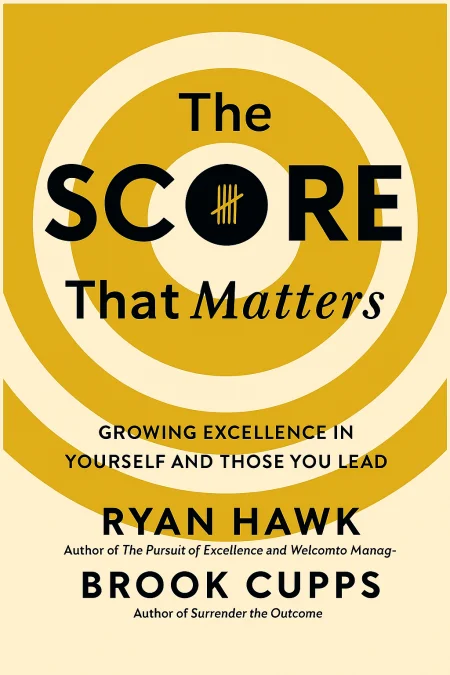
The Score That Matters
Growing Excellence in Yourself and Those You Lead
Book Edition Details
Summary
In a world where every "like" becomes a yardstick of worth, "The Score That Matters" challenges the tyranny of external validation with a bold proposition: true success is an inside job. Ryan Hawk and Brook Cupps invite readers to abandon the superficial chase for applause and instead cultivate an internal scoreboard, one that aligns with personal values and purpose. This refreshing guide, rich with practical wisdom and poignant anecdotes, offers tools to transform fear into fuel, liberate oneself from the chains of comparison, and embrace the often-overlooked art of everyday excellence. It's a call to reset our emotional thermostats and forge a path of genuine fulfillment, not by tallying wins, but by living with intention and integrity in every moment.
Introduction
In the hushed moments before the state championship game, Brook Cupps watched his team huddle together, their faces a mixture of determination and anticipation. Years of early morning practices, countless hours of preparation, and unwavering commitment had led to this single moment. Yet as he looked at these young men, he realized the most profound lesson wasn't about winning or losing—it was about discovering what truly matters when the external noise fades away. We live in a world obsessed with keeping score, where success is measured by comparisons, rankings, and visible achievements. From social media metrics to corporate ladder climbing, we're constantly evaluating ourselves against others' accomplishments. But what if this external scoreboard is leading us away from the very fulfillment we seek? What if the score that truly matters isn't the one everyone else can see? This exploration invites you into a different way of thinking about success and excellence. Through the experiences of coaches, athletes, business leaders, and everyday individuals who've discovered the power of internal purpose, you'll uncover how shifting focus from external validation to internal values creates not just better performance, but deeper satisfaction. The journey ahead reveals how authenticity, genuine relationships, and process-focused thinking can transform both individual lives and team dynamics, offering a pathway to excellence that sustains rather than depletes.
From External Validation to Internal Compass
The 1992 Olympics taught American basketball a harsh lesson that would echo for over a decade. After years of dominance, the unthinkable happened in Athens 2004—a team of NBA superstars lost not just the gold medal, but their very identity as champions. Tim Duncan lay flat on the pavement between garbage cans, hands covering his face in tears, while Dwyane Wade threw his bag in frustration. The external scoreboard had delivered its devastating verdict, and America's basketball heroes were crushed. But something remarkable emerged from this defeat. When Kobe Bryant joined the 2008 Olympic team, he brought a different approach entirely. While his teammates partied on the Las Vegas Strip until dawn, Bryant was in the hotel lobby at 5:30 AM, drenched in sweat, heading to his second workout of the day. He wasn't chasing external validation or trying to prove doubters wrong—he was living by an internal standard that demanded excellence regardless of circumstances or audience. The transformation was contagious. "Next thing you know, it goes from just Kobe going at five thirty in the morning to LeBron and D-Wade. By the end of the week, the whole team was getting up every morning, and we're on Kobe's schedule," teammate Carlos Boozer recalled. Bryant hadn't lectured or demanded; he had simply embodied a different score—one measured by personal commitment rather than public recognition. The power of an internal compass becomes clear when we examine what sustained Bryant throughout his career. As an eleven-year-old, when a school counselor told him that reaching the NBA was unrealistic, he didn't argue or seek validation. He simply responded, "I will be that one." This wasn't arrogance or naive optimism—it was the quiet confidence that comes from knowing your true north isn't determined by others' expectations or limitations. When we anchor ourselves to external scoreboards, we become dependent on circumstances beyond our control. We celebrate when comparisons favor us and despair when they don't, riding an emotional rollercoaster that ultimately leads nowhere meaningful. But those who discover their internal compass find something different—a sustainable source of direction that transcends wins and losses, praise and criticism. They understand that excellence isn't about being better than others; it's about becoming the best version of themselves, one day at a time.
Building Your Foundation: Values, Behaviors, and Team
David Taylor's journey to Olympic gold began not with grand proclamations or media attention, but in a small-town Ohio gymnasium where he made a decision that would define his character. As a high school wrestler, he chose to move up a weight class specifically to face another undefeated champion, creating what sports writers dubbed "the match of the century." This wasn't about external recognition—it was about testing the limits of what he could become. The path that followed would test Taylor's commitment to his internal score repeatedly. From 2012 to 2017, he lost five consecutive matches at the U.S. Olympic Trials, watching others claim the spots he desperately wanted. Each defeat could have been interpreted as proof that his dreams were unrealistic, that perhaps he should settle for lesser goals. Instead, Taylor used each setback to refine his understanding of what truly mattered—not the approval of others or even immediate success, but unwavering dedication to becoming excellent. Your personal foundation begins with identifying the values that will guide you regardless of external circumstances. For Taylor, this meant embracing challenge over comfort, process over results, and long-term growth over short-term satisfaction. These weren't abstract concepts but daily choices that shaped how he trained, competed, and recovered from disappointment. When he finally won Olympic gold in 2021, the victory was meaningful not because it validated him in others' eyes, but because it represented the culmination of a decade-long commitment to his internal score. Building this foundation requires more than identifying values—it demands translating them into specific behaviors that you can practice daily. Excellence emerges not from occasional heroic efforts but from consistent small actions that compound over time. The most successful individuals and teams create what they call "critical behaviors"—specific, observable actions that bring their values to life in real situations. These behaviors become their non-negotiable standards, the daily choices that determine who they're becoming regardless of external results. The people you surround yourself with either reinforce or undermine this foundation. True teammates aren't those who tell you what you want to hear, but those who care enough to tell you what you need to hear. They're the ones who will pick you up at 3 AM not because they have to, but because they're genuinely invested in your growth and success. When you build your foundation on authentic values, consistent behaviors, and genuine relationships, you create something that external circumstances cannot shake—a source of strength that sustains you through both triumph and adversity.
The Process of Excellence: Standards Over Results
JJ Redick's obsession with precision became legendary among his NBA peers, but few understood the depth of commitment behind his reputation as one of basketball's purest shooters. Every Sunday during the offseason, for thirteen straight years, Redick made exactly 342 shots—no more, no less. This wasn't arbitrary; it represented his systematic approach to excellence, where every element of preparation was measured and intentional. His game-day routine was equally meticulous. Redick knew precisely what he would eat for breakfast, when he would arrive at the gym, how long he would spend in the hot tub, and even timed his naps to wake up at exactly the right moment. When he used a cold tub for recovery, he didn't settle for the recommended twelve minutes—he stayed for twelve minutes and twenty-five seconds to ensure he never shortchanged the process. This level of detail might seem excessive, but it reflected something deeper: a love for the process itself rather than just its outcomes. What separated Redick from other talented players wasn't natural ability—many possessed equal or greater physical gifts. The difference was his understanding that excellence lives in the daily choices that others consider mundane. While competitors focused on game-time performance, Redick found fulfillment in the unglamorous work of constant improvement. His offseasons were harder than the regular season, filled with multiple daily workouts that most would consider punishment. For Redick, they represented freedom—the liberation that comes from knowing you've done everything possible to prepare. Process-oriented thinking transforms how we experience both success and failure. When outcomes become the primary measure, we're constantly at the mercy of factors beyond our control—the performance of opponents, the decisions of judges, the whims of market conditions. But when we anchor ourselves to process, we gain access to something more reliable: the satisfaction that comes from giving our best effort regardless of results. This shift doesn't guarantee favorable outcomes, but it provides something more valuable—sustainable motivation and genuine fulfillment. The most resilient individuals and teams understand that standards matter more than rules, consistency more than intensity, and daily faithfulness more than occasional heroics. They create systems that support their values and then trust those systems even when immediate results disappoint. This requires a different kind of courage—the willingness to stay committed to what you know is right even when external scoreboards suggest you should change course. Excellence isn't a destination you arrive at; it's a way of traveling that transforms both the journey and the traveler.
Leading Through Adversity and Authentic Connection
The 2020 basketball season presented Centerville High School with an unprecedented challenge that could have derailed their championship aspirations. COVID-19 restrictions meant constant uncertainty—games canceled without notice, players quarantined at random moments, and practices conducted in empty gymnasiums. Many teams allowed these disruptions to become excuses for diminished performance. Brook Cupps and his players chose a different response: "Advantage us." This wasn't merely positive thinking or motivational rhetoric. It represented a fundamental shift in how they interpreted adversity. Instead of viewing challenges as obstacles to overcome, they saw them as opportunities to demonstrate their true character. When forced to practice individually rather than as a team, players found creative ways to maintain their conditioning and skills. When games were played in silent gymnasiums, they learned to generate their own energy and motivation. Each disruption became evidence that they could handle whatever circumstances arose. The "advantage us" mentality proved transformative not because it eliminated difficulties, but because it changed their relationship with difficulty itself. Other teams experienced the same challenges, but Centerville developed confidence in their ability to thrive regardless of conditions. This internal resilience became their greatest competitive advantage—not superior talent or favorable circumstances, but unshakeable belief in their capacity to respond excellently to whatever emerged. Authentic leadership in challenging times requires vulnerability and transparency rather than false bravado. The most effective leaders don't pretend difficulties don't exist; they model how to face them with courage and creativity. They understand that trust is built not through perfection but through consistency—showing up with the same values and commitment whether circumstances are favorable or challenging. This creates psychological safety where others feel empowered to take risks, share ideas, and support one another through uncertainty. The deepest connections are forged not in moments of easy success but in shared struggles where true character emerges. When teams learn to say "advantage us" in the face of adversity, they discover something profound about human potential—that our greatest limitations often exist not in external circumstances but in how we choose to interpret and respond to them. This shift from victim to victor, from reactive to responsive, represents the essence of internal scorecard living. It's about finding meaning and purpose not despite life's challenges, but because of how we choose to meet them.
Summary
The most profound discovery in pursuing excellence isn't that external achievements become meaningless, but that they become secondary to something far more sustainable—the daily choice to align actions with values, to build authentic relationships, and to find fulfillment in process rather than just outcomes. When we shift from asking "How do I measure up?" to "How do I become who I'm meant to be?", everything changes. True excellence emerges when we stop treating life as a competition against others and start viewing it as a collaboration with our highest potential. This doesn't mean abandoning goals or becoming indifferent to results, but rather discovering that the most meaningful victories happen within us—in moments of courage when we choose growth over comfort, authenticity over approval, and service over self-interest. The teams and individuals who sustain excellence over time understand that the score visible to others tells only part of the story. Your internal compass is always available, waiting to guide you toward decisions that honor your deepest values and highest aspirations. The question isn't whether you have what it takes to pursue excellence—you do. The question is whether you're willing to trust a different kind of scoreboard, one that measures progress in character, relationships, and the quiet satisfaction that comes from knowing you're becoming exactly who you were meant to be. That transformation, invisible to many but felt by all who encounter you, represents the truest measure of a life well-lived.
Related Books
Download PDF & EPUB
To save this Black List summary for later, download the free PDF and EPUB. You can print it out, or read offline at your convenience.
By Ryan Hawk
