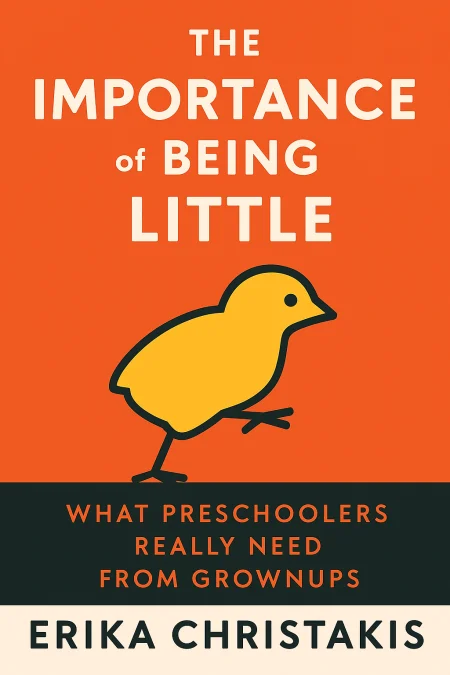
The Importance of Being Little
What Preschoolers Really Need From Grown-Ups
Book Edition Details
Summary
In a world where children's laughter and curiosity are stifled by rigid lesson plans and academic pressures, Erika Christakis offers a revelatory perspective on early childhood education. Armed with her expertise and passion, Christakis champions the innate genius of young minds, urging parents and educators to liberate learning from the constraints of conventional schooling. She paints a vivid picture of the preschool years as a time rich with potential, not just a stepping stone to an uncertain future. Her compelling narrative dismantles the myth that success is born from standardized metrics, revealing instead a landscape where imagination thrives and genuine learning unfolds. With pragmatic strategies to nurture a child's natural wonder, Christakis empowers adults to cultivate environments that truly support the vibrant, inquisitive spirits of the little ones they guide.
Introduction
Picture a three-year-old crouched on the sidewalk, completely absorbed in watching ants march in formation toward a dropped cookie crumb. She narrates their journey with scientific precision, creating elaborate theories about their destination and purpose. To most adults hurrying past, this might seem like simple child's play, but what's actually unfolding is a sophisticated display of observation, hypothesis formation, and scientific reasoning that would impress any researcher. This scene captures a profound truth that modern education often overlooks: young children possess extraordinary intellectual capabilities that far exceed our expectations, yet we've created learning environments that frequently stifle rather than nurture their natural brilliance. The early years of human development contain some of the most remarkable learning achievements our species ever accomplishes. Children master language, develop complex social understanding, and construct intricate theories about how the world works, all while appearing to simply play and explore. But here's the paradox: as we've learned more about children's incredible cognitive abilities, we've simultaneously moved further away from educational approaches that honor and support these natural learning processes. Instead, we've embraced methods that treat young minds as empty containers to be filled rather than powerful engines of discovery to be fueled. This exploration reveals how children's minds actually work during these crucial early years, why their natural ways of learning through play and exploration are far more sophisticated than we realize, and what happens when we create environments that truly understand and support the remarkable learning power that lies within every young child.
The Remarkable Intelligence Hidden in Young Minds
Young children are natural scientists, philosophers, and mathematicians whose intellectual capabilities consistently astonish researchers who take the time to study them carefully. Babies as young as six months demonstrate moral reasoning, distinguishing between helpful and harmful characters in simple scenarios. Toddlers grasp mathematical concepts like one-to-one correspondence and basic algebraic thinking long before they can count to ten. Preschoolers engage in sophisticated logical reasoning, understanding complex relationships between cause and effect while constructing elaborate theories about everything from why shadows change shape to how friendship works. Consider the four-year-old who announces that birds could steal socks from a clothesline for their nests because that makes sense with what birds do, but the same birds couldn't operate a television remote because birds don't understand human technology. This child is demonstrating nuanced thinking about biological constraints, intentionality, and the boundaries between what's possible and impossible in the natural world. Such reasoning reveals cognitive sophistication that many educational approaches completely miss, focusing instead on whether the child can recite the alphabet or identify colors on command. The tragedy lies not in children's capabilities, which are remarkable, but in our failure to recognize and build upon them. Traditional early childhood education often treats young minds as deficient versions of adult minds, emphasizing what children cannot yet do rather than marveling at what they can accomplish. We drill them on isolated facts like letter names and number sequences while ignoring their profound questions about justice, identity, and how the world works. We interrupt their deep investigations to move them through predetermined curricula, missing opportunities to witness and support genuine intellectual development. When we truly see children's hidden intelligence, everything changes. We begin to understand that the question isn't whether young children are capable of sophisticated thinking, they clearly are. The question becomes whether we're creating environments and interactions worthy of their remarkable minds. The most effective early learning happens when adults recognize children as competent thinkers who bring their own observations, theories, and insights to every encounter, rather than empty vessels waiting to be filled with adult knowledge.
Play as Nature's Learning Laboratory
Play represents far more than a pleasant break from serious learning, it is the primary mechanism through which young children develop the cognitive, social, and emotional skills that will serve them throughout life. Every mammal plays, and the more intelligent the species, the more complex and extended their play behaviors become. For humans, play serves as an evolutionary adaptation that allows children to practice essential skills, explore social roles, and develop creativity in a safe, low-stakes environment where mistakes become learning opportunities rather than failures. Through play, children naturally develop mathematical thinking as they sort objects by attributes, create repeating patterns with blocks, and explore spatial relationships while building elaborate structures. They enhance language skills through storytelling, negotiation with playmates, and the rich vocabulary that emerges from imaginative scenarios requiring precise communication. Scientific reasoning flourishes as children experiment with cause and effect, test hypotheses about how materials behave, and make predictions about outcomes. The child who spends an hour perfecting a block tower is simultaneously learning about physics, engineering, persistence, and problem-solving in ways that no worksheet could replicate. The social dimensions of play prove equally crucial for development. When children engage in pretend play together, they must negotiate complex social dynamics, establish and modify rules, take turns, and navigate conflicts. They learn to read facial expressions and vocal tones, understand different perspectives, and regulate their emotions when interactions don't proceed as planned. These experiences build the foundation for empathy, collaboration, and communication skills that will influence every future relationship and learning opportunity. Unfortunately, many educational settings have created a false dichotomy between play and learning, treating them as competing activities rather than complementary aspects of development. This misunderstanding has led to the systematic elimination of play from preschool and kindergarten classrooms, replaced by direct instruction and academic drills that are demonstrably less effective at promoting the flexible thinking skills children need for long-term success. When we restore play to its rightful place as nature's curriculum for young minds, we give children access to their most powerful learning tool.
Creating Environments That Honor Child Development
The most effective learning environments for young children are thoughtfully designed to support exploration, discovery, and meaningful relationships rather than passive absorption of predetermined content. These spaces recognize that children learn best when they can pursue genuine interests, ask authentic questions, and construct understanding through hands-on experience and social interaction. The environment itself becomes a teacher, offering rich materials and experiences that invite investigation and support development across all domains. Quality learning environments provide open-ended materials that can be transformed according to children's imagination and purposes. Simple wooden blocks become buildings, vehicles, or animal habitats depending on the child's current interests and developmental needs. Art materials invite experimentation with color, texture, and form rather than production of predetermined crafts that all look identical. Natural materials like water, sand, clay, and collected treasures from nature offer endless possibilities for scientific exploration, mathematical thinking, and creative expression while connecting children to the physical world in meaningful ways. The physical environment matters enormously, but the social and emotional climate proves even more crucial for supporting development. Children thrive when they feel emotionally safe to take intellectual risks, make mistakes, and express their ideas freely without fear of judgment or correction. This requires adults who listen carefully to children's thinking, ask genuine questions about their observations and theories, and provide just enough support to help children reach beyond their current abilities without taking over the learning process entirely. Time represents another essential element often overlooked in busy educational settings focused on covering predetermined curricula. Deep learning requires unhurried exploration, the opportunity to return to fascinating problems over multiple days or weeks, and the freedom to follow unexpected discoveries wherever they might lead. When children are constantly rushed from one adult-directed activity to another, they never develop the sustained attention, persistence, and intrinsic motivation that characterize powerful learners. The most effective environments protect and prioritize time for the kind of deep engagement that leads to genuine understanding and lasting learning.
Supporting Natural Growth Through Relationships and Communication
Supporting children's natural development requires understanding that learning is fundamentally a social process rooted in caring relationships and meaningful communication between children and adults who know them well. Children learn best when they feel truly seen and valued as individuals, when their ideas are taken seriously and extended thoughtfully, and when they can engage in genuine dialogue with adults who understand both child development principles and the unique characteristics, interests, and capabilities of each specific child. This relational approach stands in stark contrast to standardized curricula that treat all children as if they should learn identical content in identical ways at identical paces regardless of their individual developmental readiness, cultural backgrounds, or personal interests. While standards and benchmarks serve useful purposes in educational planning, they become problematic when they drive instruction in ways that ignore children's natural curiosity and developmental variations. The most effective teaching remains opportunistic and responsive, building on children's authentic questions and observations as starting points for deeper exploration and learning. Parents and teachers can support natural development by becoming keen observers of children's interests and emerging capabilities, offering materials and experiences that match their developmental needs and challenge them appropriately, and engaging in rich conversations that extend and deepen children's thinking. This might mean spending several weeks exploring the properties of clay and other malleable materials before expecting children to create specific representational objects, or following a child's fascination with insects into extended investigations of habitats, life cycles, classification systems, and ecological relationships. The goal is never to accelerate development artificially or push children beyond their natural readiness, but rather to provide the richest possible environment for their inherent capabilities to flourish at their own pace and in their own ways. When adults trust in children's natural learning power and create conditions that support rather than constrain it, they witness remarkable growth in confidence, creativity, persistence, and intellectual engagement that serves as a strong foundation for lifelong learning and continued development.
Summary
The most profound insight from understanding young children's natural learning power is recognizing that they are not empty vessels waiting to be filled with adult knowledge, but rather active, intelligent beings whose natural curiosity, reasoning abilities, and capacity for deep thinking far exceed what most educational approaches acknowledge or nurture effectively. When we shift our perspective from seeing children as deficient beings who need to be fixed, filled, or hurried along predetermined developmental pathways to recognizing them as competent learners who need rich environments, caring relationships, and respect for their natural ways of engaging with the world, everything about early childhood education and care can transform for the better. This understanding challenges us to ask fundamental questions about how we structure children's daily experiences and what we prioritize in their early years. How might our communities change if we designed all spaces and interactions with young children around their remarkable capabilities rather than our assumptions about their limitations? What would happen if we trusted children's natural learning instincts and developmental wisdom as much as we trust our own adult perspectives about what they should know and when they should know it? This perspective offers hope not just for individual children and their families, but for creating a society that truly values and develops human potential from the very earliest years of life.
Related Books
Download PDF & EPUB
To save this Black List summary for later, download the free PDF and EPUB. You can print it out, or read offline at your convenience.
By Erika Christakis
