
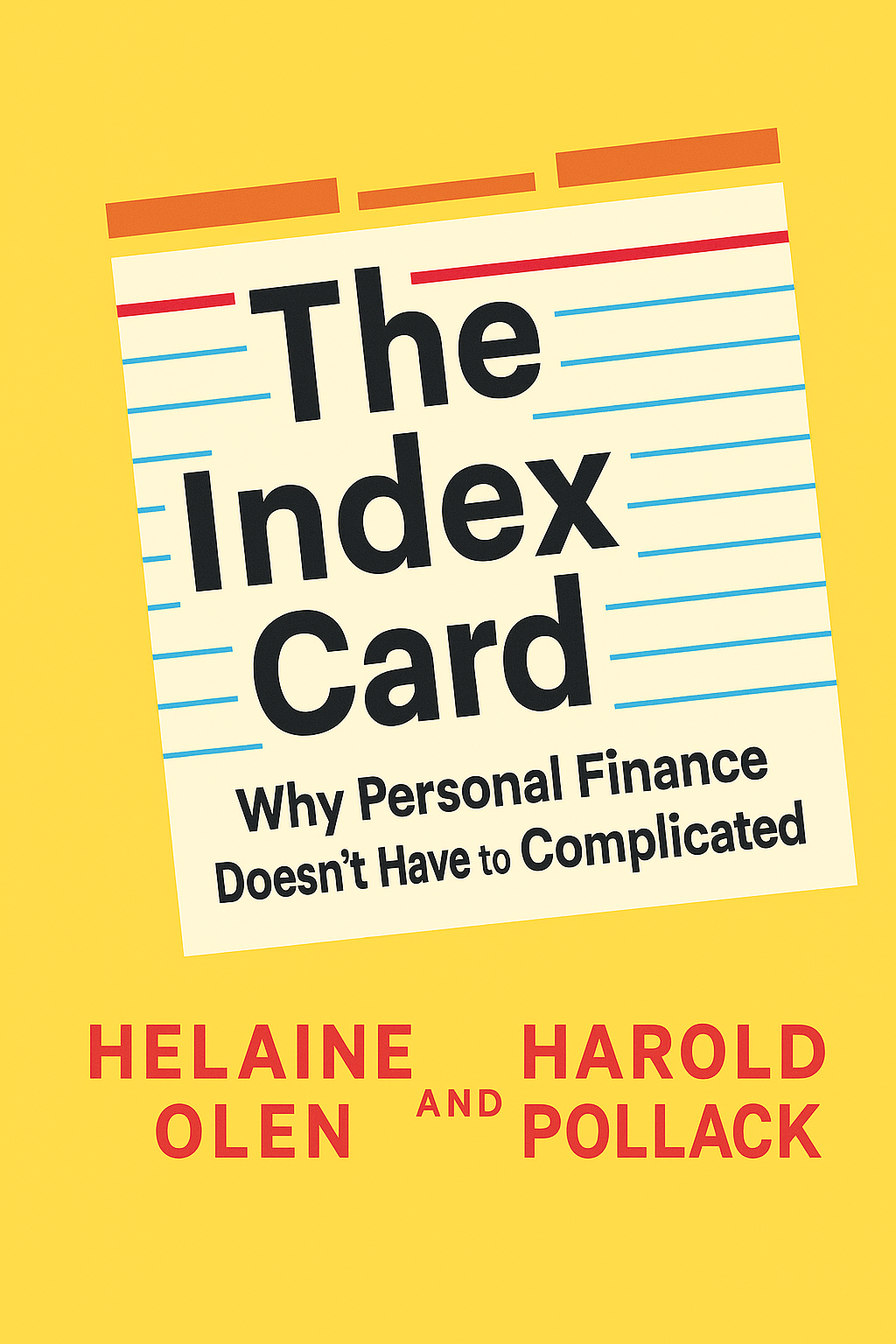
The Index Card
Why Personal Finance Doesn’t Have to Be Complicated
byHelaine Olen, Harold Pollack
Book Edition Details
Summary
In the vast landscape of financial advice, where complexity reigns supreme and expert opinions often clash, a humble 4" x 6" index card quietly revolutionized how we think about money. When Harold Pollack, a respected University of Chicago professor, casually suggested to acclaimed financial journalist Helaine Olen that all essential money management wisdom could fit on such a card, neither foresaw the viral sensation that would follow. Now, with "The Index Card," Pollack and Olen distill personal finance into ten straightforward rules that outshine convoluted strategies, offering a lifeline of clarity and empowerment. This book is your compass through the financial fog, equipping you with the simple yet profound tools to confidently navigate mortgages, life insurance, savings, and beyond. Say goodbye to financial intimidation and hello to a future of informed independence.
Introduction
Picture this: you're staring at your bank account, wondering where all your money went this month. The bills keep coming, your savings account barely budgets, and every financial expert seems to have a different opinion about what you should do. Sound familiar? You're not alone in feeling overwhelmed by the endless stream of complicated financial advice that floods our daily lives. But what if the solution to securing your financial future was simpler than you ever imagined? What if everything you need to know about money management could fit on a single index card? This revolutionary approach cuts through the noise of the financial industry to reveal the fundamental truths that can transform your relationship with money. By focusing on proven, straightforward principles rather than complex schemes, you can build lasting financial security while reclaiming control over your economic destiny. The journey to financial freedom doesn't require advanced degrees or insider knowledge, just the courage to embrace simplicity and take consistent action.
Build Your Financial Foundation
At its core, building your financial foundation means establishing the bedrock upon which all your future prosperity will rest. This foundation consists of two essential pillars: saving consistently and eliminating destructive debt. Without these fundamentals in place, even the most sophisticated investment strategies become castles built on sand. Consider Sam's story from the book. After his father passed away, Sam inherited a substantial sum of money that sat in a low-interest savings account for years. Despite meeting with multiple wealth advisors and receiving conflicting advice from friends, Sam remained paralyzed by indecision. The overwhelming array of options and his fear of making the wrong choice led him to make the worst choice of all: doing nothing. While Sam worried about picking the perfect investment, his inheritance lost purchasing power to inflation and missed years of potential growth in the stock market. Sam's paralysis transformed into action only when he discovered the power of simplicity. By focusing first on building his emergency fund and then establishing automatic savings transfers, Sam created the stability he needed to make confident financial decisions. The key breakthrough came when he stopped trying to optimize every detail and instead committed to consistent, basic actions that compound over time. Start by saving ten to twenty percent of your income automatically through direct deposit splits or scheduled transfers. Track your spending for three months to identify where your money actually goes versus where you think it goes. Create separate accounts for different goals, giving them specific names like "Emergency Fund" or "Vacation Dreams" to make your progress tangible. Pay yourself first by treating savings as your most important monthly bill. Remember that small, consistent actions create extraordinary results over time. Don't let perfectionism prevent you from starting, and don't let temporary setbacks derail your long-term progress. Your financial foundation grows stronger with every dollar saved and every debt payment made.
Master Smart Investing Strategies
Smart investing strategies revolve around a counterintuitive truth: the best way to beat the market is to stop trying to beat it. This means embracing low-cost index funds that track the overall market rather than attempting to pick individual winners or time market movements. Harold's early investing experience illustrates this perfectly. Like many people, he initially tried his hand at picking individual stocks, drawn to the excitement of potentially striking it rich with the right choice. He invested in dot-com stocks during the late 1990s boom, confident that his research and intuition would lead to outsized returns. Instead, he learned the hard way that even seemingly obvious winners can become spectacular losers when the market shifts unexpectedly. Harold's transformation began when he shifted from trying to outsmart the market to simply participating in its long-term growth. By investing in broad-based index funds with minimal fees, he captured the market's average returns without the stress of constantly monitoring individual positions. His portfolio became a simple mix of domestic stock funds, international funds, and bonds, rebalanced annually rather than traded frequently. This approach required far less time and expertise while delivering superior results compared to his stock-picking days. Choose index funds with expense ratios below 0.2 percent and avoid actively managed funds that charge higher fees for typically inferior performance. Allocate your investments based on your age, with younger investors favoring stocks for growth and older investors gradually shifting toward bonds for stability. Automate your investments through dollar-cost averaging, investing the same amount regularly regardless of market conditions. Focus on time in the market rather than timing the market, and resist the urge to make dramatic changes based on short-term market movements. The most successful investors are often the most boring ones who stick to their plan through both bull and bear markets.
Protect Your Financial Future
Protecting your financial future requires understanding that insurance serves as your economic safety net, preventing single catastrophic events from destroying years of careful financial planning. The goal isn't to insure against every possible inconvenience, but to protect against risks that could devastate your net worth. Bob and Jean's story demonstrates the critical importance of proper insurance coverage. Bob was a successful executive with a comfortable lifestyle until a sudden stroke changed everything overnight. Without disability insurance, their family would have faced financial ruin as Bob's substantial income disappeared while their expenses remained the same. Fortunately, Bob had disability insurance that, while not replacing his full income, provided enough support to prevent financial catastrophe during their most vulnerable time. Their experience shows how insurance transformed a personal tragedy into a manageable financial challenge. The disability payments gave them breathing room to adjust their lifestyle, find new sources of income, and maintain their dignity during a difficult transition. What could have been a complete financial collapse became a story of resilience and adaptation, all because they had the right protection in place before they needed it. Secure term life insurance equal to ten times your annual income if others depend on your earnings, and choose policies with level premiums that remain constant throughout the term. Opt for high-deductible insurance policies across all categories to reduce premiums while maintaining protection against truly catastrophic losses. Review your coverage annually to ensure it matches your current financial situation and needs. Avoid whole life insurance and complex annuity products that combine insurance with investments, as these typically offer inferior returns compared to buying term insurance and investing the difference. Remember that insurance is about transferring risk, not creating investment returns.
Create Lasting Financial Security
Creating lasting financial security means building a comprehensive system that protects and grows your wealth while preparing for life's inevitable changes and challenges. This involves maximizing tax-advantaged retirement accounts, making wise housing decisions, and ensuring proper estate planning. Harold's journey toward financial security accelerated dramatically when he finally began maximizing his employer's 401k matching program. Like many people, he had initially contributed just enough to get started but left substantial free money on the table by not capturing his employer's full match. He also made the crucial decision to increase his contribution rate automatically each year, eventually reaching the maximum allowable contribution limit. Harold's disciplined approach to retirement saving, combined with his simplified investment strategy, created a powerful wealth-building engine. By age fifty, despite his late start, he had accumulated substantial retirement assets that provided peace of mind and opened up new life possibilities. His consistent contributions during market downturns actually accelerated his wealth accumulation as he purchased more shares when prices were lower. Contribute enough to your 401k or 403b to capture your employer's full matching contribution, treating this as an immediate guaranteed return on your investment. Increase your contribution rate by one percent annually until you reach the maximum allowable limit. Consider Roth IRA contributions if you expect to be in a higher tax bracket during retirement. Make housing decisions based on what you can truly afford rather than what lenders are willing to provide, and remember that your home is shelter first and investment second. Build multiple streams of financial security through diversified investments, emergency funds, and insurance coverage rather than relying on any single source of future wealth.
Summary
Financial freedom isn't reserved for the wealthy or the financial experts; it's available to anyone willing to embrace simple, proven principles and apply them consistently over time. As the authors emphasize throughout this transformative guide: "The most important advice was embarrassingly simple" yet "the power of compounding will continue to work to your benefit" when you commit to these fundamental practices. The beauty of this approach lies not in its complexity but in its accessibility and effectiveness for ordinary people facing ordinary financial challenges. Start today by choosing one simple action from this guide and implementing it immediately, whether that's setting up automatic savings, researching low-cost index funds, or calculating your true monthly expenses. Your future financial security depends not on perfect timing or expert knowledge, but on the courage to begin and the discipline to continue.
Related Books
Download PDF & EPUB
To save this Black List summary for later, download the free PDF and EPUB. You can print it out, or read offline at your convenience.
By Helaine Olen
