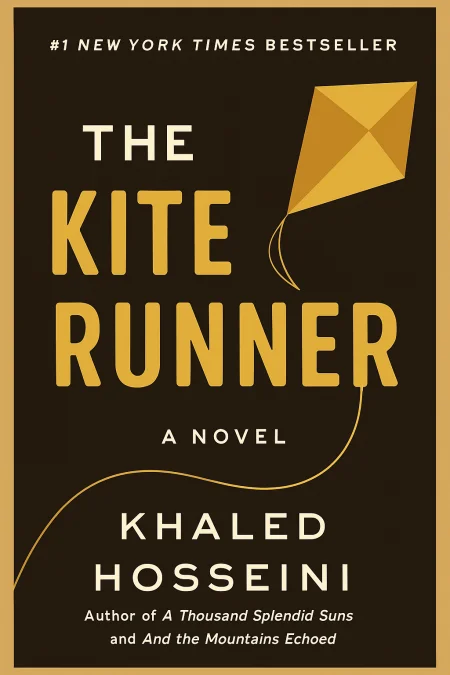
The Kite Runner
An Emotional Story of Betrayal and Redemption in 1970s Afghanistan
Book Edition Details
Summary
A tapestry of loyalty, loss, and longing unfurls in Khaled Hosseini's "The Kite Runner," where the sunlit memories of Kabul clash with shadows of betrayal. Within this poignant tale, Amir and Hassan's friendship is forged amidst the sweeping landscapes of Afghanistan, a bond tested by unspeakable choices and the inexorable march of history. As Amir, now far from his homeland, sifts through the remnants of his past, readers are drawn into a haunting exploration of paternal influence, the haunting specter of guilt, and the elusive promise of redemption. This modern classic, cherished globally, transcends mere storytelling to probe the depths of the human heart, making its mark as a narrative of unparalleled emotional resonance.
Introduction
In the winter of 1975, a twelve-year-old boy crouched behind a crumbling mud wall in Kabul, witnessing an act of violence that would haunt him for decades. This moment of cowardice, when privilege met moral failure, would define not just one life but illuminate the complex tapestries of friendship, betrayal, and the search for redemption that bind us all. The story unfolds against the backdrop of Afghanistan's transformation from a land of kite-flying children to a nation torn by war, where personal sins echo against the larger tragedy of a country's destruction. Through this deeply personal narrative, readers encounter the weight of unspoken truths and the price of silence. The journey reveals how childhood bonds forged in innocence can be shattered by a single moment of moral failure, yet also demonstrates the possibility of finding grace through courage and sacrifice. This tale offers profound insights into the nature of guilt and forgiveness, the complex dynamics of class and ethnicity, and ultimately, the redemptive power of confronting one's past to forge a meaningful future.
Kabul Childhood: Friendship, Privilege, and Moral Failure
In the affluent Wazir Akbar Khan district of 1970s Kabul, two boys grew up in the same household yet inhabited vastly different worlds. Amir, son of a wealthy Pashtun businessman, lived in the main house with its marble floors and crystal chandeliers, while Hassan, son of the family's Hazara servant, resided in a modest mud hut in the backyard. Despite this divide, they shared the intimacy of childhood companions who had fed from the same breast, played the same games, and carved their names together on a pomegranate tree. Their friendship existed in a delicate balance of affection and inequality. Hassan's unwavering loyalty to Amir was absolute, expressed in his promise "For you, a thousand times over." Yet this devotion was tinged with the complex dynamics of their social positions. Hassan was Shi'a in a Sunni-dominated society, Hazara in a Pashtun-controlled world, servant in a master's house. These distinctions, barely understood in childhood, cast long shadows over their bond. The boys found their greatest joy in the ancient art of kite fighting, where glass-coated strings battled in the winter skies of Kabul. Hassan possessed an almost supernatural ability to predict where defeated kites would fall, running through the streets with infectious joy. These moments of pure happiness masked deeper currents of jealousy and shame that Amir harbored, resentment at Hassan's natural goodness and a desperate hunger for his father's approval. The winter of 1975 brought devastating consequences when Amir witnessed Hassan's assault by neighborhood bullies but chose silence over courage. Unable to face his friend's continued loyalty after this betrayal, Amir planted money under Hassan's mattress and falsely accused him of theft. Though forgiven, Hassan and his father chose to leave, disappearing into the rain-soaked streets of Kabul forever.
American Exile: Escaping the Past, Building New Life
The Soviet invasion of 1979 forced Amir and his father to flee Afghanistan, joining the stream of refugees seeking safety in America. For Amir, America represented more than sanctuary, it was a place to bury his memories, to let the rushing river of a new life carry away his sins. The vast highways and endless cities offered the promise of reinvention, of becoming someone unmarked by the past. Yet exile brought its own challenges. Baba, once a powerful figure in Kabul society, found himself reduced to working at a gas station, his pride wounded by dependence on welfare and the indignities of starting over. The man who had wrestled bears now struggled with the English language and American customs, his health deteriorating under the weight of displacement and loss. For Amir, watching his father's decline was both heartbreaking and liberating. At the San Jose flea market, where Afghan refugees gathered to maintain connections to their homeland, Amir met Soraya Taheri. Their courtship followed traditional customs, conducted under watchful community eyes. Soraya carried her own burden of shame from a failed relationship, yet Amir found in her honesty a courage he had never possessed. Their marriage brought happiness, but also the persistent ache of childlessness. As medical procedures failed and adoption was rejected, Amir wondered if his inability to become a father was cosmic justice for his betrayal of Hassan. Meanwhile, his writing career flourished, earning recognition in the Afghan-American community. Success, however, could not fill the emptiness left by unresolved guilt and the haunting memory of a friend's sacrifice.
Return to Afghanistan: Confronting Truth and Finding Courage
In 2001, a phone call from Pakistan shattered Amir's carefully constructed American life. Rahim Khan, his father's old business partner, was dying and wanted to see him. The summons carried an implicit promise that terrified and compelled him: "There is a way to be good again." In Peshawar, Rahim Khan revealed the devastating truth that Hassan had been Amir's half-brother, Baba's secret child, recontextualizing everything about their childhood relationship. Hassan was dead now, killed by the Taliban along with his wife, leaving behind an orphaned son named Sohrab. The boy was trapped in Kabul, possibly in the hands of the same Assef who had tormented Hassan decades earlier. Rahim Khan's request was simple yet monumentally difficult: return to Taliban-controlled Afghanistan and rescue Hassan's son. For Amir, it represented the chance to finally atone for his childhood betrayal. The journey back to Kabul revealed a country transformed by war and extremism. The Afghanistan of kite-flying children and pomegranate trees had been replaced by a landscape of rubble and fear, where public executions served as entertainment and joy itself was forbidden. The search for Sohrab led through devastated streets to a horrifying discovery: the boy had been taken by a Taliban official for unspeakable purposes. In confronting Assef to rescue Sohrab, Amir finally found the courage that had eluded him as a child. The physical beating he endured felt like purification, each blow erasing years of guilt and self-loathing. Sohrab's intervention, using his slingshot to blind their tormentor just as his father might have done, completed a circle of justice that spanned generations.
Healing Through Love: Breaking Cycles of Shame
The journey to bring Sohrab to America proved almost as difficult as rescuing him from Kabul. Navigating immigration bureaucracy while caring for a traumatized child tested Amir's patience and resolve. When legal obstacles threatened to force Sohrab back into an orphanage, the boy attempted suicide, unable to bear the thought of returning to institutional care. This crisis forced Amir to confront the full weight of responsibility he had undertaken. Sohrab's silence upon arriving in America became a new kind of challenge. The boy who had once been described as gifted and lively retreated into himself, speaking only when necessary and showing little interest in the new life his uncle and aunt tried to create. Their home, carefully prepared with hope, felt hollow in the face of Sohrab's profound withdrawal. The couple who had longed for a child found themselves caring for someone who seemed unreachable. The process of healing proved gradual and uncertain, marked by small moments rather than dramatic breakthroughs. Amir's attempts to connect through stories from the Shahnamah, the same tales he had once shared with Hassan, met with polite but distant attention. The boy's pain ran too deep for easy comfort, and Amir learned that redemption was not a destination but a daily choice to keep trying, to keep loving, even when that love seemed to make no difference. The story's conclusion offers not a fairy-tale ending but something more precious: the possibility of hope. At an Afghan gathering in a California park, when Amir flies a kite and teaches Sohrab the old tricks, the boy shows the faintest hint of a smile. As Amir runs to catch the defeated kite, calling out Hassan's old promise "For you, a thousand times over," he carries not the certainty of healing but the commitment to keep trying, one day at a time.
Summary
The journey from betrayal to redemption reveals that our greatest wounds often become the source of our deepest wisdom, demonstrating that courage is not the absence of fear but the decision to act despite it. Through one man's struggle with guilt and his ultimate choice to risk everything for another's child, we witness the possibility of transformation that exists within even the most damaged souls. The story teaches us that while we cannot undo the past, we can choose to face it with courage and use our pain to serve something greater than ourselves. For anyone who has ever failed someone they loved, or struggled with the weight of unspoken truths, this narrative illuminates the difficult but essential journey toward forgiveness and grace, reminding us that redemption often requires returning to the very places we have tried hardest to forget.
Related Books
Download PDF & EPUB
To save this Black List summary for later, download the free PDF and EPUB. You can print it out, or read offline at your convenience.
By Khaled Hosseini
