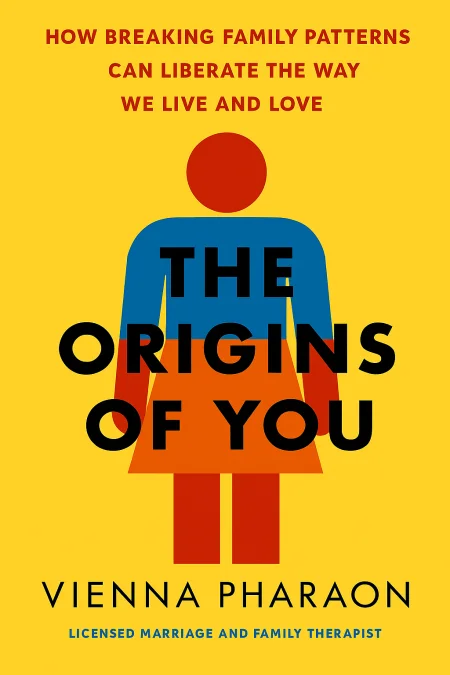
The Origins of You
How Breaking Family Patterns Can Liberate the Way We Live and Love
Book Edition Details
Summary
In "The Origins of You," Vienna Pharaon, a celebrated therapist with a keen social media following, offers a fresh lens on the roots of our emotional landscapes. Through an engaging blend of introspective tools, personal anecdotes, and transformative exercises, this book invites you to re-examine the family dynamics that quietly shape your adult relationships and self-perception. Pharaon's profound insights reveal how the unresolved echoes of our childhood can unconsciously dictate our present, often in ways that hinder growth and happiness. Whether you're a seasoned therapy enthusiast or a newcomer seeking change, this guide provides the clarity and strategies needed to transcend inherited patterns and build a more fulfilling life. Prepare to embark on a journey of self-awareness that promises to redefine the way you connect with yourself and others.
Introduction
Sarah sat across from her therapist, tears streaming down her face as she recounted yet another failed relationship. "I don't understand," she whispered. "I keep choosing men who can't commit, who make me feel invisible. My friends tell me I deserve better, but somehow I always end up in the same place." What Sarah didn't realize was that her pattern of relationships had roots that stretched back decades, woven into the very fabric of her childhood experiences. Like Sarah, millions of us find ourselves trapped in cycles we can't quite understand. We react with intensity that seems disproportionate to the situation. We attract the same types of partners, repeat familiar conflicts, and wonder why our best intentions for change keep falling short. The answer lies not in our current circumstances, but in the earliest relationships that shaped us. This exploration into family patterns reveals how our deepest wounds often become our greatest teachers. Through understanding the origins of our emotional responses, we discover that what feels like personal failure is actually the predictable result of unhealed patterns passed down through generations. The stories within these pages illuminate how childhood experiences create invisible templates that guide our adult relationships, often without our awareness. Yet this isn't a journey into blame or despair. Instead, it's a path toward profound liberation. When we understand the roots of our reactions, we gain the power to choose differently. We learn to recognize when our past is speaking louder than our present, and we develop tools to heal wounds that have shaped us for far too long. The transformation that awaits is nothing short of revolutionary.
Discovering Your Origin Wounds: From Safety to Trust
Maria remembers the exact moment her world shifted. She was eight years old, hiding behind the kitchen door, listening to her parents scream at each other about money. Her father's voice grew louder and more threatening, while her mother's sobs grew quieter and more desperate. In that moment, Maria's nervous system made a decision that would follow her for decades: home was not safe, and loud voices meant danger was coming. Thirty years later, Maria found herself unable to stay in relationships whenever conflict arose. The moment a partner raised their voice or expressed frustration, she would shut down completely or flee. She thought she was being reasonable, protecting herself from "toxic" people. What she didn't realize was that her childhood wound was still running the show, treating every disagreement as a threat to her survival. Origin wounds are the unhealed injuries from our earliest relationships that continue to influence our adult connections. They form when our fundamental needs for safety, trust, belonging, worthiness, or prioritization go unmet during our formative years. These wounds don't simply disappear with time; they become the lens through which we view all future relationships. The fascinating complexity of human psychology reveals itself in how these wounds operate. A child who felt unsafe might grow up to be hypervigilant in relationships, scanning for signs of danger that may not exist. Someone who experienced betrayal might struggle to trust even the most reliable partners. The wound creates a story about what to expect from others, and then we unconsciously seek evidence to confirm that story. Understanding these patterns isn't about excusing behavior or remaining stuck in victimhood. Instead, it's about recognizing that our reactions make perfect sense when viewed through the lens of our history. Once we identify our origin wounds, we can begin the sacred work of healing them, transforming our deepest pain into wisdom that serves not just ourselves, but everyone we touch.
Breaking Free from Destructive Patterns: Communication and Conflict
Jake and Lisa had been married for seven years, yet they found themselves having the same fight over and over again. It would start with something small—dishes left in the sink or a forgotten anniversary—but within minutes, they were both shouting, hurling accusations that cut deep. Lisa would criticize Jake's lack of consideration, while Jake would shut down and withdraw, leaving Lisa feeling even more abandoned and unheard. What neither of them realized was that their fight wasn't really about dishes or anniversaries. Lisa's criticism stemmed from a childhood where she felt invisible unless she demanded attention through dramatic displays of emotion. Jake's withdrawal echoed the survival strategy he'd learned as a child when his alcoholic father would rage—disappearing was the safest option. Their wounds were dancing together in a destructive pattern that threatened to destroy their marriage. The revelation came when they learned to pause and look beneath the surface of their conflicts. Instead of focusing on who was right or wrong, they began to explore what each person was really trying to communicate. Lisa's criticism was actually a desperate plea: "Please see me and show me that I matter to you." Jake's withdrawal was his wounded way of saying: "I don't feel safe when emotions run high, and I need space to feel secure again." This shift from reaction to understanding transformed everything. When Lisa felt the urge to criticize, she learned to express her underlying need directly: "I'm feeling disconnected from you and would love some focused time together." When Jake felt the impulse to shut down, he practiced staying present while communicating his boundary: "I'm feeling overwhelmed right now and need a few minutes to collect myself, then I'd like to talk through this with you." The most profound discovery was that conflict itself wasn't the enemy—unconscious conflict was. When they brought awareness to their patterns and learned to communicate their true needs, their arguments became opportunities for deeper intimacy and understanding. They realized that every fight contained valuable information about unhealed wounds that were asking for attention and care.
Building Healthy Boundaries and Authentic Connections
Rachel had always prided herself on being the "easy" friend, the one who never caused drama or asked for too much. She said yes to every invitation, remembered everyone's birthday, and was always available when others needed support. Yet despite being surrounded by people, she felt profoundly lonely and exhausted. She couldn't understand why her relationships felt so one-sided and why she attracted people who seemed to take advantage of her generosity. The pattern had begun in childhood with a depressed mother who relied on Rachel for emotional support. Rachel learned early that her value lay in being helpful and accommodating, never being a burden herself. She became skilled at reading others' needs while completely losing touch with her own. This survival strategy worked in childhood, but it was destroying her adult relationships. The turning point came when Rachel's best friend, Emma, repeatedly canceled their plans at the last minute. Each time, Rachel would smile and say it was fine, but internally she felt more resentful and hurt. When Emma canceled their dinner plans for the fourth time in two months—via text, just hours before they were supposed to meet—something inside Rachel finally snapped. Instead of her usual accommodating response, Rachel picked up the phone and called Emma directly. "I need to tell you something," she said, her voice shaking. "When you cancel our plans repeatedly, especially at the last minute, it makes me feel like my time doesn't matter to you. I value our friendship, but I need you to respect our commitments to each other." Emma was initially defensive, but then apologized genuinely and acknowledged that she had been taking Rachel's flexibility for granted. That conversation marked the beginning of Rachel's journey toward authentic connection. She learned that healthy boundaries weren't walls meant to keep people out, but bridges that allowed for genuine intimacy. When she stopped protecting everyone else's feelings at the expense of her own, she discovered that her real friends appreciated her honesty and rose to meet her new standards. The relationships that couldn't survive her authenticity weren't actually serving her—they were just familiar patterns that kept her stuck in old wounds.
Summary
The journey through family patterns reveals a profound truth: we are not condemned to repeat the past, but we are responsible for understanding it. Every story shared illuminates how childhood experiences create invisible blueprints that guide our adult relationships, often leading us into cycles of pain and frustration that feel inescapable. Yet within this understanding lies extraordinary power—the power to choose differently. The transformation begins with recognition. When we can identify our origin wounds and see how they show up in our present relationships, we gain the ability to pause between trigger and reaction. We learn to ask ourselves: "Is my response about what's happening now, or about something that happened long ago?" This simple question can shift the entire trajectory of a conflict, moving us from unconscious repetition toward conscious choice. Perhaps most importantly, this work teaches us that healing is not a solitary endeavor. Our wounds were created in relationship, and they heal in relationship too. When we bring our authentic selves to our connections with others—complete with our vulnerabilities, needs, and boundaries—we create space for genuine intimacy to flourish. We discover that the very patterns that once caused us pain can become doorways to deeper understanding and love, both for ourselves and for those we care about most deeply.
Related Books
Download PDF & EPUB
To save this Black List summary for later, download the free PDF and EPUB. You can print it out, or read offline at your convenience.
By Vienna Pharaon
