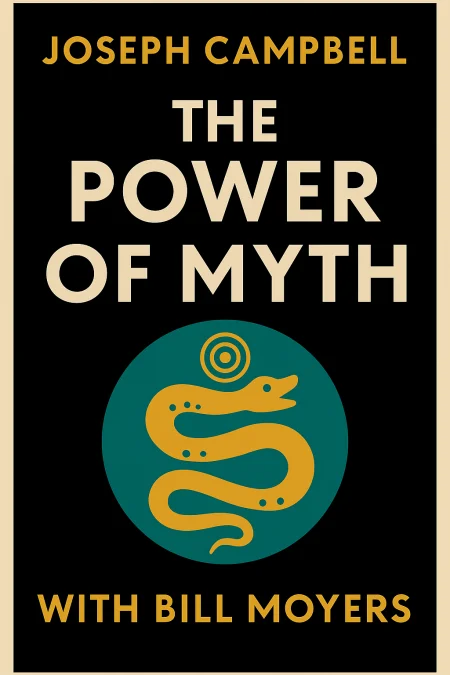
The Power of Myth
From ancient myths to Han Solo
byJoseph Campbell, Bill Moyers
Book Edition Details
Summary
In the dance between the cosmos and consciousness, Joseph Campbell emerges as a luminary, illuminating the timeless narratives that thread through the fabric of human experience. With the insightful Bill Moyers as his conversational partner, Campbell navigates the profound landscapes of mythology, transforming ancient tales into vibrant reflections of modern life. "The Power of Myth" unveils the sacred tapestries that bind humanity, from the genesis of love to the mysteries of existence, revealing myths as vital touchstones in a world where spiritual anchors seem to drift. As Campbell's wisdom harmonizes with Moyers' inquisitive spirit, readers are invited to witness the symphony of stories that echo across cultures, offering clarity and wonder in understanding our shared human journey.
Introduction
In the summer of 1985, at George Lucas's Skywalker Ranch, an extraordinary conversation unfolded between journalist Bill Moyers and a gentle scholar whose insights would forever change how we understand the power of ancient stories. Joseph Campbell, then in his eighties, possessed a rare gift for seeing the universal patterns that connect all human narratives across cultures and centuries. His weathered face and twinkling eyes reflected decades spent exploring the deepest wisdom traditions of humanity, discovering that beneath the surface differences of world religions and folklore lay a common grammar of human experience. Campbell had spent his life as a bridge-builder between the ancient and modern worlds, showing that myths are not obsolete fairy tales but living maps of consciousness that offer profound guidance for navigating the complexities of contemporary existence. From Campbell's remarkable journey through the landscape of human storytelling, readers will discover the transformative power of following one's authentic path despite conventional expectations, the universal patterns that reveal the fundamental unity of human experience across all cultures, and the practical wisdom embedded in humanity's oldest narratives that can illuminate our personal quest for meaning and fulfillment in an increasingly fragmented world.
The Scholar's Path: From Literature to Mythology
Campbell's intellectual awakening began with an unlikely encounter that would shape his entire life's work. As a young boy attending Buffalo Bill's Wild West Show at Madison Square Garden, he became captivated by the Native American performers and their stories. This childhood fascination led him to devour books about Native American mythology, where he made a startling discovery that would revolutionize his understanding of human culture. The stories he was reading contained the same fundamental motifs he had learned in his Catholic upbringing: creation tales, virgin births, death and resurrection, and journeys to otherworldly realms. This revelation sparked Campbell's lifelong quest to understand the deeper patterns underlying human storytelling. At Columbia University, he immersed himself in medieval literature, particularly the Arthurian romances, while also studying in Paris and Munich to broaden his intellectual horizons. However, Campbell's path was far from conventional. When advised to follow a narrow academic curriculum, he famously declared "To hell with it" and abandoned his doctoral studies, choosing instead to follow his own intellectual curiosity wherever it might lead. The Great Depression provided Campbell with an unexpected gift: five years of scholarly solitude in a cabin in Woodstock, New York. During this period of intensive self-directed study, he read voraciously across disciplines, devouring works in anthropology, psychology, philosophy, and religious studies. He was particularly influenced by Carl Jung's theories about the collective unconscious, which provided a psychological framework for understanding why similar mythological patterns appeared across unconnected cultures. Campbell's approach to scholarship was both rigorous and deeply personal. He understood that true wisdom emerges not from narrow specialization but from the courage to make connections across seemingly disparate fields. This synthetic approach, combined with his willingness to engage with myths as living wisdom rather than mere historical artifacts, prepared him for his revolutionary insights into the universal nature of human storytelling.
The Power of Myth: Universal Stories and Human Experience
Campbell's greatest contribution to human understanding was his recognition that myths function as sophisticated guides for navigating the psychological and spiritual challenges of existence. Through his comparative analysis of stories from cultures around the world, he discovered that the same fundamental patterns appear repeatedly, regardless of geographical or temporal separation. This insight led to his revolutionary concept of the monomyth, or the hero's journey, which identifies a consistent pattern underlying heroic narratives across all cultures. The hero's journey, as Campbell articulated it, follows a universal template: the hero's departure from ordinary life, initiation through trials and transformation in a realm of supernatural wonder, and return with wisdom or power to benefit the community. Whether examining the stories of Buddha, Jesus, Moses, or countless other mythic figures, Campbell found this same archetypal pattern. More importantly, he recognized that this pattern reflects the universal human experience of growth, challenge, and maturation that every individual must navigate in their journey toward psychological and spiritual wholeness. Campbell understood that myths operate on multiple levels simultaneously, serving both individual and collective needs. On the personal level, mythological symbols and narratives provide psychological guidance for facing life's inevitable challenges. The dragon that must be slayed represents the fears we must overcome; the wise mentor who appears at crucial moments reflects the guidance available to those who seek it; the dark night of the soul corresponds to the periods of doubt and despair that precede breakthrough and transformation. His work revealed that myths also serve essential social functions, binding communities together through shared meaning and common purpose. However, Campbell was acutely aware that when myths become rigid dogma, they lose their transformative power and can even become sources of conflict. He believed that the challenge for modern individuals is to find the living wisdom within ancient stories while avoiding the trap of literal interpretation that leads to fundamentalism and division.
Following Your Bliss: The Hero's Adventure Within
Perhaps no concept from Campbell's work has resonated more widely than his famous advice to "follow your bliss." This deceptively simple phrase emerged from his deep understanding of mythological patterns and represents a practical application of ancient wisdom to modern life. Campbell observed that in myths, heroes who follow their authentic calling, despite obstacles and social pressure, ultimately find fulfillment and make meaningful contributions to their communities. Campbell's concept of bliss was far more sophisticated than mere pleasure-seeking or self-indulgence. He understood bliss as the deep satisfaction that comes from aligning one's life with one's authentic nature and highest potential. This alignment requires tremendous courage, as it often means departing from conventional expectations and venturing into unknown territory. Like the mythological hero who leaves the familiar village to face challenges in the wilderness, individuals must sometimes abandon security and social approval to discover their true calling. The scholar's own life exemplified this principle beautifully. His decision to spend years in scholarly solitude, studying subjects that fascinated him rather than pursuing immediate financial security, demonstrated the kind of faith in one's path that he later advocated for others. Campbell believed that when individuals have the courage to follow their authentic interests and talents, they tap into a source of energy and creativity that not only fulfills them personally but also enables them to make their unique contribution to the larger human story. Campbell recognized that following one's bliss is not always easy or immediately rewarding. The mythological hero faces trials, setbacks, and moments of profound doubt. Similarly, individuals who choose authentic paths often encounter resistance from family, society, or their own fears and insecurities. However, Campbell's study of myths convinced him that those who persist in following their deepest calling ultimately find that doors open, mentors appear, and opportunities arise in ways that seem almost magical. This phenomenon reflects not wishful thinking but the psychological and social dynamics that naturally support authentic living and genuine contribution.
Summary
Joseph Campbell's life and work demonstrate that the deepest wisdom often emerges from the marriage of rigorous scholarship and imaginative insight, revealing that ancient stories contain timeless guidance for navigating the complexities of human existence. His recognition that myths are not outdated superstitions but sophisticated maps for psychological and spiritual development has transformed how we understand both literature and life itself, showing that the same heroic journey found in ancient tales continues to unfold in every individual's quest for meaning and authenticity. Campbell's legacy reminds us that true fulfillment comes not from following prescribed paths but from having the courage to discover and pursue our own unique calling, trusting that when we align with our deepest nature, we tap into sources of meaning and energy that benefit not only ourselves but the entire human community. From Campbell's example, we learn the importance of sustained intellectual curiosity, the willingness to synthesize knowledge across traditional boundaries, and the understanding that in our fragmented modern world, we desperately need individuals who can see the larger patterns and connections that unite rather than divide us, offering tools for understanding ourselves and our place in the grand story of human experience.
Related Books
Download PDF & EPUB
To save this Black List summary for later, download the free PDF and EPUB. You can print it out, or read offline at your convenience.
By Joseph Campbell
