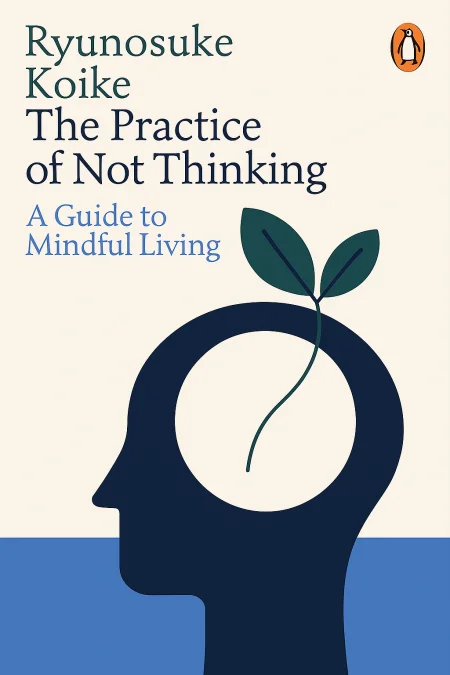
The Practice of Not Thinking
A Guide to Mindful Living
Book Edition Details
Summary
Ever wonder how to break free from the relentless chatter of your mind? Ryunosuke Koike, a former monk, shares the art of silencing mental noise through the wisdom of Zen. This international bestseller invites you to engage with the world in a deeply sensory way—seeing beyond just looking, hearing past mere listening. By retraining our minds and bodies with Koike’s transformative practices, we learn to breathe, speak, and even sleep differently. The result? A life of clarity, reduced stress, and enriched interactions. "The Practice of Not Thinking" offers a refreshing blueprint for serenity, urging us to think less and savor more, cultivating peace in a turbulent world.
Introduction
Sarah sits at her desk, staring at the same email for the third time this morning. Her mind races through tomorrow's presentation, last week's argument with her colleague, and whether she remembered to turn off the coffee machine. Meanwhile, her five-year-old daughter tugs at her sleeve, asking a simple question that somehow feels overwhelming. Sound familiar? We live in an age where our minds never rest, constantly churning through information, worries, and endless mental chatter that leaves us exhausted before the day truly begins. This ancient wisdom meets modern neuroscience in a remarkable exploration of how our thinking minds often become our greatest obstacles to peace and clarity. A former Buddhist monk turned contemporary teacher reveals that the very faculty we pride ourselves on—our ability to think—may be the source of much of our suffering. Through practical exercises rooted in traditional Buddhist meditation, combined with insights from cutting-edge brain research, this guide offers something revolutionary: the possibility of finding freedom not through more thinking, but through the deliberate practice of mental stillness. The journey ahead promises not just relief from mental overwhelm, but a complete transformation in how we relate to our thoughts, our relationships, and our daily experiences. Here lies an invitation to discover what happens when we learn to quiet the noise and rediscover the profound peace that exists beneath our thinking minds.
The Thinking Disease: How Mental Noise Controls Our Lives
Michael thought he was being a good listener as his wife shared her difficult day at work. He nodded at appropriate moments, made encouraging sounds, and maintained eye contact. Yet somehow, the conversation ended with her feeling unheard and him feeling confused about what went wrong. What Michael didn't realize was that while his body appeared present, his mind had been racing through dozens of micro-thoughts: wondering if he'd locked the car, remembering he needed to call his brother, calculating how much time remained before his favorite show started, and judging whether his wife's problems were really as serious as she made them seem. This scenario illustrates what Buddhist psychology calls "thinking disease"—our minds' compulsive habit of generating endless streams of commentary, analysis, and mental noise that disconnect us from present moment reality. Modern research confirms what ancient Buddhist teachers observed: when we retreat into our mental chatter, our capacity for genuine attention dramatically decreases. The very faculty we celebrate as uniquely human—our thinking mind—often becomes a prison that separates us from authentic connection and clear perception. The Buddhist teaching of the "three disturbing emotions" provides a framework for understanding how our minds get hijacked. Desire makes us constantly want more stimulation, always seeking the next thing to satisfy us. Anger creates resistance and rejection of what's happening now. Ignorance manifests as confusion and the tendency to escape into mental fantasies when reality feels boring or challenging. These forces work together, creating a mental environment where we lose touch with the richness of immediate experience. The path forward isn't to stop thinking entirely—an impossible task—but to recognize when our minds are controlled by these habitual patterns and consciously redirect our attention to our direct sensory experience. When we learn to catch ourselves in the act of mental wandering and gently return to what's actually happening in the present moment, we begin to reclaim our mental freedom and rediscover the profound satisfaction available in simply being awake to life as it unfolds.
Training the Mind Through the Five Senses
Elena discovered the power of mindful listening during a heated argument with her teenage son. As his voice rose in frustration, she felt her own anger building, ready to launch into her usual defensive responses. Instead, she took a breath and shifted her attention from the content of his words to the actual sound of his voice. She noticed how it cracked slightly when he felt vulnerable, how his breathing became shallow when he struggled to express himself, and how the pitch changed when he moved from anger to genuine hurt. This simple shift in attention completely transformed the conversation—instead of escalating into familiar patterns of conflict, she found herself responding with genuine understanding to the pain beneath his words. This transformation happened because Elena discovered a fundamental principle of mental training: our senses can serve as anchors that bring us back from mental reactivity to present-moment awareness. Rather than getting lost in the story our minds create about what's happening, we can train ourselves to focus on the direct sensory information we're receiving. When we actively listen instead of just hearing, consciously see instead of merely looking, we discover that reality is far more rich and interesting than our mental commentary about it. The practice extends beyond dramatic moments into everyday activities. Take eating, for example—most of us consume meals while thinking about other things, barely tasting our food. When we slow down and pay attention to the texture, temperature, and flavor of each bite, we often find we need less food to feel satisfied because we're actually experiencing what we're eating. The same principle applies to walking, where focusing on the sensation of our feet touching the ground can transform a routine activity into a refreshing mental break. This sensory training serves a deeper purpose than mere relaxation. Each time we anchor our attention in direct sensory experience, we're literally rewiring our brains to be less reactive to mental noise and more responsive to what's actually happening. Over time, this creates a stable foundation of awareness that remains calm and clear even when challenging thoughts and emotions arise, allowing us to respond to life from wisdom rather than reactivity.
Nurturing Compassion While Taming Inner Demons
When David's elderly mother began showing early signs of dementia, his first impulse was to research everything he could about the condition, create care plans, and solve the problem through action. But as he watched her struggle to remember his name during a visit, he realized that all his mental preparation hadn't prepared him for the actual experience of witnessing her confusion and fear. His heart broke as he saw her trying to hide her disorientation, and in that moment of genuine heartbreak, something shifted—his need to fix transformed into a simple desire to be present with her exactly as she was. This experience taught David a crucial distinction between two kinds of compassion: the anxious helping that comes from our need to feel useful, and the deeper compassion that arises when we're willing to face suffering without immediately trying to make it go away. The first kind often makes both parties feel worse because it's driven by our own discomfort with witnessing pain. The second kind creates a spacious presence that allows suffering to be acknowledged and held without adding the extra burden of our own anxiety about it. Buddhist psychology recognizes that our "inner demons"—the voices of self-criticism, anxiety, and judgment—often disguise themselves as helpful concerns. The worried mind that keeps us up at night thinking about all the things that could go wrong believes it's protecting us, but actually creates more suffering than the situations we're worried about. Learning to recognize these mental patterns requires the same gentle attention we bring to training our senses, noticing when we're being controlled by anxious thoughts and choosing to redirect our attention to what's actually needed in the present moment. True compassion emerges naturally when we stop being hijacked by our mental reactions to suffering—both our own and others'. Instead of drowning in empathy or hardening our hearts to avoid pain, we learn to maintain an open, stable presence that can witness difficulty without being overwhelmed by it. This creates space for genuine wisdom and appropriate action to arise, allowing us to help others from a place of strength rather than our own emotional reactivity.
The Science Behind Ancient Wisdom: Brain Meets Buddhism
Dr. Ikegaya's research team made a fascinating discovery while studying the brain activity of people engaged in meditation. They found that when practitioners focused their attention on a single point of awareness—such as the breath or a simple phrase—the areas of the brain associated with self-referential thinking became significantly less active. At the same time, regions connected to present-moment awareness and emotional regulation showed increased activity. Most remarkably, these changes occurred within minutes of beginning the practice, suggesting that the benefits of mental training are immediately accessible, not just the result of years of meditation. This neurological evidence supports what Buddhist teachers have observed for centuries: the chattering mind and the aware mind operate through different neural networks. When we're lost in mental stories about ourselves—worrying about the future, replaying the past, or constructing elaborate narratives about what others think of us—specific brain circuits become hyperactive. But when we shift attention to direct sensory experience or cultivate states like compassion and loving-kindness, different neural pathways engage, creating measurable changes in brain chemistry that correspond to increased feelings of well-being and decreased reactivity to stress. Perhaps most intriguingly, the research revealed that people who practice mental training develop what scientists call "meta-cognitive awareness"—the ability to observe their own thinking processes without being completely identified with them. Brain scans show that practitioners can literally watch their minds generate thoughts and emotions while maintaining enough distance to choose how to respond rather than being automatically controlled by mental content. This biological capacity for self-observation provides scientific validation for the Buddhist insight that we are not our thoughts, but rather the awareness that can witness thinking. The implications extend far beyond personal well-being into our understanding of human potential itself. If we can train our brains to be less reactive and more responsive, less caught in mental loops and more present to direct experience, we're essentially evolving our capacity for both individual happiness and collective wisdom. The ancient practice of mental cultivation, supported by modern neuroscience, offers a practical path toward becoming more fully human in the deepest sense.
Summary
This exploration of mental freedom reveals a profound paradox: the very thinking that we believe makes us most human often creates our greatest suffering, while the practice of stepping back from constant mental activity opens us to deeper wisdom and genuine connection. Through the integration of traditional Buddhist psychology and contemporary neuroscience, we discover that peace isn't something we need to acquire through more thinking, but rather something we uncover by learning to rest in the awareness that exists beneath our mental chatter. The techniques offered—from mindful listening that transforms conversations to sensory anchoring that brings us back to present-moment reality—provide practical tools for anyone seeking relief from the overwhelming pace of modern mental life. The journey toward mental clarity requires neither retreat from the world nor suppression of thoughts, but rather a fundamental shift in our relationship to our minds. When we learn to recognize the difference between useful thinking and compulsive mental noise, we can engage our analytical abilities when they serve us while maintaining access to the spacious awareness that remains calm and clear regardless of circumstances. This balance allows us to respond to life's challenges with both wisdom and compassion, finding stability that doesn't depend on external conditions. The practice promises not just personal transformation but the possibility of bringing more presence, kindness, and authentic connection into every interaction and relationship we encounter.
Related Books
Download PDF & EPUB
To save this Black List summary for later, download the free PDF and EPUB. You can print it out, or read offline at your convenience.
By Ryūnosuke Koike
