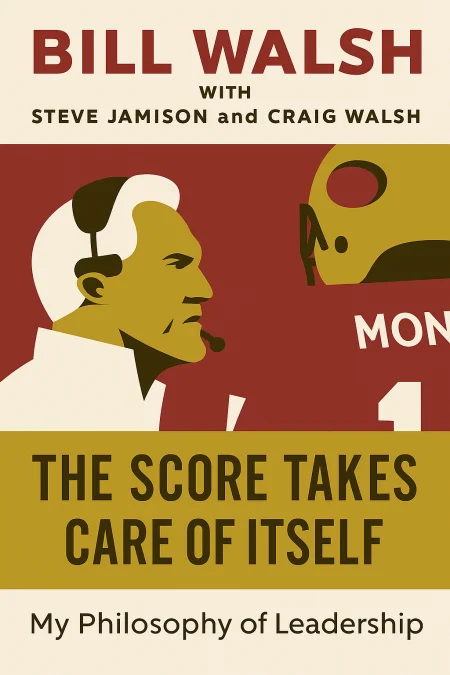
The Score Takes Care of Itself
My Philosophy of Leadership
byBill Walsh, Steve Jamison, Craig Walsh
Book Edition Details
Summary
In the high-stakes arena of professional football, mastery is not measured by the final score but by the relentless pursuit of excellence. "The Score Takes Care of Itself" is a riveting exploration of the leadership philosophy that propelled the San Francisco 49ers to greatness under their legendary coach. This isn't just a playbook of strategies; it's an artful dissection of motivation, team-building, and resilience. The coach’s mantra, “Believe in people,” echoes through stories of grit and perseverance, while his advice to “Keep a short enemies list” highlights the importance of focus and discipline. This book reveals how a steadfast commitment to process and preparation can transform potential into triumph, offering readers timeless insights into building a culture of sustained success.
Introduction
In the frigid confines of Candlestick Park on January 10, 1982, a young quarterback named Joe Montana threw a perfect pass to Dwight Clark in the back of the end zone, a moment forever etched in football history as "The Catch." Behind this iconic play stood Bill Walsh, a soft-spoken coach whose revolutionary approach to football would transform not just the San Francisco 49ers, but the entire landscape of professional sports leadership. Walsh inherited a franchise mired in dysfunction, a team so woeful it had won just two games the season before his arrival. Yet within three years, he had engineered one of the most remarkable turnarounds in sports history, culminating in a Super Bowl championship. What made Walsh extraordinary was not merely his football acumen, though his West Coast Offense would fundamentally change how the game was played. Rather, it was his comprehensive philosophy of leadership that treated every detail, from how receptionists answered phones to how players conducted themselves in the locker room, as essential components of excellence. This was a man who understood that true leadership extends far beyond the boundaries of any single arena, whether a football field or a corporate boardroom. Through Walsh's journey, we witness the evolution of a leader who discovered that sustainable success requires not just tactical brilliance, but a systematic approach to building organizational culture. His story reveals the price of perfectionism, the power of teaching, and the profound truth that lasting achievement comes from focusing on process rather than results.
Building Excellence Through Standards of Performance
When Bill Walsh first walked into the San Francisco 49ers' headquarters in 1979, he encountered an organization in complete disarray. The previous management had stripped the building of all success memorabilia, creating a sterile environment that reflected the team's rock-bottom morale. Players wandered aimlessly, coaches lacked direction, and the entire franchise seemed resigned to perpetual mediocrity. Yet Walsh saw opportunity where others saw only despair. Rather than immediately focusing on wins and losses, he embarked on something far more ambitious: the complete transformation of the organization's DNA through what he called his "Standard of Performance." This standard encompassed everything from the profound to the seemingly trivial. Players were required to tuck in their shirts, arrive punctually, and treat every staff member with respect regardless of their position in the hierarchy. Walsh insisted that the team's emblem be treated with dignity, that meeting rooms be kept immaculate, and that every interaction reflect the professionalism of a championship organization. Critics initially scoffed at these requirements, viewing them as meaningless distractions from the real work of winning football games. Yet Walsh understood something they didn't: excellence is not an accident but the result of countless small decisions executed with unwavering consistency. The Standard of Performance extended beyond behavior to encompass every aspect of preparation and execution. Walsh demanded that plays be run with mathematical precision, that receivers hit exact spots on the field down to the inch, and that every practice be conducted with the intensity and focus of a championship game. He created detailed job descriptions for every position, from star quarterbacks to equipment managers, ensuring that everyone understood exactly what was expected of them. This wasn't about micromanagement; it was about creating a culture where mediocrity became impossible because the system itself wouldn't allow it. The transformation wasn't immediate. In Walsh's first season, the 49ers finished with the same dismal 2-14 record as the year before he arrived. But those who looked closely could see fundamental changes taking place. The team carried themselves differently, communicated more effectively, and approached their work with a seriousness of purpose that had been absent for years. Walsh was building the foundation for sustained excellence, understanding that true success requires patience, persistence, and an unwavering commitment to doing things the right way, even when the scoreboard doesn't immediately reflect that commitment.
Innovation and Strategic Leadership in Competition
Innovation in leadership often emerges not from abundance, but from constraint. When Walsh arrived in Cincinnati as an assistant coach, he faced a quarterback in Virgil Carter who possessed neither a strong arm nor blazing speed, traditional prerequisites for NFL success. Rather than bemoan these limitations, Walsh saw them as catalysts for creativity. He began designing an entirely new offensive system built around short, precise passes that utilized timing, intelligence, and ball control rather than brute force. This became the foundation of what the media would later dub the "West Coast Offense," though Walsh preferred to think of it simply as smart football adapted to the talents at hand. The genius of Walsh's innovation lay not just in its tactical brilliance, but in its systematic thinking. He understood that every offensive play created multiple options and contingencies, that success depended on all eleven players understanding not just their individual responsibilities but how those responsibilities connected to create something greater than the sum of its parts. Walsh spent countless hours diagramming plays that looked like architectural blueprints, complete with precise measurements and detailed specifications. His offensive playbook resembled a technical manual more than a traditional football guide, reflecting his belief that complexity could be mastered through methodical teaching and relentless practice. Perhaps Walsh's most revolutionary innovation was his approach to preparation through what he called "scripting." Unlike other coaches who made decisions in the heat of battle, Walsh would predetermine the first twenty-five plays of each game, creating a carefully orchestrated sequence designed to test the defense and establish offensive rhythm. This wasn't rigid adherence to a predetermined plan, but rather intelligent preparation that allowed for maximum flexibility within a structured framework. By thinking through various scenarios in advance, Walsh could make clear-headed decisions when emotions ran high and time was short. The broader lesson of Walsh's innovative approach extends far beyond football strategy. True innovation requires leaders who can see beyond conventional wisdom, who understand that limitations can become catalysts for breakthrough thinking. Walsh didn't simply adapt existing methods; he fundamentally reconceptualized how offensive football could be played. His willingness to challenge orthodoxy and trust his own analytical abilities, even in the face of skepticism and ridicule, demonstrates that innovative leadership requires both intellectual courage and the patience to allow new ideas to prove their worth over time.
Managing People and Creating Winning Teams
The art of leadership ultimately comes down to the art of working with people, and in this realm, Walsh proved himself to be a master psychologist. He understood that different individuals required different approaches, that motivation was not a one-size-fits-all proposition. With Joe Montana, the quiet perfectionist, Walsh provided steady guidance and unwavering confidence. With more volatile personalities, he might use calculated anger or strategic praise. Yet underneath these varied approaches lay consistent principles: treat everyone with dignity, maintain high expectations, and never allow personal relationships to compromise professional standards. Walsh's philosophy of team building rested on what he called "connection and extension," the idea that every person in the organization was connected to and responsible for the success of every other person. This wasn't mere sentiment but practical wisdom. When Jerry Rice caught a touchdown pass, Walsh made sure Rice understood that his success depended on the offensive line's blocking, other receivers' route-running, and the quarterback's protection. Similarly, when things went wrong, blame was shared rather than assigned to individuals. This created an environment where ego was subordinated to team success and where every person understood their role in the larger mission. One of Walsh's most challenging tasks was managing what he called the "bottom twenty percent" of his roster, the backup players and role players who might see limited action but whose attitudes could poison the entire organization if not properly managed. Rather than ignore these players or treat them as expendable, Walsh made a point of acknowledging their contributions, finding ways to make them feel valued, and preparing them for the moments when they would be called upon. He understood that in high-pressure situations, it's often the unexpected contributors who determine the outcome, and that every person on the team needed to feel invested in the organization's success. The delicate balance between individual excellence and team cohesion required constant attention. Walsh had to manage enormous egos, fierce competition for playing time, and the natural tendency of successful people to take credit for achievements. His solution was to create systems that recognized individual contributions while emphasizing collective responsibility. He insisted on sharing credit for successes and taking responsibility for failures as a leader. This approach fostered loyalty and trust, creating an environment where talented people could flourish without undermining the team's overall effectiveness.
Summary
Bill Walsh's legacy transcends football, offering a masterclass in how exceptional leaders build sustainable excellence through systematic attention to culture, innovation, and human development. His journey from the depths of organizational dysfunction to the pinnacle of professional success demonstrates that true leadership is not about charisma or inspiration alone, but about creating systems and standards that enable ordinary people to achieve extraordinary results. The price Walsh paid for his relentless pursuit of perfection, including eventual burnout and early retirement, serves as both inspiration and cautionary tale for leaders who seek to transform their organizations. The most profound lesson from Walsh's career is that focusing intensely on process and preparation allows results to emerge naturally, rather than forcing outcomes through sheer will or temporary motivation. His Standard of Performance created a framework that outlasted his own tenure, enabling the 49ers to continue winning even after his departure. For leaders in any field, Walsh's example suggests that sustainable success requires the courage to build differently, the patience to allow excellence to develop gradually, and the wisdom to understand that the score, ultimately, takes care of itself when every other element is properly aligned.
Related Books
Download PDF & EPUB
To save this Black List summary for later, download the free PDF and EPUB. You can print it out, or read offline at your convenience.
By Bill Walsh
