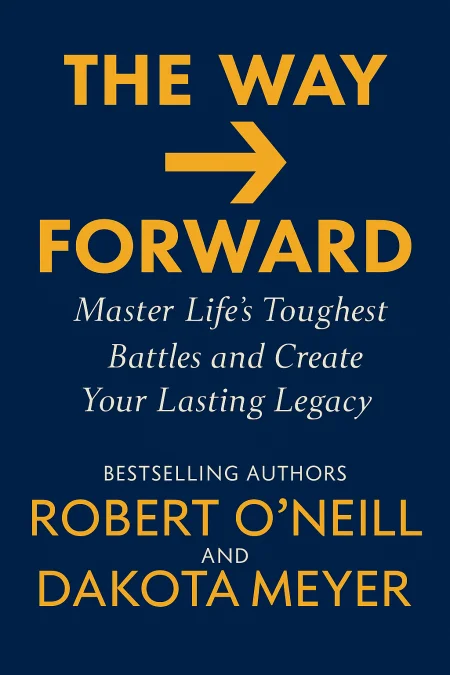
The Way Forward
Master Life's Toughest Battles and Create Your Lasting Legacy
byRobert O'Neill, Dakota Meyer
Book Edition Details
Summary
Two extraordinary lives, two unparalleled journeys. In "The Way Forward," Rob O’Neill and Dakota Meyer strip away the glorified veneer of war, laying bare the raw, unvarnished truths behind their storied military exploits. Through the eyes of these acclaimed veterans, readers will traverse the dusty battlefields of Afghanistan and Iraq and venture into the uncharted territories of the heart and mind. This isn't just another war memoir—it's a manifesto of resilience, humor, and the unyielding spirit of survival. O’Neill and Meyer, each a titan in his own right, oscillate between the dark and the comedic, sharing lessons forged in the crucible of conflict and triumph over invisible adversaries: fear, doubt, and self-imposed limitations. With candor and a dash of irreverence, they invite you to redefine your battles and emerge victorious in the theater of life.
Introduction
In the annals of modern warfare, few stories capture the essence of courage, brotherhood, and redemption like those of two extraordinary warriors whose paths converged through shared sacrifice and mutual understanding. One emerged from the mining hills of Montana, the other from the tobacco farms of Kentucky, yet both would find themselves forged in the crucible of America's longest wars. Their journeys took them from small-town dreams to the most elite fighting forces on earth, where they would face not only foreign enemies but also the internal battles that define true heroism. Through triumph and trauma, victory and loss, these men discovered that the greatest battles are often fought not on distant battlefields, but in the quiet moments of return, healing, and rebuilding. Their story illuminates the profound transformation that occurs when ordinary individuals answer extraordinary calls to service, and reveals how the bonds forged in combat can become the foundation for healing and growth long after the guns fall silent. From their parallel yet distinct paths through military service to their eventual friendship and mutual support, readers will discover the power of resilience, the importance of authentic leadership, and the courage required to face one's deepest wounds in pursuit of a meaningful life beyond war.
Formation: From Small Towns to Elite Warriors
Growing up in the shadow of Montana's Continental Divide, Rob O'Neill learned early that success demanded more than natural talent. In the Irish-Catholic mining town of Butte, where the Berkeley Pit scarred the landscape and the Lady of the Rockies watched over hard-luck families, young Rob discovered his calling through the disciplined pursuit of perfection on the basketball court. His father's relentless coaching sessions, with their demand for twenty consecutive free throws before calling it a night, instilled a philosophy that would later save his life in the world's most dangerous places. The hours spent mastering fundamentals in Montana's thin mountain air taught him that excellence was not a destination but a daily practice. Meanwhile, fifteen hundred miles southeast, Dakota Meyer was learning different lessons on his adoptive father's Kentucky farm. After a childhood marked by instability and broken trust, Big Mike's ranch became Dakota's sanctuary and classroom. Here, among the cattle and tobacco fields, he discovered that responsibility was not just a word but a way of life. The pre-dawn chores, the careful tending of animals, and the harsh reality of life and death on the farm shaped his understanding that true strength comes not from dominating others, but from protecting those who depend on you. Both young men carried within them a restless energy that their small towns could not contain. Rob's fascination with Michael Jordan's relentless work ethic merged with his love of hunting to create a vision of military service that promised both purpose and adventure. Dakota's natural athleticism and fierce loyalty found expression in football and an unlikely stint with the cheerleading squad, where he learned that trust and teamwork could overcome any challenge. The paths that led them away from home were marked by moments of clarity that crystallized their destinies. For Rob, it was the sight of former Marines returning to Butte, transformed by their service into confident men who commanded respect without demanding it. For Dakota, it was a high school recruiter's challenge that he couldn't make it as a Marine, a dare that ignited his determination to prove that small-town kids could rise to meet any standard. Their departures from home were not escapes but launching points toward becoming the warriors they were meant to be.
Combat: Rules, Brotherhood, and the Cost of War
The transformation from civilian to elite warrior demanded more than physical conditioning or tactical training. It required a fundamental rewiring of how these men understood fear, leadership, and the bonds that hold fighting units together. In the crucible of advanced military training, both Rob and Dakota learned that surviving combat was less about individual heroics and more about systematic preparation and unwavering adherence to proven principles. The infamous SEAL training evolutions and Marine Corps discipline stripped away civilian thinking and rebuilt their minds around a simple but profound truth: proper preparation and calm execution under extreme stress were the only reliable paths to victory. Rob's journey through BUD/S and into the SEAL Teams coincided with America's awakening to a new kind of warfare. The September 11th attacks transformed training exercises into deadly serious preparation for battles that would define a generation. His early deployments to places like Albania and Liberia taught him that the world was far more complex and dangerous than small-town Montana had revealed. Each mission built upon the last, creating layers of experience and judgment that would prove essential when facing the ultimate test of his skills and courage. Dakota's path through Marine training and into combat advisory roles in Afghanistan revealed the brutal realities of counterinsurgency warfare. Working alongside Afghan forces, he witnessed firsthand how cultural differences, political complications, and poor decision-making could turn routine operations into deadly catastrophes. The bonds he formed with Afghan soldiers like Dodd Ali transcended language and religion, showing him that courage and sacrifice were universal human qualities that could bridge any divide. The rules of engagement that governed their combat operations were more than military protocols; they were lifelines that kept small units cohesive and alive in chaotic situations. Both warriors learned that discipline under fire was not about blind obedience but about trusting systems that had been proven in blood. When those systems failed or were ignored by higher commanders, the consequences could be devastating. Their combat experiences taught them that true leadership meant making hard decisions based on ground truth rather than political convenience, even when those decisions carried personal costs that would last long after the fighting ended.
Transition: Finding Purpose Beyond the Battlefield
The journey home from war proved more treacherous than any battlefield either warrior had faced. For Rob, the aftermath of the bin Laden raid brought unexpected isolation and resentment from the very brotherhood he had served with distinction. The qualities that made him an exceptional operator—his precision, his confidence, his willingness to step forward when others hesitated—became sources of friction in peacetime. The decision to speak publicly about his experiences was driven not by ego but by a deep conviction that the American people deserved to know the truth about their military's capabilities and sacrifices. Dakota's return was marked by an even more profound struggle with survivor's guilt and the weight of decisions made in the heat of battle. The Medal of Honor ceremony that should have represented the pinnacle of recognition instead became a burden that highlighted the gap between public perception and private anguish. His initial rejection of the award reflected a deeper truth about warriors who measure success not by medals received but by brothers brought home alive. The transition from Marine to civilian forced him to confront demons that no amount of training had prepared him to fight. Both men discovered that the skills that made them lethal on the battlefield—hypervigilance, split-second decision-making, and the ability to compartmentalize trauma—could become obstacles to civilian life. The bureaucracy of the Veterans Administration, the shallow gratitude of politicians, and the impossible task of explaining combat to those who had never experienced it created new forms of isolation. They learned that asking for help was not a sign of weakness but a recognition that healing, like warfare, required the support of trusted allies. The path forward demanded courage of a different kind: the willingness to be vulnerable, to admit mistakes, and to seek unconventional solutions to invisible wounds. Rob's eventual treatment with MDMA and Dakota's journey to Mexico for psychedelic therapy represented desperate but necessary attempts to reclaim their lives from the shadows of war. Their experiences revealed that sometimes the most effective treatments lay outside the conventional medical establishment, requiring the same kind of calculated risk-taking that had served them in combat.
Legacy: Building Circles and Fighting Forward
The transformation from warriors to healers and mentors marked a new chapter in both men's lives, one defined not by past achievements but by present service to others. Rob's speaking career and Dakota's work as a first responder represented different expressions of the same fundamental drive: the need to continue serving something larger than themselves. Their public platforms became vehicles for sharing hard-won wisdom about leadership, resilience, and the true cost of freedom, delivered with the authenticity that only comes from having paid those costs personally. The circles of trust they built around themselves in civilian life reflected lessons learned in combat about the crucial importance of choosing the right people to watch your back. Rob's hunting expeditions with childhood friends and Dakota's tight-knit group of training partners in Austin demonstrated that the brotherhood formed in war could be replicated in peace, provided it was built on mutual respect, shared values, and genuine care for one another's wellbeing. These relationships became foundations for continued growth and sources of strength during difficult times. Their eventual friendship, forged through shared experiences of combat, trauma, and healing, illustrated the power of vulnerability to create connections that transcend individual differences. Despite following different paths through military service and civilian life, they discovered common ground in their commitment to helping others navigate similar challenges. Their willingness to speak openly about mental health struggles, family difficulties, and the ongoing work of healing helped destigmatize these issues for other veterans facing similar battles. The legacy they continue to build is measured not in medals or accolades but in lives touched and changed through their example. Rob's advocacy for alternative PTSD treatments and Dakota's work as an emergency responder demonstrate that service to others remains the most effective antidote to the isolation and meaninglessness that can plague returning warriors. Their story proves that the end of military service is not the end of the mission but the beginning of a different kind of fight, one waged not against foreign enemies but against the forces that would keep people from reaching their full potential.
Summary
The journey of these two extraordinary warriors reveals that true heroism is not found in moments of spectacular courage but in the quiet determination to keep fighting for what matters most, even when the battles move from foreign fields to the home front. Their transformation from small-town dreamers to elite operators to wounded healers demonstrates that resilience is not the absence of trauma but the ability to transform suffering into service to others. The most profound lesson from their shared story is that healing happens in community, that the bonds forged in shared struggle can become the foundation for continued growth and service long after the original mission is complete. For anyone facing their own battles with purpose, meaning, or the weight of past experiences, their example offers hope that with the right support, unconventional courage, and commitment to helping others, it is possible to transform even the deepest wounds into sources of strength and wisdom that can light the way forward for others walking similar paths.
Related Books
Download PDF & EPUB
To save this Black List summary for later, download the free PDF and EPUB. You can print it out, or read offline at your convenience.
By Robert O'Neill
