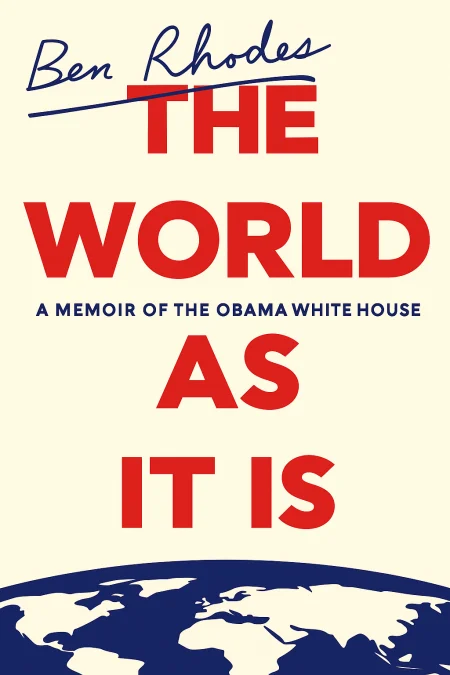
The World as It Is
A Memoir of the Obama White House
Book Edition Details
Summary
In the high-stakes arena of global politics, Ben Rhodes was more than just a spectator—he was a confidant to one of the most consequential leaders of our time. "The World as It Is" unspools a gripping narrative that paints a vivid portrait of the Obama presidency through the eyes of a man who stood at its core. Rhodes, initially a storyteller by trade, offers a rare blend of intimacy and immediacy as he recounts his journey from novice staffer to seasoned strategist. With moments of tension and triumph, from the clandestine talks with Cuba to the tense nights in the Situation Room, this memoir illuminates the inner workings of an administration grappling with a changing world. It's a tale of friendship, politics, and the relentless pursuit of progress, told with the lyrical precision of a true wordsmith.
Introduction
Picture a young speechwriter sitting in the cramped basement offices of the West Wing, crafting words that would echo across continents while the weight of global crises pressed down from above. This intimate chronicle reveals how America navigated eight transformative years that reshaped the nation's role in an increasingly complex world. Through the eyes of someone who witnessed history from the inside, we see how idealistic campaign promises collided with stubborn realities, how secret diplomacy opened doors that had been sealed for decades, and how the forces of authoritarianism began their assault on democratic institutions worldwide. The story illuminates three profound questions that continue to define our era: How does a superpower maintain global leadership while acknowledging the limits of its power? What happens when America's moral authority faces systematic challenges from both foreign adversaries and domestic dysfunction? And perhaps most critically, how do democratic societies defend themselves against authoritarian tactics that exploit their very openness and pluralism? These questions gained urgency as the administration that promised hope and change gave way to one that would systematically dismantle many of its achievements, revealing the fragility of progress in democratic systems. This account speaks to anyone seeking to understand how recent history was made, why democratic institutions feel vulnerable today, and what lessons emerge from America's attempt to lead through persuasion rather than coercion in an age of rising global chaos.
From Campaign Promises to Presidential Constraints (2007-2009)
The transformation from candidate to commander-in-chief began in Chicago campaign offices where young idealists believed they could fundamentally alter America's relationship with the world. Barack Obama's foreign policy emerged from a generation scarred by September 11th and the Iraq War, determined to restore America's moral authority while confronting new global challenges. The candidate who dared to suggest meeting with adversaries like Iran and Cuba without preconditions faced fierce establishment criticism, yet this willingness to challenge conventional wisdom would later define his presidency's most significant breakthroughs. The 2008 financial crisis fundamentally altered the trajectory before the presidency even began. What was intended to be a transformational foreign policy agenda became a rescue mission for both the American economy and global stability. The young administration found itself managing inherited wars in Iraq and Afghanistan while preventing economic collapse, learning quickly that governing meant choosing between competing priorities rather than pursuing idealistic visions. The gap between campaign rhetoric about hope and change and the daily reality of intelligence briefings filled with threats established a tension that would persist throughout eight years in office. Obama's early approach reflected hard-learned lessons about American overreach in the previous decade. Unlike predecessors who viewed military intervention as the primary tool of statecraft, his team recognized that America's greatest strength lay not in its ability to impose solutions, but in its capacity to convene allies, inspire cooperation, and lead by moral example. The Cairo speech in June 2009 exemplified this philosophy, attempting to reset America's relationship with the Muslim world through acknowledgment of past mistakes and extension of partnership rather than dominance. These early experiences established patterns that would define the entire presidency: meticulous deliberation over military action, emphasis on multilateral cooperation, and faith that patient diplomacy could achieve what force could not. Critics dismissed this as weakness, but supporters recognized wisdom born from Iraq's costly lessons about the limits of military power in complex societies.
Arab Spring Upheaval and the Limits of Power (2010-2013)
The self-immolation of a fruit vendor in Tunisia ignited revolutionary fires that would test every assumption about stability, democracy, and American influence in the Middle East. The Arab Spring presented Obama with impossible choices: support aging dictators who had served American interests for decades, or embrace popular movements demanding freedom with uncertain outcomes. The decision to abandon Egypt's Hosni Mubarak marked a watershed moment, signaling America's willingness to side with democratic aspirations over strategic convenience, yet the aftermath would prove far more complex than the inspiring images from Tahrir Square suggested. Libya became the crucible where idealistic intervention met reality's harsh edges. The military operation that prevented Gaddafi's threatened massacre in Benghazi succeeded in its immediate humanitarian objective but failed to establish lasting stability. The September 11, 2012 attack on the American diplomatic compound in Benghazi transformed a tactical failure into a political weapon that would haunt the administration for years, illustrating how partisan warfare could obscure genuine policy complexities and turn tragedy into conspiracy theory. The Syrian conflict exposed the tragic limitations of both intervention and restraint in equal measure. Obama's reluctance to commit American military power reflected hard-won wisdom about unintended consequences, yet his caution could not prevent the humanitarian catastrophe that followed. The red line episode of 2013, when chemical weapons attacks failed to trigger promised military retaliation, crystallized perceptions of American weakness while actually representing a president's determination not to repeat his predecessor's mistakes in rushing toward military solutions. These experiences taught harsh lessons about the complexity of social change and the unintended consequences of American action. The forces unleashed by the Arab Spring proved far more powerful than American influence, revealing the gap between Washington's ambitions and its actual capacity to shape political outcomes in distant societies undergoing revolutionary transformation.
Secret Diplomacy and Rising Authoritarianism (2013-2016)
While public attention focused on Middle Eastern chaos, Obama's most significant achievements unfolded in secret conference rooms and clandestine meetings that would reshape global relationships. The Iran nuclear negotiations represented a fundamental shift in American strategy, replacing decades of sanctions and military threats with patient diplomacy backed by unprecedented economic pressure. Months of quiet talks in Oman slowly built the framework for what would become the Joint Comprehensive Plan of Action, proving that even the most intractable conflicts could yield to sustained engagement and technical expertise. Simultaneously, an even more audacious diplomatic gambit took shape through secret channels with Cuba, conducted in hotel conference rooms across Canada and the Vatican. These negotiations required extraordinary discretion, as both domestic politics and entrenched bureaucratic interests threatened to derail progress toward ending one of the Cold War's last remaining conflicts. The involvement of Pope Francis as moral guarantor demonstrated how creative diplomacy could overcome seemingly insurmountable obstacles rooted in decades of mutual hostility and mistrust. Yet these diplomatic breakthroughs occurred against a backdrop of rising authoritarianism that would define the post-Obama era. Putin's annexation of Crimea and intervention in Ukraine marked the return of great power competition to Europe, challenging the post-Cold War order that had defined American strategy for two decades. The Russian leader's willingness to pay enormous economic and diplomatic costs for territorial expansion revealed how authoritarian leaders could exploit democratic societies' reluctance to escalate conflicts, using aggression as a tool of domestic legitimacy. The emergence of ISIS from the chaos of Iraq and Syria forced a reluctant return to military intervention in the Middle East, demonstrating that the war on terror could not be easily concluded through withdrawal alone. The terrorist group's sophisticated use of social media and ability to inspire attacks in Western cities showed how globalization had transformed security threats, requiring new approaches that combined military action with counter-narrative strategies and international cooperation.
Legacy Under Siege and Democratic Fragility (2016-2017)
Obama's final year began with optimism about cementing diplomatic achievements and ended with the shocking reality of Donald Trump's electoral victory, which threatened to unravel much of what had been accomplished through eight years of patient relationship-building. The Paris Climate Agreement represented multilateral cooperation at its finest, bringing together nearly 200 nations to address humanity's greatest collective challenge, while the successful implementation of the Iran nuclear deal and continued progress with Cuba suggested that diplomatic engagement could indeed produce lasting change in international relationships. Yet beneath these achievements, darker currents were gathering strength that would reshape American politics and global order. Russian interference in the 2016 election represented a new form of warfare designed to exploit democratic societies' openness and turn their freedoms against them. The administration's response, constrained by concerns about appearing partisan and faith in American democratic resilience, proved inadequate to the scale of the threat posed by systematic disinformation campaigns and cyber operations targeting electoral infrastructure. Trump's victory represented more than normal partisan alternation in democratic systems. The candidate who promised to tear down everything Obama had built embodied a fundamental rejection of the values and approaches that had guided American foreign policy for decades. His hostility to career professionals, established alliances, and international agreements suggested that much of the patient diplomatic work of the previous eight years would be vulnerable to rapid reversal, highlighting the fragility of progress in systems where elections can erase years of relationship-building overnight. The peaceful transfer of power proceeded according to constitutional norms, but the incoming administration's embrace of authoritarian rhetoric and systematic attacks on democratic institutions revealed how vulnerable American democracy had become to the same forces that were undermining liberal societies worldwide. The final flights on Air Force One carried a team that had restored America's global standing and prevented multiple wars, yet they departed knowing that their legacy remained hostage to the very democratic processes they had sought to strengthen and defend.
Summary
The Obama years illuminate a fundamental tension in democratic governance: the gap between the transformational change citizens demand and the incremental progress that complex institutions can deliver. Obama's presidency demonstrated both the possibilities and limitations of idealistic leadership in a world where authoritarian adversaries faced no such constraints on their actions. His greatest achievements required patience and persistence that democratic politics rarely rewards, from the technical complexity of nuclear negotiations to the slow work of rebuilding alliance relationships damaged by previous administrations. The period reveals how authoritarian leaders systematically exploit democratic societies' strengths as weaknesses, turning freedom of information into weapons of disinformation and using democratic norms as constraints on democratic leaders while ignoring those same norms themselves. Putin's success in weaponizing social media and Trump's rise to power both reflect democracy's vulnerability to those willing to abandon truth and decency for power, suggesting that defending democratic institutions requires more active engagement than many citizens realized. Three crucial lessons emerge for navigating contemporary challenges. First, meaningful diplomatic progress requires sustained engagement beyond electoral cycles, as the most important breakthroughs took years of patient work away from public attention and political credit. Second, defending democracy demands active citizen participation rather than passive hope, since the institutions that protect freedom require constant tending by engaged populations willing to hold leaders accountable. Finally, the stories societies tell about themselves shape the world they create, making it essential to choose narratives that inspire cooperation and mutual understanding rather than division and conflict. History's arc bends toward justice only when people choose to bend it through sustained commitment to democratic values and international cooperation.
Related Books
Download PDF & EPUB
To save this Black List summary for later, download the free PDF and EPUB. You can print it out, or read offline at your convenience.
By Ben Rhodes
