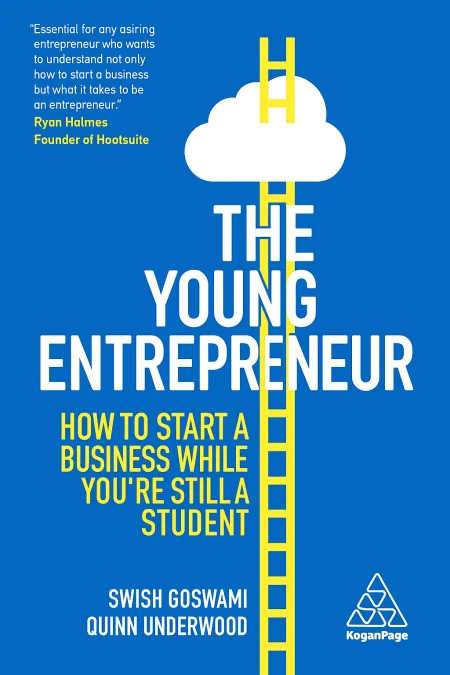
The Young Entrepreneur
How to Start a Business While You're Still a Student
bySwish Goswami, Quinn Underwood
Book Edition Details
Summary
Entrepreneurial dreams are no longer confined to graduation speeches and corporate boardrooms. "The Young Entrepreneur" by Swish Goswami and Quinn Underwood is your invitation to defy the conventional timeline. Tailored for the ambitious minds of Generation Z, this invigorating guide distills the chaos of business innovation into actionable wisdom. Here, practical advice is woven with real-world examples, equipping you with the tools to launch your venture while still balancing the demands of college life. This isn’t just a manual; it’s a manifesto for those unwilling to wait for change. Step into a narrative where youthful audacity meets strategic foresight, and learn how to carve your entrepreneurial path now, with the confidence to shape the future.
Introduction
Picture this: you're sitting in a lecture hall, your mind wandering from the professor's words to that brilliant business idea that's been nagging at you for weeks. You glance around at your classmates, most absorbed in note-taking, but you're different. You're seeing opportunities where others see obstacles, solutions where others see problems. The entrepreneurial fire is already burning within you, but like many young visionaries, you're caught between two worlds – the safety of academic life and the thrilling uncertainty of building something from scratch. This tension between education and entrepreneurship doesn't have to be a choice. In fact, being a student while launching your venture offers unique advantages that seasoned entrepreneurs can only dream of. You have access to diverse networks, reduced financial obligations, and most importantly, the fearlessness that comes with youth. The question isn't whether you should wait until graduation – it's how you can harness your current position to build something extraordinary. Your age isn't a limitation; it's your greatest asset in a world that desperately needs fresh perspectives and innovative solutions.
Build for People, Not Products
The most dangerous trap young entrepreneurs fall into is building solutions to problems that exist only in their imagination. True entrepreneurship begins with a fundamental shift in perspective – moving from "What can I create?" to "What problem can I solve for real people?" This isn't about having the most cutting-edge technology or the sleekest design; it's about understanding human pain points so deeply that your solution becomes inevitable. Consider the story of Jan Koum, who would eventually create WhatsApp. Growing up in Ukraine, his family lived in a small house without hot water, surviving on government aid and food stamps after immigrating to California. Jan wasn't dreaming of becoming a tech mogul – he was simply trying to understand how people struggled to communicate across distances and borders. His childhood experiences of separation and limited resources gave him an intimate understanding of why simple, reliable communication mattered so much to ordinary people. He spent years at Yahoo learning about infrastructure, but more importantly, observing how people actually used technology in their daily lives. When Koum finally developed WhatsApp, it wasn't because he had a revolutionary technical breakthrough. It was because he recognized that people were frustrated with expensive text messaging and complicated communication apps. His solution was almost embarrassingly simple – reliable, affordable messaging that worked across different phones and countries. The app's success came not from its technical sophistication but from how perfectly it addressed a real, widespread problem. Within five years, Facebook acquired WhatsApp for nineteen billion dollars, not because of its code, but because of its deep connection to genuine human needs. The path to building something people actually want starts with becoming genuinely curious about others' struggles. Spend time in coffee shops, libraries, and student centers – not to network, but to listen. Ask your classmates about their daily frustrations. Interview your professors about their professional challenges. Reach out to local business owners and understand what keeps them awake at night. Your goal isn't to sell them anything; it's to develop an almost obsessive understanding of problems that matter. Create a simple notebook where you document every complaint, inefficiency, or "I wish there was a better way to..." statement you encounter. These conversations will reveal patterns that most people miss because they're too focused on their own ideas to truly hear what others need.
From MVP to Market Launch
The journey from your first prototype to a market-ready product is where dreams either flourish or die. This phase demands a delicate balance between speed and quality, between listening to feedback and maintaining your vision. The key is understanding that your Minimum Viable Product isn't meant to be perfect – it's meant to start conversations with real customers who will guide your next steps. Take the remarkable story of Brian Chesky and Joe Gebbia, the founders of Airbnb. These young entrepreneurs were so broke they couldn't even pay their rent in San Francisco. When a design conference came to town and hotel rooms became scarce and expensive, they had a simple idea – what if they could rent out air mattresses in their apartment to conference attendees? Their first MVP was almost laughably basic: a simple website with photos of their spare room, three air mattresses, and a promise of breakfast and WiFi. They weren't trying to revolutionize the hospitality industry; they were just trying to make enough money to pay rent. What happened next transformed their understanding of what they were building. Their first three guests didn't just need a place to sleep – they wanted local recommendations, insider tips about the city, and genuine human connections during their travels. The founders spent hours with these early customers, learning that people weren't just looking for cheaper accommodation; they were seeking authentic, personal experiences that hotels couldn't provide. This intimate customer feedback revealed that their real business wasn't about air mattresses at all – it was about creating a platform where people could belong anywhere in the world. Building on this insight, Chesky and Gebbia expanded slowly but deliberately. Instead of rushing to scale, they focused intensely on perfecting the experience for their next fifty hosts and guests. They personally visited properties, helped hosts take better photos, and resolved every customer complaint themselves. This hands-on approach taught them exactly what features mattered most and which ones were just nice-to-have additions. When they finally launched to a broader market, their platform wasn't just functional – it was refined by hundreds of real interactions with real people facing real travel challenges. Your MVP development should follow this same principle of intimate customer engagement. Start with the simplest possible version that demonstrates your core value proposition. Share it with five to ten people who represent your target market, but don't just collect their opinions – observe how they actually use what you've built. Watch where they hesitate, note what confuses them, and pay special attention to the features they ignore completely. Use these insights to guide your next iteration, always asking whether each new feature brings you closer to solving the fundamental problem you've identified. Remember, successful products aren't built in isolation; they're sculpted through countless conversations with the people who will ultimately decide their fate.
Scale Smart and Exit Strategic
The transition from a promising startup to a scalable business requires a fundamental shift in how you think about growth. This isn't just about getting more customers or raising more money – it's about building systems and culture that can handle exponential change while maintaining the core values that made your business special in the first place. The story of Stewart Butterfield and his team at Slack illustrates this evolution perfectly. When they started, Slack wasn't even intended to be a communication platform – it began as an internal tool for their gaming company. But as they used their simple messaging system to coordinate their own work, they realized they had stumbled onto something powerful. Instead of rushing to build every feature imaginable, Butterfield made a counterintuitive decision: he obsessed over making their core messaging experience absolutely flawless for small teams before expanding to larger organizations. This focus on excellence over expansion paid dividends when larger companies began adopting Slack organically. Because the product had been refined through thousands of small team interactions, it naturally scaled to handle more complex organizational needs. Butterfield's team had built something so fundamentally useful that customers became evangelists, driving growth through word-of-mouth recommendations rather than expensive marketing campaigns. When they eventually decided to expand features, each addition was based on deep understanding of how real teams actually collaborated, not on theoretical assumptions about what businesses might want. The key to scaling successfully lies in identifying which aspects of your business can grow exponentially and which require careful, personal attention. Create systems for the scalable elements – customer onboarding, basic support, routine operations – while maintaining high-touch relationships in areas that define your competitive advantage. This might mean personally calling your first hundred customers to understand their experience, even as you automate your billing and signup processes. It means hiring people who share your commitment to customer obsession, not just those with impressive technical skills. As you build toward a potential exit – whether through acquisition, merger, or going public – remember that buyers aren't just purchasing your current revenue stream. They're investing in your team's ability to continue growing and innovating within their larger ecosystem. Document not just what you've built, but how you've built it. Preserve the customer insights, cultural practices, and systematic approaches that enabled your success. The most valuable exits aren't just financial transactions; they're opportunities to amplify your impact by connecting your innovation with resources and reach you couldn't achieve alone.
Summary
The entrepreneurial journey while still a student isn't just about building a business – it's about developing a mindset that sees opportunity in every challenge and solutions in every frustration. As the founders discovered time and again, success comes not from having the most sophisticated technology or the biggest marketing budget, but from maintaining an almost obsessive focus on creating genuine value for real people. The most powerful insight from every successful student entrepreneur is this simple truth: "Build something 100 people love, not something a million people kind of like." Your greatest advantage right now isn't your youth, your energy, or even your access to university resources – it's your willingness to start before you feel ready. Take that idea that's been occupying your thoughts, find five people who share the problem you want to solve, and build the simplest possible version of your solution. Share it with them this week, learn from their feedback, and iterate based on what you discover. The perfect business plan can wait; the perfect moment will never come. Your future self will thank you for starting today, imperfectly but authentically, rather than waiting for tomorrow's impossible perfection.
Related Books
Download PDF & EPUB
To save this Black List summary for later, download the free PDF and EPUB. You can print it out, or read offline at your convenience.
By Swish Goswami
