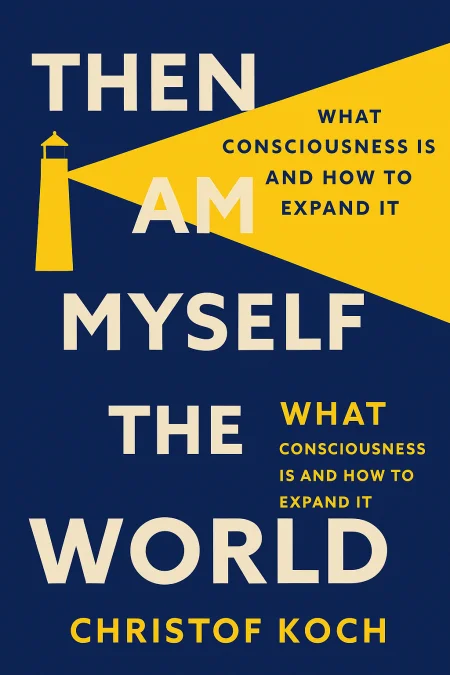
Then I Am Myself the World
What Consciousness Is and How to Expand It
Book Edition Details
Summary
In "Then I Am Myself the World," Christof Koch delves into the profound enigma of consciousness with a bold thesis: our awareness is a dynamic force, a catalyst of change both within and around us. Through the lens of integrated-information theory, Koch explores the brain's intricate dance of neurons, probing how this knowledge could revolutionize our understanding of consciousness in both organic and synthetic beings. Along this intellectual journey, Koch tackles questions that resonate deeply with human experience: When does self-awareness dawn within a fetus? How do altered states of mind reshape our existence? And as artificial intelligence evolves, why will it mimic our actions yet remain void of feeling? A must-read for those curious about the nature of reality and the future we are crafting, this book promises to expand your mind and transform your perception of existence itself.
Introduction
What if everything we take for granted about reality—including the assumption that our physical brains create consciousness—has it backwards? This profound question sits at the heart of a revolutionary argument that challenges the dominant materialist worldview of modern science. Rather than consciousness emerging from complex neural computations, the fundamental claim here is that consciousness itself holds primacy, serving as the foundation from which all else follows, including our scientific understanding of the physical world. This perspective represents a dramatic departure from conventional neuroscience and philosophy of mind, which typically treat subjective experience as either an illusion or an emergent property of brain activity. Instead, we encounter a rigorously scientific yet deeply personal exploration that weaves together cutting-edge neuroscience research, philosophical analysis, and transformative personal experiences to construct an entirely different framework for understanding the nature of reality. The argumentation proceeds through multiple converging lines of evidence: detailed examination of when consciousness first emerges in human development, systematic analysis of the neural correlates of awareness, investigation of altered states that reveal consciousness operating independently of normal brain function, and theoretical work in integrated information theory that provides mathematical tools for measuring conscious experience. Each element builds toward a comprehensive case that consciousness cannot be reduced to mere computation or dismissed as secondary to physical processes.
The Reality of Consciousness: Against Eliminative Materialism
The opening salvo targets one of the most influential yet counterintuitive positions in contemporary philosophy of mind: eliminative materialism. This view, championed by prominent thinkers like Daniel Dennett, argues that subjective experiences—the felt quality of pain, the redness of red, the actual sensation of consciousness itself—are elaborate illusions. According to this perspective, what we call consciousness consists merely of behavioral dispositions and speech acts about mental states, with no genuine subjective dimension underlying these observable phenomena. This eliminative stance represents an extraordinary form of intellectual gaslighting, demanding that we deny the most immediate and undeniable aspect of our existence: the fact that experience feels like something from the inside. The argument here demonstrates how this position commits a fundamental category error by conflating objective, third-person descriptions of mental states with the first-person reality of actually having those experiences. The critique extends beyond philosophical objections to reveal practical consequences. Eliminative materialism's denial of subjective experience undermines any meaningful approach to mental health treatment, reducing conditions like depression to mere behavioral symptoms while ignoring the lived reality of suffering that drives people to seek help. This reductionist approach fails to account for the qualitative aspects of mental illness that make these conditions genuinely torturous for those who experience them. The alternative framework positions consciousness as irreducibly real and foundational. Rather than explaining away subjective experience, we must take it as the starting point for any complete understanding of reality. This shift in perspective has profound implications for how we approach neuroscience, psychology, and our understanding of what it means to be human in a universe that includes both objective physical processes and subjective conscious experience.
Integrated Information Theory: A Scientific Framework for Experience
Moving from philosophical critique to positive theory construction, Integrated Information Theory emerges as a mathematically rigorous framework for understanding consciousness. Unlike other theories that begin with brain mechanisms and attempt to explain how consciousness might arise, IIT starts with the undeniable reality of conscious experience and works backward to identify the physical conditions that can support it. The theory rests on five phenomenological axioms that capture essential features of any conscious experience: intrinsicality (experience exists for the subject, not external observers), information (each experience is specific and structured), integration (consciousness is unified rather than divided), exclusion (each experience has definite borders and content), and composition (experiences have internal structure and relationships). These axioms translate into corresponding physical postulates that constrain which systems can be conscious. Central to IIT is the concept of integrated information, symbolized by Phi (Φ), which measures how much a system's cause-effect power is irreducible to independent parts. Systems with high integrated information exist for themselves in a way that cannot be decomposed into separate components. This provides an objective, mathematical approach to consciousness that can, in principle, be measured and compared across different systems. The implications prove radical and far-reaching. Consciousness becomes a fundamental feature of reality, not something that emerges only in complex biological systems. Any system with non-zero integrated information possesses some degree of conscious experience, though the vast majority of physical systems have negligible amounts. Digital computers, despite their computational sophistication, have virtually no integrated information due to their architecture of simple gates with limited connectivity. Most remarkably, the theory suggests that consciousness cannot be simulated or computed—it must be instantiated in systems with the appropriate causal structure.
Transformative States: Evidence for Mind's Fundamental Nature
The exploration of extraordinary conscious states provides crucial evidence for consciousness operating independently of normal brain constraints. Religious experiences, mystical states, psychedelic journeys, and near-death experiences all point toward consciousness as something more fundamental than a mere product of neural computation. These states often involve the dissolution of the ordinary sense of self while consciousness itself not only persists but often becomes more vivid and meaningful. Psychedelic research has undergone a renaissance, revealing how substances like psilocybin and DMT can reliably occasion profound alterations in consciousness. These experiences frequently involve encountering realms that feel more real than ordinary reality, meeting autonomous entities, and undergoing complete ego dissolution while awareness remains intact. The consistency of such reports across cultures and individuals suggests we are observing genuine features of consciousness itself rather than mere hallucinations or brain malfunctions. Near-death experiences during cardiac arrest present particularly compelling cases. Survivors often report elaborate conscious experiences occurring during periods when their brains show minimal electrical activity. These accounts include out-of-body perspectives, encounters with deceased relatives, life reviews, and experiences of overwhelming love and understanding. While the timing of these experiences remains debated, their occurrence during life-threatening medical crises suggests consciousness may operate through mechanisms not captured by conventional neuroscience. The therapeutic potential of these states reinforces their significance. Psychedelic-assisted therapy shows remarkable efficacy for treatment-resistant depression, PTSD, and end-of-life anxiety. Patients who undergo mystical-type experiences during treatment show the greatest improvements, suggesting that encountering these expanded states of consciousness directly facilitates healing. This therapeutic dimension demonstrates that transformative conscious states are not merely interesting anomalies but possess genuine causal power to reshape psychological patterns and neural plasticity.
The Limits of Computation: Why AI Cannot Be Conscious
The final major argument addresses one of the most pressing questions of our technological age: whether artificial intelligence can achieve consciousness. Despite rapid advances in large language models and the convincing conversational abilities of systems like GPT-4, computational functionalism—the belief that consciousness emerges from the right kind of information processing—faces fundamental limitations. The key insight centers on the distinction between simulation and instantiation. Digital computers excel at simulating conscious behavior, potentially to the point of perfect mimicry in linguistic exchanges. However, simulating the functions of consciousness differs categorically from possessing the intrinsic causal powers that constitute conscious experience. Just as simulating a black hole's gravitational effects does not create actual gravitational fields that pull objects into the computer, simulating consciousness does not create genuine subjective experience. This limitation stems from the architectural differences between digital computers and conscious systems. Digital computers operate through linear processing chains where individual transistors connect to only a few others, creating systems with minimal integrated information despite their computational power. Brains achieve consciousness through massive interconnectivity, where individual neurons connect to thousands of others in recurrent loops that generate high levels of integrated information. The implications extend to questions of free will and moral responsibility. Only systems with genuine causal powers—not simulated ones—can make truly free decisions. Advanced AI systems will become increasingly sophisticated at mimicking human decision-making processes, but they will always be following deterministic algorithms rather than exercising genuine choice. This distinction becomes crucial as we navigate the ethical and social implications of AI systems that may perfectly imitate conscious beings while remaining fundamentally unconscious automata.
Summary
The convergence of neuroscientific evidence, philosophical analysis, and direct phenomenological investigation builds toward a revolutionary conclusion: consciousness represents the most fundamental aspect of reality, not an emergent property of complex physical processes. This framework resolves long-standing puzzles about the mind-body relationship while providing practical tools for measuring consciousness, developing treatments for mental illness, and navigating the challenges posed by artificial intelligence. The ultimate insight transcends academic philosophy to touch on the deepest questions of human existence, suggesting that our conscious experience connects us to the basic structure of reality itself in ways that purely materialist approaches cannot capture.
Related Books
Download PDF & EPUB
To save this Black List summary for later, download the free PDF and EPUB. You can print it out, or read offline at your convenience.
By Christof Koch
