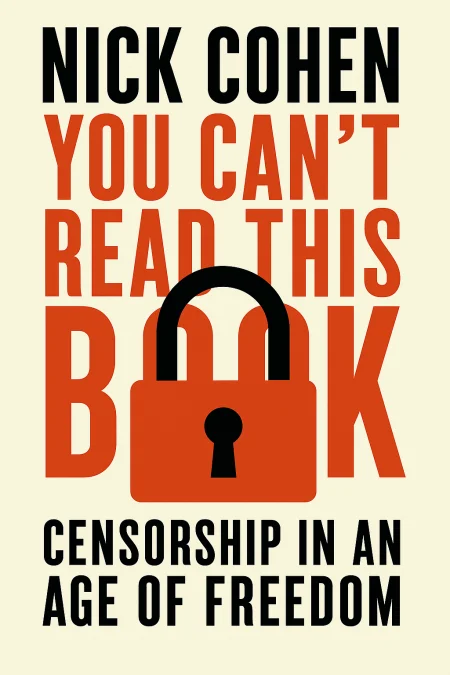
You Can’t Read This Book
Censorship in an Age of Freedom
Book Edition Details
Summary
In an era where freedom was supposed to flourish, shadows linger in places you least expect. "You Can't Read This Book" challenges the comforting illusion of limitless speech, spotlighting the sinister forces that threaten to silence us even now. From the aftermath of The Satanic Verses controversy to today's pervasive digital barriers, Nick Cohen unravels the unnerving resurgence of censorship cloaked in modern guise. This compelling narrative doesn't just recount history; it unearths the unsettling truth that in the age of information, power still trumps voice. When the stakes include your words, your thoughts, and your very freedom, can any of us truly speak without fear?
Introduction
The contemporary landscape of free expression presents a troubling paradox that challenges fundamental assumptions about liberty in democratic societies. While technological advancement and constitutional protections suggest unprecedented opportunities for open discourse, sophisticated mechanisms of silencing have emerged that prove far more effective than traditional authoritarian censorship. These new forms of suppression operate not through crude government prohibition, but through the strategic manipulation of liberal values themselves—transforming tolerance into intolerance, rights into restrictions, and protection into persecution. The examination reveals how religious extremism, corporate power, and digital surveillance create interlocking systems that silence dissent while maintaining the appearance of legitimacy. Religious groups weaponize offense to establish sacred boundaries around secular discourse. Wealthy individuals and corporations exploit legal systems designed to protect reputation, transforming them into instruments of intimidation. Digital platforms that promise liberation instead enable unprecedented surveillance and control. Each mechanism succeeds precisely because it masquerades as protection—of religious sensibilities, individual dignity, or social harmony. This analysis demonstrates that preserving intellectual freedom requires more than constitutional guarantees or technological innovation. It demands recognition that the greatest threats to free expression in liberal societies come not from obvious enemies of freedom, but from those who exploit democratic values to impose their own forms of tyranny. Understanding these mechanisms becomes essential for anyone committed to maintaining the open discourse upon which democratic civilization depends.
Religious Extremism's Manipulation of Liberal Tolerance
Religious extremism has developed a sophisticated strategy for constraining secular discourse by transforming offense into a weapon against free expression. This approach operates through the deliberate conflation of criticism with persecution, presenting any intellectual challenge to religious doctrine as an assault on entire communities. The mechanism proves particularly effective because it exploits liberal societies' genuine commitment to protecting minority groups from discrimination, inverting these protective instincts into tools of suppression. The manufacturing of outrage follows a predictable pattern that reveals its calculated nature. Religious authorities identify works of art, literature, or scholarship that reference religious themes, extract isolated elements from their context, and present them as deliberate provocations requiring violent response. The temporal gap between publication and protest—often months or years—demonstrates the coordinated rather than spontaneous nature of these campaigns. When writers create nuanced portrayals of religious figures or artists incorporate sacred imagery into their work, extremist groups transform these creative expressions into existential threats demanding immediate suppression. The success of this strategy depends on manipulating well-meaning progressives into defending censorship as anti-racism. By claiming victimhood, religious extremists create a perverse inversion where those advocating for universal human rights are labeled as bigots, while those demanding the right to silence critics are celebrated as defenders of minority rights. This dynamic extends far beyond immediate targets, creating a chilling effect that encourages preemptive self-censorship among writers, publishers, and artists who fear becoming the next focus of manufactured controversy. The broader implications threaten the entire framework of rational inquiry underlying democratic deliberation. When societies accept that certain ideas are too sacred to question, they abandon the principle that truth emerges through open debate and evidence-based reasoning. The result is a creeping theocracy that operates not through formal religious establishment, but through the gradual acceptance of religious veto power over secular discourse, fundamentally undermining the intellectual foundations necessary for democratic governance.
Corporate Power and the Weaponization of Legal Systems
Wealthy individuals and corporations have discovered that legal systems ostensibly designed to protect reputation can be transformed into instruments of intimidation that silence criticism more effectively than direct government censorship. This privatization of suppression operates through apparently legitimate legal processes, making it particularly difficult to recognize and resist. The strategy exploits fundamental asymmetries in legal systems that place crushing financial burdens on defendants while allowing plaintiffs to impose costs regardless of the merit of their claims. The mechanism operates through economic intimidation rather than legal victory. Publishers and journalists face impossible choices between expensive legal battles they may lose despite the truth of their reporting, or preemptive self-censorship that avoids legal risk entirely. The mere threat of litigation often proves sufficient to suppress unwelcome scrutiny, creating a chilling effect that extends far beyond cases that reach courtrooms. Most censorship occurs in editorial meetings and publishing houses, where potential stories are killed to avoid financial catastrophe. This system proves particularly dangerous because it inverts the traditional relationship between power and accountability. Those with the greatest ability to influence society through their economic decisions face the least scrutiny of their actions, while those seeking to hold them accountable bear the greatest risks. The result is a form of plutocratic immunity that shields the wealthy from democratic oversight essential to preventing abuse of power. Financial institutions exemplify this dynamic, where hierarchical cultures and economic incentives systematically silence internal critics who witness dangerous practices. The catastrophic consequences became evident during the financial crisis, when thousands of employees possessed information about unsustainable risks that threatened global economic stability. The legal and economic incentives for silence proved stronger than any motivation to serve the public interest, contributing to a disaster that could have been prevented if internal critics had been protected rather than marginalized. The system designed to protect individual reputation instead protected institutional corruption, demonstrating how legal mechanisms can be perverted to serve power rather than justice.
Digital Technology's False Promise of Liberation
Digital technology presents a fundamental paradox that confounds optimistic narratives about technological progress and human freedom. While the internet provides unprecedented opportunities for information sharing and democratic participation, it simultaneously creates mechanisms for surveillance and control that exceed the capabilities of traditional authoritarian systems. The same technologies that enable global communication also enable global monitoring, and the same platforms that democratize publishing also centralize control over information distribution in ways that threaten rather than enhance intellectual freedom. The promise of digital liberation rests on naive assumptions about the relationship between access and empowerment. Optimistic visions assume that information naturally wants to be free and that decentralized networks inherently resist authoritarian control. This analysis overlooks how digital systems depend on infrastructure controlled by governments and corporations, and how apparent decentralization can mask new forms of centralized power. The result is often the illusion of freedom rather than its substance, as users mistake the ability to consume information for genuine intellectual autonomy. Authoritarian regimes have proven remarkably adept at adapting to digital challenges, developing sophisticated techniques for monitoring online activity, manipulating information flows, and using digital platforms to identify and suppress dissent. Democratic societies face subtler but equally significant threats as private companies accumulate unprecedented data about individual behavior and preferences, creating possibilities for manipulation that operate below the threshold of conscious awareness. The interconnected nature of digital systems enables distributed censorship, where online retailers, payment processors, and hosting services can be pressured to cut ties with controversial content creators without any single actor appearing responsible for the silencing. The most profound challenge lies in how digital systems undermine the social foundations necessary for democratic discourse. The fragmentation of shared information sources, the creation of echo chambers that reinforce existing beliefs, and the acceleration of information cycles that prevent careful deliberation all threaten the conditions under which rational democratic debate can occur. Social media platforms become battlegrounds where manufactured controversies spread instantly across the globe, amplifying censorious campaigns that overwhelm targets with threats and abuse, effectively silencing them through digital mob action that makes traditional legal protections inadequate.
Defending Free Expression Against Disguised Authoritarianism
Effective resistance to contemporary censorship requires understanding that freedom of speech represents an achievement that must be constantly defended rather than a natural state that maintains itself. Historical examples demonstrate that free expression has always faced opposition from established authorities, but the arguments for intellectual liberty remain relevant because they address fundamental human tendencies to suppress uncomfortable truths. The insight that truth emerges through open debate rather than authoritative decree directly challenges modern attempts to protect ideas from criticism, regardless of their apparent legitimacy or widespread acceptance. Successful defense must address both legal and cultural dimensions of the problem. Legal reforms should shift the burden of proof back to claimants in libel cases, cap costs to prevent economic intimidation, and provide robust protection for whistleblowers who expose wrongdoing in powerful institutions. However, legal changes alone prove insufficient without cultural transformation that values intellectual courage over comfortable conformity. Society must learn to distinguish between legitimate criticism and genuine harassment, refusing to allow bad-faith actors to exploit anti-discrimination principles to silence their critics. The most crucial element involves solidarity among those committed to free expression. When writers, journalists, and artists stand together against censorship, they make it much harder for would-be censors to isolate and destroy individual targets. The success of publishers in defending controversial authors, despite enormous pressure and real physical danger, demonstrates what can be achieved when institutions commit to principle over profit. Conversely, the abandonment of critics by liberal establishments shows how quickly censorship succeeds when potential allies choose safety over solidarity. Building effective resistance requires honest acknowledgment of the costs involved. Defending free speech sometimes means protecting offensive or uncomfortable expression, and it always means accepting some level of risk. Those who value intellectual freedom must be prepared to pay these costs, understanding that the alternative—a world where only approved thoughts can be safely expressed—represents a far greater danger to human flourishing and democratic governance. The battle for intellectual freedom cannot be won through passive reliance on constitutional protections, but demands active commitment to the principle that no idea, however cherished or widely held, should be immune from criticism and debate.
Summary
The fundamental insight emerging from this analysis reveals that censorship in liberal societies succeeds not through crude prohibition but through the manipulation of liberal values themselves, transforming tolerance into a weapon against the tolerant and using the language of rights to justify the suppression of rights. The most effective modern censors present themselves as victims seeking protection rather than authorities demanding obedience, exploiting democratic societies' commitment to pluralism and minority protection to silence those who would hold power accountable. This sophisticated understanding of how freedom of expression can be undermined from within demands more than constitutional protections or technological solutions—it requires cultural commitment to the principle that ideas must be evaluated on their merits rather than their capacity to offend, enrich, or comfort those in positions of power. Only through recognizing how modern censorship actually operates can societies develop effective strategies for maintaining the intellectual freedom essential to human flourishing and democratic governance, understanding that this freedom must be actively defended against those who would exploit our highest values to impose their own forms of tyranny.
Related Books
Download PDF & EPUB
To save this Black List summary for later, download the free PDF and EPUB. You can print it out, or read offline at your convenience.
By Nick Cohen
