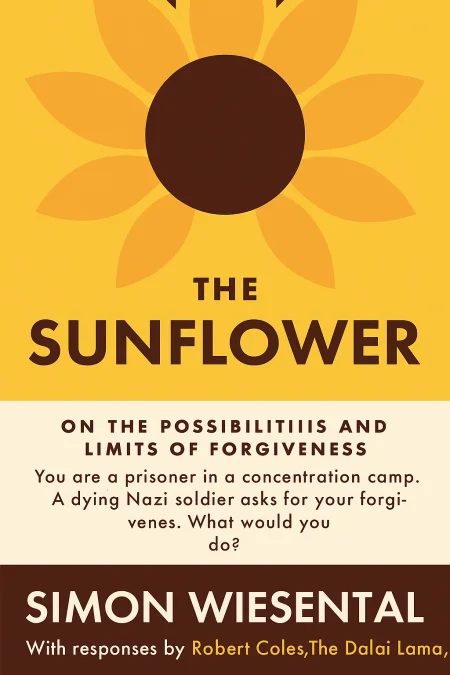
The Sunflower
On the Possibilities and Limits of Forgiveness
Book Edition Details
Summary
In a world shadowed by the atrocities of war, a profound silence reverberates through the soul of Simon Wiesenthal. Pulled from the suffocating routine of a Nazi concentration camp, he is confronted with a haunting dilemma at the bedside of a dying SS soldier seeking forgiveness. This chilling encounter births a timeless question: can justice and compassion coexist, or must one be sacrificed for the other? "The Sunflower" invites you into a gripping dialogue where 53 voices—spanning from Holocaust survivors to global leaders—wrestle with the complexities of mercy and justice. Each perspective, as rich and varied as the storytellers themselves, challenges you to examine the boundaries of forgiveness in an unforgiving world. Prepare to be stirred, provoked, and inspired to confront your own beliefs in this extraordinary exploration of humanity’s darkest and brightest impulses.
Introduction
In a makeshift hospital room in Nazi-occupied Poland, a dying SS officer summoned a Jewish prisoner to his bedside. The soldier's bandaged head bore witness to his fatal wounds, but it was his desperate plea for forgiveness that would haunt both men for eternity. This extraordinary encounter between victim and perpetrator illuminates one of history's most profound moral questions: can—or should—we forgive the unforgivable? The story unfolds against the backdrop of humanity's darkest hour, when industrial-scale murder challenged every assumption about civilization, morality, and human nature. Through this singular moment of confession and silence, we witness the collision between individual conscience and collective tragedy, between the desire for redemption and the weight of unspeakable crimes. The narrative forces us to grapple with questions that extend far beyond any single historical moment: What are the limits of human forgiveness? Who has the authority to grant absolution for crimes against others? And how do survivors of atrocity navigate the treacherous waters between justice and mercy? This profound meditation speaks to anyone wrestling with moral complexity in our modern world, where the shadows of past atrocities continue to shape contemporary debates about reconciliation, justice, and the possibility of redemption after unthinkable evil.
The Death Chamber Encounter (1943): A Nazi's Deathbed Confession
In the summer of 1943, amid the systematic extermination that was consuming European Jewry, an unlikely confrontation unfolded in a converted military hospital. A young SS officer, Karl, lay dying from wounds sustained on the Eastern Front, his head wrapped in bloodstained bandages that left only openings for his mouth and nose. Through these narrow apertures came a confession that would challenge every assumption about guilt, redemption, and human nature. The wounded soldier had specifically requested the presence of any Jew—not a particular individual, but simply a representative of the people he had helped to murder. This detail reveals the dehumanizing logic that even repentance could not fully escape: Jews remained interchangeable symbols rather than unique human beings. Yet Karl's desperation was genuine. Haunted by memories of burning families leaping from windows, of children's screams echoing through the night, he sought absolution from those he had wronged. The dying man's account of his transformation from altar boy to mass murderer illustrated how ordinary individuals became instruments of genocide. Raised in a devout Catholic household with anti-Nazi parents, Karl had chosen to join the Hitler Youth against his father's wishes, then volunteered for the SS. His story demonstrated that evil often emerges not from inherent monstrosity, but from a series of seemingly small moral compromises that gradually erode the conscience. This encounter established the central tension that would define Holocaust memory: the collision between human sympathy for suffering and the magnitude of crimes that seem to transcend forgiveness. Karl's genuine remorse, evident in his physical and emotional anguish, stood in stark contrast to the calculated brutality of his actions, creating a moral puzzle that would resonate through subsequent generations.
Voices from the Camps: Prisoners Debate Forgiveness and Justice
Within the suffocating confines of the barracks, three men grappled with questions that transcended their immediate survival. Arthur, the cynical intellectual, saw the request as an obscene attempt by a "superman" to demand the impossible from a "subhuman." His bitter wisdom reflected the inmates' daily reality: they were already condemned to death, making discussions of forgiveness seem almost absurd. Yet even Arthur's harsh pragmatism could not entirely dismiss the moral complexity of the situation. Josek, the devoutly religious businessman turned makeshift rabbi, brought centuries of Jewish theological tradition to bear on the dilemma. Drawing from Talmudic teachings, he argued that only victims themselves possessed the authority to grant forgiveness—a principle that rendered Karl's plea fundamentally invalid. The murdered families of Dnepropetrovsk could never consent to their own absolution. This theological framework provided clarity in an otherwise murky moral landscape. The camp's brutal environment had stripped away most human comforts, but it could not eliminate the prisoners' capacity for moral reasoning. Their debates revealed how extreme circumstances can both clarify and complicate ethical thinking. The immediacy of death focused their minds on essential questions while the degradation of their conditions made traditional moral categories seem inadequate. These discussions among the condemned illuminated a crucial aspect of Holocaust memory: the victims themselves disagreed about fundamental questions of justice and mercy. Their varied perspectives, shaped by different backgrounds and beliefs, demonstrated that there was no single "correct" response to unprecedented evil. The diversity of their views would later be reflected in the broader post-war debates about memory, justice, and reconciliation.
Postwar Reckonings: Visiting the Mother and Confronting Memory
In the bombed-out ruins of postwar Stuttgart, a profound act of mercy unfolded quietly. The survivor, now liberated but scarred, stood before the photograph of his former tormentor, seeing for the first time the youthful face behind the bandages. Karl's elderly mother, broken by loss and living amid rubble, cherished the memory of her "good son" who had died serving his country. She knew nothing of his participation in mass murder. The decision to preserve her illusions represented a different kind of moral courage. Here was an opportunity for revenge that would have cost nothing but an old woman's peace of mind. Yet the survivor chose silence, understanding that truth without the possibility of repair might be its own form of cruelty. This grandmother would spend her remaining years believing in her son's fundamental decency, never knowing that strangers had burned alive at his hands. This encounter revealed how the trauma of atrocity ripples outward, affecting not only direct perpetrators and victims but entire communities. The mother's ignorance was not accidental—it reflected a broader German society that preferred comfortable myths to uncomfortable truths. Her genuine grief and confusion illustrated how evil often destroys the innocent alongside the guilty, leaving survivors to navigate complex webs of complicity and victimization. The visit also demonstrated the ongoing burden carried by survivors long after liberation. The moral questions that began in the death chamber continued to evolve, shaped by new circumstances and responsibilities. The choice to show mercy to the mother while maintaining memory of the crimes established a template for how individuals might balance justice with compassion in the aftermath of atrocity.
Contemporary Responses: Scholars and Survivors on Unforgivable Acts
Half a century later, the dying soldier's plea continued to generate passionate debate among theologians, philosophers, and fellow survivors. Christian respondents frequently emphasized the transformative power of genuine repentance, seeing Karl's deathbed confession as evidence of his fundamental humanity. They argued that forgiveness could serve the dual purpose of liberating both victim and perpetrator from the chains of past evil. Jewish voices, drawing from different theological and experiential traditions, generally maintained that some acts transcend human forgiveness. They pointed to the practical impossibility of speaking for the dead and the dangerous precedent of granting absolution for genocide. The murdered families of Dnepropetrovsk had neither authorized anyone to forgive on their behalf nor had the opportunity to make that choice themselves. These contemporary discussions revealed how the Holocaust continued to challenge traditional categories of moral thought. Secular philosophers questioned whether forgiveness without justice might actually perpetuate evil by making it seem less consequential. Others argued that the refusal to forgive could trap survivors in cycles of hatred that diminished their own humanity. The diversity of responses illustrated a crucial insight: moral clarity in extreme circumstances may be impossible to achieve. The Nazi's request forced confrontation with the limits of human judgment and the inadequacy of conventional ethical frameworks when faced with unprecedented evil. These ongoing debates demonstrated how the Holocaust's moral legacy extends far beyond historical memory, continuing to shape contemporary discussions about justice, reconciliation, and the possibilities of human redemption.
Summary
The central tension illuminated by this wartime encounter transcends any single historical moment: it reveals the eternal struggle between our capacity for both evil and redemption. The dying soldier's genuine remorse confronted the absolute nature of his crimes, creating a moral paradox that conventional frameworks of justice and mercy could not resolve. This collision between individual humanity and systematic inhumanity continues to define how societies grapple with the aftermath of atrocity. The story's enduring relevance lies not in providing easy answers, but in forcing us to confront uncomfortable questions about the nature of evil, responsibility, and reconciliation. In our contemporary world, where ethnic cleansing, genocide, and mass atrocities persist, these moral dilemmas remain painfully relevant. The survivor's choice of silence offers a profound model: rejecting both the extremes of vengeful hatred and premature forgiveness while maintaining the essential human capacity for moral reasoning even in the face of ultimate evil. This nuanced approach suggests that justice and mercy need not be mutually exclusive, but rather can coexist in the complex work of preserving memory while building more humane futures. The true lesson may be that some moral questions are meant to remain open, continuing to challenge each generation to examine its own capacity for both cruelty and compassion.
Related Books
Download PDF & EPUB
To save this Black List summary for later, download the free PDF and EPUB. You can print it out, or read offline at your convenience.
By Simon Wiesenthal
