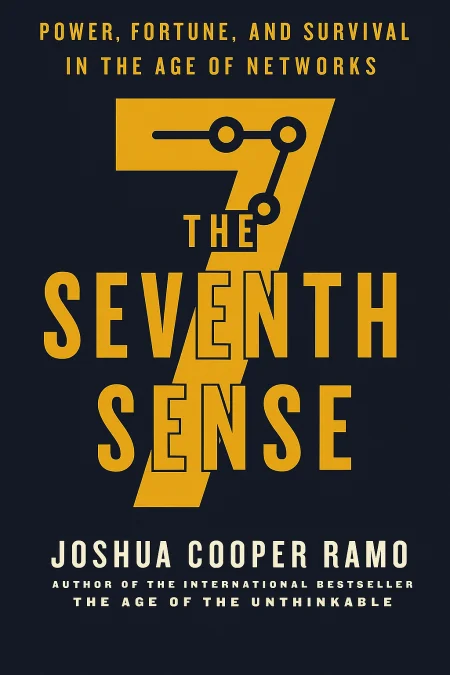
The Seventh Sense
Power, Fortune, and Survival in the Age of Networks
Book Edition Details
Summary
What if the tangled threads of today's chaotic world hold a secret pattern, visible only to the keenest eyes? In "The Seventh Sense," Joshua Cooper Ramo unravels the hidden webs of power that define our era, where the surge of technology, the tremors of politics, and the intricate dance of economies are all connected. This isn't just about the Internet; it's about the networks that bind trade, finance, and even our DNA. Drawing from his deep experience with global leaders, Ramo illuminates what the winners perceive and what the rest overlook. This book is your guide to understanding and thriving in a world where unseen forces shape our destinies.
Introduction
The modern world stands at a profound inflection point where traditional power structures face unprecedented challenges from invisible forces of connection. Networks of all kinds—technological, financial, biological, and social—are fundamentally reshaping how power operates, flows, and concentrates in ways that defy conventional understanding. This transformation represents more than mere technological advancement; it constitutes a complete reimagining of the relationship between individuals, institutions, and influence itself. The central argument emerges from a recognition that connection itself changes the essential nature of any object it touches. A person, a currency, a weapon, or a nation becomes something entirely different when wired into networks of constant, high-speed interaction. This phenomenon demands a new form of perception—a seventh sense—capable of detecting and navigating the hidden architectures of networked power that increasingly determine outcomes in politics, economics, warfare, and daily life. The analysis proceeds through careful examination of how networks create simultaneous concentration and distribution of power, generating unprecedented vulnerabilities alongside extraordinary capabilities. Through historical parallels, technical insights, and strategic analysis, the exploration reveals why traditional approaches to governance, security, and competition prove inadequate in an age where small forces can produce massive effects and where control can be exercised without possession.
Connection as Transformation: Networks Change Everything They Touch
Networks represent the defining infrastructure of contemporary power, fundamentally altering how influence operates across all domains of human activity. Unlike traditional hierarchical systems where authority flows downward through clear chains of command, networked power emerges from the dynamic interplay between countless connected nodes, creating patterns of influence that are both more distributed and more concentrated than anything previously seen in human history. The transformation becomes apparent when examining how connection changes the essential nature of objects within these systems. A currency linked to global trading networks behaves differently from isolated money; a person connected to social media platforms possesses different capabilities and vulnerabilities than someone operating in purely physical space. This metamorphosis occurs not as a gradual evolution but as a phase transition—a sudden shift from one state of being to another, much like water becoming ice at a specific temperature threshold. Modern examples illuminate this principle across diverse fields. Financial markets now operate as vast networks where algorithmic trading systems interact at light speed, creating emergent behaviors that no single participant can predict or control. Similarly, terrorist organizations have evolved from hierarchical cells into distributed networks that can regenerate and adapt faster than traditional military forces can respond. These systems demonstrate how networked structures can simultaneously amplify individual agency while subjecting participants to forces beyond their comprehension. The implications extend beyond technology into the fundamental organization of society itself. Traditional institutions—governments, corporations, educational systems—find themselves increasingly unable to achieve their stated objectives because they operate according to pre-network logic in a post-network world. The mismatch between institutional design and operational reality creates the persistent sense of dysfunction that characterizes so much of contemporary political and economic life.
The Architecture of Network Power: Concentration and Distribution
The internal structure of networks reveals a paradoxical architecture where power concentrates at certain nodes while simultaneously distributing across countless connection points. This dual nature creates a tension that reshapes everything it touches, generating both unprecedented opportunities for individual empowerment and new forms of systemic vulnerability that can cascade across entire civilizations. At the core of this architecture lies the principle that networks naturally evolve toward configurations that maximize both efficiency and resilience. The most successful network designs feature dense central hubs connected to vast peripheries of distributed nodes, creating structures that can process enormous volumes of information while maintaining functionality even when significant portions are damaged or destroyed. This design principle, first developed for military communications systems, now governs everything from internet protocols to global supply chains. The concentration aspect manifests in the emergence of platform companies and protocol controllers who occupy strategic positions within network infrastructures. These entities derive power not from traditional assets like land or capital, but from their ability to facilitate and mediate connections between other network participants. Their influence grows exponentially with network size, creating winner-take-all dynamics that can establish near-monopolistic control over entire sectors of human activity. Simultaneously, the distribution aspect enables individuals and small groups to access capabilities previously reserved for large institutions. A person with a smartphone can broadcast to global audiences, access vast databases of human knowledge, or coordinate complex activities across multiple time zones. This democratization of capability creates new forms of agency while also exposing participants to manipulation and control by those who design and operate the underlying network infrastructure. The resulting architecture generates constant tension between centralization and decentralization, creating dynamic systems that resist simple categorization or control. Traditional regulatory approaches prove inadequate because they assume stable institutional boundaries and clear hierarchies of authority, neither of which exist in networked systems where power flows along invisible pathways and can shift configuration in milliseconds.
The New Elite: Masters of Network Systems and Time Compression
A distinct social stratum has emerged around the control and operation of network systems, representing a new form of elite whose power derives from intimate knowledge of how connected systems function rather than traditional sources of authority like wealth, birth, or formal position. This network caste possesses capabilities that would have seemed magical to previous generations while remaining largely invisible to those who depend on their systems. Members of this group share certain characteristics that distinguish them from traditional elites. They tend to be self-taught in the specific skills that matter most for network control, often dropping out of formal educational institutions that cannot keep pace with technological change. Their expertise lies not in managing people or physical assets, but in designing and manipulating the protocols, algorithms, and data structures that govern how networks operate. This technical mastery translates into unprecedented leverage over social and economic systems. The power wielded by this caste operates through what might be called black box mechanisms—systems whose internal operations remain opaque to users while producing seemingly magical results. When someone asks a question of a search engine or makes a purchase through an e-commerce platform, they interact with complex systems involving millions of lines of code, vast server farms, and sophisticated algorithms, yet the entire process appears as simple as pressing a button. This opacity creates a fundamental asymmetry of knowledge and capability. Networks fundamentally alter the relationship between time and space, creating new strategic realities where speed becomes the ultimate source of competitive advantage and where traditional concepts of distance and duration lose their meaning. The acceleration enabled by networks creates topological rather than geographical relationships, where the functional distance between two points depends not on physical separation but on the speed and quality of their connection. This creates new maps of power and influence that overlay but do not correspond to traditional geographical boundaries.
Hard Gatekeeping: Strategic Response to Network Age Vulnerabilities
The recognition that networks create new forms of power and vulnerability demands a strategic response based on the principle of hard gatekeeping—the deliberate construction of secure, carefully designed communities that can harness network benefits while managing network risks. This approach abandons the naive assumption that openness and connectivity are inherently beneficial, instead recognizing that effective networks require careful curation and active management of what and who gains access. Hard gatekeeping operates on multiple levels simultaneously. At the technical level, it involves designing systems with security and resilience built in from the ground up rather than added as an afterthought. At the economic level, it means creating trading and financial arrangements that can capture network benefits while maintaining stability and preventing contagion. At the political level, it requires new forms of alliance and cooperation that can coordinate responses to network-enabled threats while preserving democratic values and individual liberty. The goal is not isolation or autarky but rather the creation of gated communities that can engage with the broader networked world on favorable terms. Just as successful cities throughout history have combined walls for defense with gates for commerce, successful nations and organizations in the network age must combine security measures with selective openness. The key insight is that in a networked world, the ability to exclude becomes as important as the ability to include. This approach requires abandoning the false choice between complete openness and complete closure in favor of sophisticated systems that can make nuanced decisions about access and participation. Such systems must be able to operate at network speed while maintaining human oversight and democratic accountability. They must be robust enough to resist attack while remaining flexible enough to adapt to changing circumstances. Most importantly, they must be designed to serve human flourishing rather than merely technical efficiency, ensuring that the compression of time and space serves to expand rather than constrain human possibility.
Summary
The emergence of networked power represents a fundamental phase transition in human organization, comparable to the agricultural or industrial revolutions in its scope and implications. The core insight reveals that connection itself transforms the essential nature of everything it touches, creating new forms of power that operate according to principles fundamentally different from those that governed previous eras. This transformation demands the development of new perceptual capabilities—a seventh sense—capable of detecting and navigating the invisible architectures of influence that increasingly determine outcomes across all domains of human activity. The analysis demonstrates that success in this new environment requires understanding how networks simultaneously concentrate and distribute power, creating opportunities for unprecedented individual agency while generating new forms of systemic vulnerability and control.
Related Books
Download PDF & EPUB
To save this Black List summary for later, download the free PDF and EPUB. You can print it out, or read offline at your convenience.
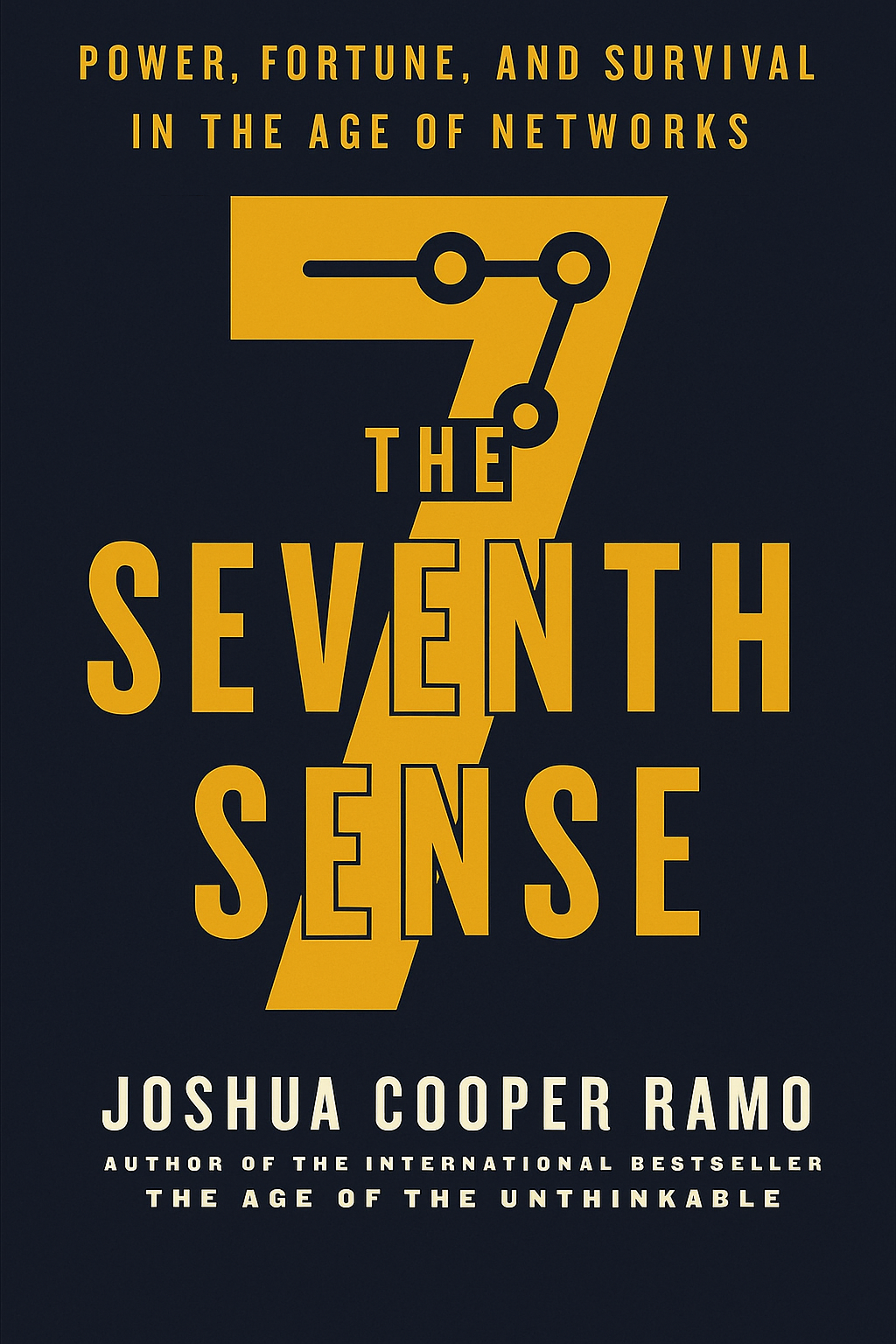
By Joshua Cooper Ramo
