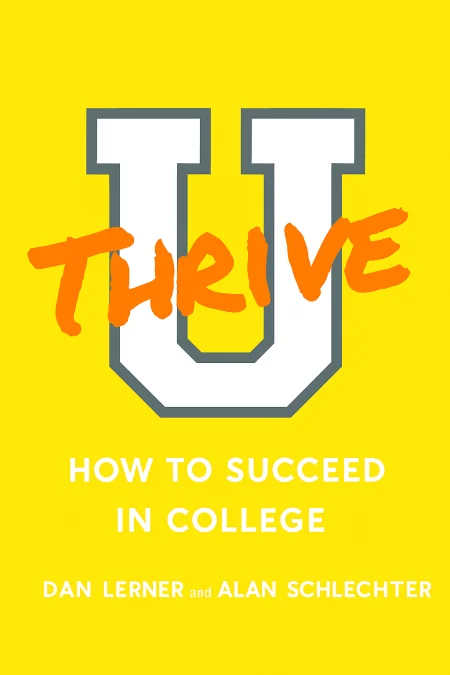
U Thrive
How to Succeed in College (and Life)
Book Edition Details
Summary
Amidst the whirlwind of college life, where the promise of freedom often collides with the reality of sleepless nights and stress-filled days, "U Thrive" emerges as a beacon for the overwhelmed student. Crafted by the insightful duo Daniel Lerner and Dr. Alan Schlechter, this guide doesn’t just offer survival tips—it transforms the collegiate experience into a flourishing journey. Dive into a treasure trove of compelling science, engaging narratives, and transformative habits that promise to turn chaos into a canvas for success. Whether you're wrestling with daunting exams or the enigma of dorm life, "U Thrive" is your passport to happiness and success, turning daunting college years into the best years of your life.
Introduction
Sarah stared at her dorm room ceiling at 2 AM, her mind racing despite her exhausted body. Three weeks into her freshman year, she felt like she was drowning. The academics were more demanding than anything she'd faced in high school, her roommate seemed to have it all figured out, and every social interaction felt like a test she was failing. She'd worked so hard to get here, but now that she'd arrived, thriving felt impossible. What Sarah didn't know was that she wasn't alone in feeling this way, and more importantly, there was a science to not just surviving college, but flourishing in ways she'd never imagined. College represents one of life's greatest opportunities for transformation, yet many students find themselves merely surviving rather than thriving during these crucial years. The transition from the structured world of high school to the open landscape of university life can feel overwhelming, leaving even the most accomplished students questioning their abilities and worth. The pressures are real, the challenges significant, but within the research of positive psychology lies a roadmap for not just getting through college, but making these years the foundation for a life of genuine fulfillment and success. This exploration reveals how small, science-backed changes in mindset, relationships, and daily habits can transform your college experience from a source of stress into a launchpad for extraordinary personal growth and happiness.
Building Foundations: Mindsets and Mental Well-being
When Carol Dweck studied thousands of students, she discovered something remarkable about how we view our abilities. In one experiment, students were given challenging puzzles to solve. After struggling with the tasks, some students were told they were "really smart," while others were praised for "working really hard." When presented with even more difficult puzzles later, the students praised for intelligence quickly gave up, afraid to risk looking foolish. But those praised for effort tackled the new challenges with enthusiasm, seeing difficulty as an opportunity to grow stronger. This simple difference in perspective represents one of the most powerful forces in human psychology: the distinction between a fixed mindset and a growth mindset. Students with fixed mindsets believe their abilities are carved in stone, making every challenge feel like a threat to their identity. When they encounter difficulty, they interpret it as evidence of their limitations. In contrast, those with growth mindsets understand that abilities can be developed through dedication and hard work, transforming obstacles into stepping stones toward mastery. The implications for college students are profound. Research shows that freshmen with growth mindsets not only achieve higher grades but also experience greater resilience when facing setbacks. They seek out challenging courses rather than easy A's, ask questions without fear of appearing ignorant, and bounce back from failures with renewed determination. Perhaps most importantly, they maintain better mental health throughout the inevitable ups and downs of college life. The beauty of mindset research lies in its revelation that these perspectives can be consciously cultivated. By understanding how our beliefs about ability shape our experiences, we gain the power to rewrite the stories we tell ourselves about what's possible, setting the stage for unprecedented growth in every area of our lives.
Physical Health as Mental Performance
When researchers at Naperville Central High School decided to revolutionize their approach to education, they made an unexpected choice: they focused on the gymnasium rather than the classroom. Students were equipped with heart rate monitors and challenged to maintain elevated cardiovascular activity during physical education classes. Instead of being graded on athletic prowess, they were evaluated on effort and improvement. The results were staggering. These students, who had previously scored average on international tests of math and science, suddenly ranked sixth in the world in mathematics and first in science. The connection between physical activity and cognitive performance runs deeper than most students realize. When we exercise, our brains produce a protein called brain-derived neurotrophic factor, essentially fertilizer for our neural networks. This biological boost enhances memory formation, increases focus, and improves our ability to learn new information. Students who incorporate regular movement into their routines don't just feel better physically; they think more clearly, process information more efficiently, and demonstrate greater creativity in problem-solving tasks. Sleep, too, plays a crucial role in academic success that extends far beyond simply feeling rested. During sleep, our brains consolidate memories, moving information from temporary storage into long-term retention. Students who consistently get seven to nine hours of sleep perform significantly better on exams, demonstrate improved emotional regulation, and show greater resilience in facing daily challenges. Conversely, sleep-deprived students often experience the cruel irony of working harder while learning less, as their exhausted brains struggle to encode and retrieve information effectively. The relationship between nutrition and cognitive function completes this trinity of physical wellness. Research consistently shows that students who eat breakfast, regardless of what they consume, perform better on tests and demonstrate improved concentration throughout the day. The fuel we provide our bodies directly impacts our mental energy, mood stability, and ability to sustain attention during lengthy study sessions. These findings illuminate a fundamental truth: the artificial separation between mind and body undermines our potential for excellence. By recognizing our physical health as the foundation for mental performance, we unlock a powerful pathway to academic and personal success.
Excellence Through Purpose and Passion
Dave Levin arrived at college without a clear sense of direction, exploring courses across multiple disciplines while working three jobs and playing pickup basketball whenever possible. His life changed when he began tutoring two local children, Tyrone and his younger brother John. As he worked with the boys each week, Dave experienced something profound: the pure joy that came from witnessing their breakthrough moments, those instances when confusion transformed into understanding and their eyes lit up with newfound confidence. He found himself staying late at his summer internship in Tokyo not for career advancement, but to teach English to custodial workers, eventually building a class of fifty-three eager students. Dave's story illustrates the power of harmonious passion, where our deepest interests align with meaningful contribution to others. Unlike obsessive passion, which drives us toward activities for external rewards like money, status, or approval, harmonious passion emerges from genuine love of the activity itself. Research shows that people with harmonious passions experience greater life satisfaction, better relationships, and superior performance in their chosen fields. They maintain balance, welcome feedback, and find joy in the process rather than fixating solely on outcomes. The development of expertise follows a similar pattern. K. Anders Ericsson's research on deliberate practice reveals that excellence isn't primarily about innate talent but rather about engaging in focused, challenging practice with specific goals for improvement. The most successful individuals don't just work harder; they work smarter, constantly pushing beyond their comfort zones while seeking feedback from mentors and coaches. This process, while demanding, becomes sustainable when fueled by genuine passion and supported by meaningful connections with others. Dave's journey from uncertain college student to co-founder of the Knowledge Is Power Program, which has transformed educational opportunities for thousands of underserved children, demonstrates how passion and purpose can converge to create extraordinary impact. His office wall, covered with hundreds of photographs of proud graduates, stands as testament to the power of aligning our deepest interests with service to something greater than ourselves. The research reveals that excellence and well-being need not be mutually exclusive. When we pursue our passions with purpose, supported by strong relationships and guided by growth mindsets, we create the conditions not just for success, but for a life of meaning and fulfillment.
Summary
The science of student well-being reveals a profound truth: thriving in college isn't about perfection or having it all figured out from day one. Instead, it emerges from understanding how our minds, bodies, and relationships work together to create conditions for growth and fulfillment. When we embrace growth mindsets, we transform challenges from threats into opportunities. When we care for our physical health through movement, sleep, and nutrition, we provide our minds with the foundation they need for peak performance. When we pursue our passions with purpose and maintain meaningful connections with others, we create lives of both achievement and joy. The students who thrive aren't necessarily the smartest or most talented; they're the ones who understand these principles and apply them consistently. They recognize that setbacks are temporary, that effort leads to improvement, and that success is enhanced when shared with others. They take care of their bodies as carefully as they tend to their studies, knowing that physical vitality fuels mental clarity. Perhaps most importantly, they understand that college isn't just about earning a degree—it's about discovering who they're meant to become and developing the skills and mindsets that will serve them throughout their lives. The research provides the roadmap, but the journey is uniquely yours. By embracing these evidence-based strategies with courage and consistency, you can transform your college years from a period of mere survival into a launching pad for extraordinary personal growth and lifelong thriving.
Related Books
Download PDF & EPUB
To save this Black List summary for later, download the free PDF and EPUB. You can print it out, or read offline at your convenience.
By Dan Lerner
