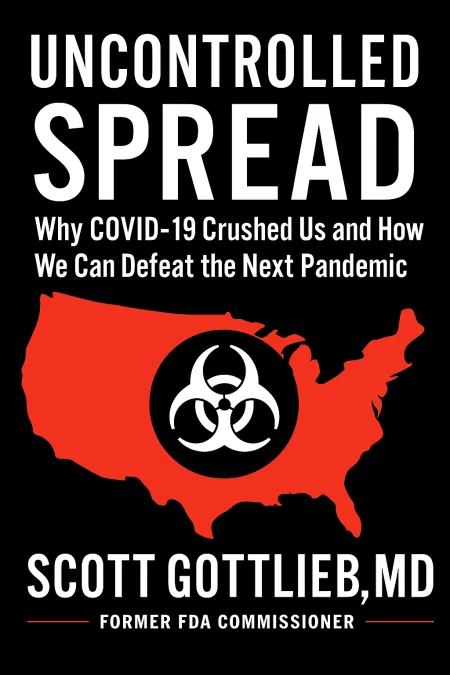
Uncontrolled Spread
Why COVID-19 Crushed Us and How We Can Defeat the Next Pandemic
Book Edition Details
Summary
From the front lines of America's pandemic response, former FDA commissioner Scott Gottlieb delivers a gripping exposé in "Uncontrolled Spread." This unflinching narrative delves into the systemic failures that left the U.S. vulnerable to COVID-19's relentless assault. As Gottlieb navigates the corridors of power, he unveils a chilling tapestry of bureaucratic inertia, misguided strategies, and leadership shortfalls. But beyond the stark recounting of a nation's missteps lies a blueprint for resilience. Gottlieb's firsthand insights reveal how we must radically rethink our health defenses, revamp institutions like the CDC, and harness the full spectrum of intelligence capabilities. With the specter of future pandemics looming, this work is both a cautionary tale and a clarion call for transformation—a must-read for anyone invested in safeguarding our future.
Introduction
On a cold January morning in 2020, as a mysterious pneumonia began spreading through the crowded markets of Wuhan, China, the world stood on the precipice of its greatest health crisis in over a century. What followed would expose fundamental weaknesses in how even the most advanced nations prepare for and respond to biological threats. This crisis revealed a sobering truth: despite decades of planning, billions in investment, and unprecedented scientific capabilities, institutional failures could transform a manageable outbreak into a global catastrophe that would claim millions of lives and reshape civilization itself. The story that emerges from America's pandemic response illuminates three critical blind spots that left the nation vulnerable. First, the dangerous gap between scientific capability and institutional readiness, where breakthrough technologies existed alongside bureaucratic systems incapable of deploying them effectively. Second, the failure to treat pandemic threats as national security priorities deserving the same attention and resources as traditional military threats. Third, the breakdown of international cooperation mechanisms precisely when global coordination was most essential. These lessons offer invaluable insights for policymakers, public health professionals, and citizens seeking to understand how we can build more resilient defenses against future biological threats. The next pandemic is not a question of if, but when, and the choices we make today will determine whether we face it with strength or repeat the tragic failures of the recent past.
Early Warning Failures: China's Concealment and America's Blind Response (2019-2020)
The first critical failures began in December 2019, when Chinese authorities detected unusual pneumonia clusters in Wuhan but chose secrecy over the transparency that international health regulations demanded. Local doctors who recognized they were confronting something dangerous and novel faced official reprimands when they attempted to warn colleagues. Dr. Li Wenliang, an ophthalmologist who shared test results through social media, was detained by police and forced to sign a statement promising silence. Meanwhile, genomics laboratories that had identified the new coronavirus were ordered to stop testing and destroy remaining samples. This pattern of concealment violated the international agreements China had signed after the SARS outbreak, which required immediate reporting of novel pathogens with pandemic potential. Chinese officials assured the World Health Organization that human-to-human transmission was unlikely, even as healthcare workers in Wuhan hospitals were falling ill with the mysterious disease. The hashtag "Wuhan SARS" was scrubbed from social media platforms, while critical weeks passed without accurate information reaching the international community. The information vacuum left American officials operating with incomplete and often misleading data during the crucial early period when containment might still have been possible. American intelligence agencies detected early signals through satellite imagery and communications intercepts, but these warnings failed to penetrate the bureaucratic barriers separating intelligence from public health response. The CDC, despite its global reputation, lacked meaningful presence in China and relied heavily on official Chinese reports rather than independent assessment. By the time international awareness finally dawned, the virus had already seeded outbreaks across multiple continents through air travel networks. The combination of authoritarian information suppression and democratic institutional sluggishness created perfect conditions for a localized outbreak to become a global pandemic. This early failure in international cooperation would cast a long shadow over everything that followed, demonstrating how quickly global health security could collapse when nations prioritized political considerations over scientific transparency.
Testing Collapse: CDC Missteps and Lost Containment Opportunities (January-March 2020)
As reports of the mysterious illness reached American shores, the Centers for Disease Control and Prevention made a fateful decision that would handicap the nation's response for months. Rather than adopting the World Health Organization's proven test or allowing commercial laboratories to develop their own versions, the CDC chose to create its own diagnostic, reflecting an institutional mindset that prioritized control over speed and adaptability. The agency's test included an unnecessary third component designed to detect any SARS-like coronavirus, making it more complex but theoretically more precise. When the CDC attempted to mass-produce these test kits, contamination occurred during manufacturing at their Atlanta facility. The very components meant to ensure accuracy were themselves contaminated with coronavirus genetic material, rendering the tests useless. State laboratories across the country found themselves in an impossible situation, unable to validate tests that consistently produced false positives even with sterile water samples. While South Korea was conducting tens of thousands of tests daily by late February, the United States was managing only hundreds. This testing drought meant that community spread was occurring invisibly across major metropolitan areas. Without the ability to detect where the virus was spreading, health officials remained blind to transmission chains that were already establishing themselves in nursing homes, schools, and workplaces. The CDC's monopoly on testing, combined with FDA regulatory barriers that prevented qualified laboratories from developing alternatives, created a bottleneck that would prove catastrophic. The consequences extended far beyond mere numbers. The testing failure forced America to abandon targeted containment strategies in favor of blunt mitigation measures that would prove economically and socially devastating. By March, when widespread testing finally became available, the virus had established multiple chains of transmission that could no longer be traced or broken. The window for containment had closed, and America was left to confront a pandemic with tools designed for a different kind of crisis entirely.
From Lockdowns to Vaccines: Policy Chaos Amid Scientific Breakthroughs (2020-2021)
The spring of 2020 witnessed both America's greatest pandemic policy failure and its most remarkable scientific achievement. As hospitals overwhelmed and morgues overflowed, state and local officials implemented unprecedented lockdown measures that federal authorities had failed to coordinate. The absence of national leadership forced governors to make life-and-death decisions with incomplete information, leading to a patchwork of inconsistent policies that reflected political calculations as much as public health science. The mitigation strategies that emerged drew heavily from pandemic plans developed for influenza, but COVID-19 was not influenza. The virus's ability to spread through asymptomatic carriers and aerosol transmission made traditional measures less effective than planners had anticipated. The six-foot distancing rule, derived from century-old studies of droplet transmission, became a rigid requirement that forced schools to remain closed even when evidence suggested children were not major drivers of community spread. Yet even as institutional systems crumbled, American scientific and industrial capacity demonstrated extraordinary innovation. Pharmaceutical companies pivoted with remarkable speed to develop vaccines using messenger RNA technology, compressing development timelines from years to months without compromising safety standards. The Operation Warp Speed initiative, despite its flaws, showed how government resources could accelerate private sector innovation when bureaucratic obstacles were removed and financial risks were shared. The vaccine rollout exemplified the contradictions that defined America's pandemic response. The nation possessed the world's most effective vaccines but lacked the administrative infrastructure to deliver them efficiently. Nursing homes, which had suffered the highest death rates, waited weeks for initial doses while complex eligibility criteria created confusion and inequity. The triumph of vaccine development was nearly overshadowed by the failure of vaccine distribution, demonstrating that scientific capability alone could not overcome institutional dysfunction when coordinated implementation was required.
Building Pandemic Resilience: National Security Lessons for Future Threats
The COVID-19 pandemic fundamentally challenged traditional concepts of national security, revealing that microscopic pathogens could inflict damage exceeding that of conventional military threats. The crisis exposed dangerous dependencies on foreign supply chains for critical medical supplies, highlighted the vulnerability of interconnected global systems, and demonstrated how quickly social cohesion could fracture under biological stress. These revelations demand a comprehensive reimagining of how nations prepare for and respond to pandemic threats. Future preparedness must integrate intelligence capabilities with public health infrastructure, treating disease surveillance as a core national security function. The same satellite technologies and communication intercepts used to monitor military movements can detect early signs of disease outbreaks, while diplomatic networks can gather crucial epidemiological intelligence that traditional health channels might miss. This integration requires breaking down bureaucratic silos that have historically separated national security and public health communities. Domestic resilience depends on rebuilding manufacturing capacity for critical medical supplies and pharmaceuticals, reducing dangerous dependencies on foreign production that proved so costly during the crisis. Strategic stockpiles must be continuously maintained and regularly updated, while surge capacity for testing, treatment, and vaccine production must be built into the industrial base. The private sector cannot be expected to maintain excess capacity for rare emergencies without government support and coordination that treats pandemic preparedness as an ongoing national priority. International cooperation remains essential despite the nationalist tendencies revealed during the crisis. Future pandemic preparedness requires strengthening global surveillance networks, improving pathogen sharing mechanisms, and developing rapid response capabilities that can contain outbreaks before they become pandemics. However, this cooperation must be built on realistic assessments of national interests rather than naive assumptions about international altruism, with backup plans for scenarios where cooperation fails and nations prioritize their own populations over global solidarity.
Summary
The COVID-19 pandemic revealed a fundamental paradox at the heart of modern American power: unprecedented scientific capability coupled with institutional systems inadequate to harness that capability when it mattered most. The core tension throughout this crisis was between the speed of viral transmission and the sluggishness of bureaucratic response, between the interconnectedness that enables global prosperity and the vulnerabilities that same interconnectedness creates when systems come under stress. The most devastating consequences emerged from the intersection of authoritarian information suppression, democratic institutional inertia, and the prioritization of short-term political considerations over long-term strategic planning. America's pandemic preparedness failures stemmed not from lack of knowledge or resources, but from structural problems in how institutions process information, make decisions, and coordinate responses across organizational boundaries. The nation had prepared extensively for the pandemic it expected while remaining vulnerable to the one that actually emerged. The path forward requires three fundamental shifts in approach that extend far beyond public health policy. First, pandemic threats must be elevated to the highest levels of national security priority, with corresponding investments in surveillance, intelligence, and response capabilities that match those devoted to traditional military threats. Second, institutional systems must be redesigned for speed and adaptability rather than control and hierarchy, with clear protocols for emergency decision-making that can bypass normal bureaucratic processes when lives are at stake. Third, domestic resilience must be rebuilt through strategic investments in manufacturing capacity, supply chain independence, and surge capabilities that can respond rapidly to unexpected crises. The next pandemic will test not just America's scientific prowess, but its capacity for the kind of sustained, coordinated action that has historically defined the nation's greatest achievements.
Related Books
Download PDF & EPUB
To save this Black List summary for later, download the free PDF and EPUB. You can print it out, or read offline at your convenience.
By Scott Gottlieb
